Christian Churches of God

[156]

Le Calendrier de Dieu

(Édition 4.0 19960316-20000320-20070724-20080103-20160508)
Le Calendrier mis en place par Dieu a été mis en mouvement à la création. Il ne dépend pas de l'homme ni d'aucun système d'observation pour être déterminé. Il était en place pendant la période entière du Temple d'Israël et il n'est pas le même calendrier que celui observé par les Juifs aujourd'hui. Les Chrétiens sont obligés par la Loi et le Témoignage de la Bible d'observer ce Calendrier et aucun autre.
Christian Churches of God
PO Box 369, WODEN ACT 2606, AUSTRALIA

(Copyright © 1996, 1999, 2000, 2007, 2008, 2016 Wade Cox)
(Tr. 2003, rév. 2020)

This paper may be freely copied and distributed provided it is copied in total with no alterations or deletions. The publisher’s name and address and the copyright notice must be included.  No charge may be levied on recipients of distributed copies.  Brief quotations may be embodied in critical articles and reviews without breaching copyright.

This paper is available from the World Wide Web page:
http://www.logon.org and http://www.ccg.org

Le Calendrier de Dieu

Introduction au Calendrier juif

Le calendrier du système Juif est un système dérivé postérieur. Il n’était pas celui utilisé durant la période du Temple, à l’époque de Christ et de l’Église. Dans l’Annexe 3 de The History of the Jewish People in the Age of Jesus Christ (Vol. 1, p. 587 et suiv.), Schurer dit que “les noms Juifs sont d’origine Assyro-Babylonienne ; leurs équivalents Akkadiens sont : ni-sa-an-nu, a-a-ru, sf-ma-nu, du-u-zu, etc. ” et il se réfère à l’œuvre de Landsburger sur le sujet (Materialen zum Sumerischen Lexicon V (1957), pp. 25-26 etc.). Schurer dit :

Dans la sphère du Judaïsme, le document le plus ancien mentionnant tous les mois en succession est le Megillath Ta’anith. Il a été compilé au premier ou au début du deuxième siècle A.D., puisqu’il est déjà cité dans la Mishnah [la Mishnah a été compilée vers le deuxième siècle]. Parmi les autorités postérieures, il est seulement nécessaire de mentionner le Chrétien peu connu, Josephus, qui inscrit, dans son Hypomnesticum (PG cvi, col. 33), [Nesan, Eiar, Eiouan, Thamouz, Ab, ‘Eloul, ‘Osri (lire Thisri), Marsaban, Chaseleu, Tebeth, Eabath, ‘Adar].

Après avoir donné la preuve pour les noms des mois juifs (voir l’Annexe), il dit ensuite :

Les mois juifs ont toujours continué d’être ce que les mois de toutes les nations civilisées étaient à l’origine; à savoir, des mois lunaires véritables. Comme la durée astronomique d’un mois est de 29 jours, 12 heures, 44′, 3″, les mois de 29 jours doivent alterner assez régulièrement avec les mois de 30 jours. Mais douze mois lunaires correspondent à seulement 354 jours, 8 heures, 48′, 38″, tandis que l’année solaire correspond à 365 jours, 5 heures, 48′, 48″. La différence entre une année lunaire de douze mois et une année solaire, par conséquent, est de 10 jours 21 heures. Pour compenser pour cette différence, au moins une fois à chaque troisième année et parfois dans la deuxième, un mois doit être intercalé. Il a été observé dans les temps anciens qu’une compensation suffisamment précise  était atteinte en intercalant un mois trois fois à tous les huit ans (pendant cette période, la différence s’élève à 87 jours). Les jeux grecs quadriennaux dépendaient déjà d’une reconnaissance de ce cycle de 8 ans (‘octaeteris’), le cycle de quatre ans étant obtenu simplement en le divisant en deux.

Par conséquent, l’Olympiade est basée sur le calendrier lunaire.

Schurer continue :

Aussi tôt qu’au cinquième siècle av. J.-C, l’astronome Meton d’Athènes avait formulé un système encore plus exact de compensation sous la forme d’un cycle de 19 ans, dans lequel un mois devait être intercalé sept fois. Cela a considérablement excellé le cycle de 8 ans en exactitude, parce qu’en dix-neuf ans, il restait une différence d’un peu plus de deux heures, tandis que dans le cycle de huit ans, elle était de 1,5 jours. Parmi les astronomes postérieurs qui ont fourni des calculs encore plus précis, Hipparchus de Nicée (v. 180-120 av. J.-C) mérite une mention particulière. Le fait qu’à tous les dix-neuf ans, les orbites du soleil et de la lune coïncident de nouveau presque exactement, était aussi bien connu des Babyloniens. En fait, on pense que des inscriptions cunéiformes montrent qu’ils ont régulièrement employé un cycle intercalaire de 19 ans, dès le temps de Nabonnassar, donc bien avant Meton. Même si ce n’est pas encore prouvé, l’utilisation d’une période intercalaire de dix-neuf ans durant les ères perses et séleucides peu néanmoins être acceptée comme étant vérifiée, quoiqu’il ne soit toujours pas absolument certain si la priorité appartient aux Grecs ou (comme il est probable) aux Babyloniens.

Les Babyloniens possédaient donc la connaissance du cycle de 19 ans du calendrier lunaire. Ils l’ont compris bien avant le philosophe Meton. Même si ce n’est pas encore prouvé pour Babylone, la période intercalaire de dix-neuf ans durant les ères Perses et Séleucides peut néanmoins être acceptée comme étant vérifiée. Schurer n’est pas absolument certain si la priorité de la compréhension appartient aux Grecs ou, comme c’est probable, aux Babyloniens. Il sera découvert qu’elle a longtemps précédé même les Babyloniens.

Schurer note :

que le cycle de dix-neuf ans était utilisé dans le royaume des Arsacides, au premier siècle av. J.-C. et de notre ère. Cela a été démontré par Th. Reinach, à partir de pièces de monnaie sur lesquelles les années 287, 317 et 390 de l’ère séleucide apparaissent comme des années intercallaires. Jusqu’où étaient avancés les Juifs de l’ère inter-Testamentale dans ces questions ? Ils avaient un peu de connaissance générale sur ces choses, bien sûr, mais à moins que nous nous soyons trompés complètement, à l’époque de Jésus, ils n’avaient toujours pas de calendrier fixe; mais, sur la base de l’observation purement empirique, ils commençaient chaque nouveau mois avec l’apparition de la nouvelle lune et, de la même façon, sur la base de l’observation, ils intercalaient un mois au printemps de la troisième ou la deuxième année, conformément à la règle que, dans toutes les circonstances, la Pâque doit tomber après l’équinoxe vernal.

Les citations commencent l’étude par cette période inter-Testamentale et les commentaires de Schurer à propos du calendrier. Le Calendrier de Dieu a son origine à la création. Le calendrier de Dieu ne dépend pas de ce que les Juifs faisaient à l’époque de Jésus Christ. En effet, nous verrons pourquoi Schurer, en fait, n’est pas correct ou sa recherche n’a pas été faite de manière exhaustive à cet égard. Nous savons que le système d’observation a été introduit à une période ultérieure et utilisé de concert avec les calculs de la conjonction, apparemment pour justifier les traditions. Les érudits sont en général d’accord pour dire que les Samaritains et les Sadducéens avaient le même système qui était basé sur la conjonction, qui était calculée et annoncée au moins huit mois à l’avance – certainement dans le cas des Samaritains. Nous examinerons cet aspect plus en détail. Schurer ne fait pas le pas logique, dans son argument, pour montrer pourquoi les Juifs en sont venus à fonctionner par l’observation, quand ils connaissaient mieux, et, en effet, pourquoi ils ont même présenté l’argument pour l’observation à la fin de la période du Temple. En effet, nous verrons que les Pharisiens n’ont pas eu le pouvoir de l’introduire pendant la période du Temple, à travers leur propre fourberie.

Il peut être accepté sans trop de risque que les Samaritains ont eu le même calendrier pendant 2,500 ans, au moins, et que le calendrier, les Sabbats et le système qu’ils utilisent aujourd’hui, basés sur la conjonction, sont le même calendrier et les mêmes Sabbats qu’ils ont utilisés pendant la période du Temple et par la suite. Les commentaires d’Ibrahim ibn Ya’kub, le commentateur Samaritain de la Bible, montrent que les pratiques Samaritaines étaient selon la conjonction. Ils commençaient le jour en soirée ou au crépuscule. Ils ont observé le festival de deux jours du 14 et du 15, comme l’Église qui observe le Sabbat l’a fait pendant deux mille ans (voir l’étude Le Rôle du Quatrième Commandement dans les Églises de Dieu Observant le Sabbat (No. 170)). Ils ont observé le sacrifice le 14 Nisan en soirée, à la fin du 14ème jour, et commencé le repas, le soir du 15 Nisan, déterminé selon la conjonction. De plus, comme les Sadducéens dans la période du Temple, ils ont observé la Fête de la Pentecôte le dimanche, cinquante jours après l’Offrande de la Gerbe Agitée, le dimanche durant les Pains sans Levain (cf. John Bowman (éd. et tr.), Samaritan Documents Relating to Their History, Religion and Life, Pittsburgh Original texts and Translation Series Number 2, pp. 223-237).

Il n’y a aucune évidence pour soutenir l’affirmation que les Samaritains ont changé le système, ou qu’eux-mêmes et les autres nations mentionnées ci-dessus n’avaient pas la capacité de calculer la conjonction précisément, longtemps à l’avance durant la période entière du Deuxième Temple. Si les Juifs “ont perdu” cette connaissance à la fin de la période du Deuxième Temple, alors, ils l’ont fait délibérément pour introduire leurs traditions. L’Église ne les a jamais suivis dans la détermination du calendrier et des Nouvelles Lunes, sauf dans sa période plus ignorante de Judaïsation, durant la période postérieure à la Réformation. Au troisième siècle, le Judaïsme Rabbinique a aussi introduit des festivals et des systèmes païens en provenance de Babylone, dans son calendrier. R. Samuel Kohn, le Grand Rabbin de Budapest et un auteur sur les pratiques samaritaines, qui a écrit à Budapest en 1894, enregistre les pratiques de l’Église Sabbatarienne durant la période de la Réformation. Il note que l’église Sabbatarienne là, déterminait le calendrier selon la conjonction (avec une variation aux pratiques Samaritaines). Il considère aussi que le fait que les Judaïsants postérieurs (post-Simon Pechi), en Transylvanie, suivaient Rosh HaShanah ou le Nouvel An, célébré en Tishri, était la preuve de l’influence Juive. Il déclare que Rosh HaShanah n’a pas été introduit dans le Judaïsme avant la période postérieure au Temple, au troisième siècle. Le Docteur Kohn mentionne ce fait important dans l’œuvre The Sabbatarians in Transylvania (Les Sabbatariens en Transylvanie),  déclarant que cela est entré au troisième siècle et dans une période “post-biblique” (se référant au Talmud Rosh haShanah 8a à n. 18 au ch. 7) (Éd. W. Cox, tr. T. McElwain et B. Rook, Les Éditions CCG, USA, 1998, pp. v, 58, 106 et suiv.) Bibliquement, le Nouvel An est en Abib/Nisan, qui est le Premier mois.

La progression du calendrier biblique, pur et original, au calendrier rabbinique introduit de Babylone, premièrement sous le Rabbin Hillel II en 358 EC (ère actuelle), a été plutôt tortueuse, car les traditions ont dû être enracinées pour justifier les changements graduels. La Mishnah, qui a été compilée autour de 200 EC et sur lequel le Talmud a été plus tard écrit comme commentaire, enregistre plus ou moins ce processus par les commentaires et les autorités qu’il cite.

Nous verrons ci-dessous qu’au moment de la période du Temple, le Calendrier a suivi le calcul des Sadducéens. Le calcul ou le système Pharisaïque est seulement entré en vigueur après la destruction du Temple, en 70 EC. La Mishnah fait mention de plusieurs pratiques, que le calendrier Juif moderne est conçu pour empêcher. Ce calendrier n’a pas été vraiment perfectionné – même sous Hillel II vers 358 EC – et il n’a été modifié qu’au onzième siècle. Les détails des changements et des conflits sont enregistrés dans l’étude Le Calendrier et la Lune : Ajournements ou Festivals (No. 195).

La Mishnah montre que les Jours Saints tombaient avant et après le Sabbat de façon répétée ; cela signifie que les traditions et le système que les Pharisiens avaient inventé pour protéger les traditions, n’étaient pas en place, même lors de la compilation de la Mishnah (cf. Soncino Talmud : Shabbat 114b ; Menachoth 100b ; et Mishnah Besah 2:1 ; Shabbat 15:3 ; Sukkah 5:7 ; Arakhin 2:2 ; Hagigah 2:4). Les Sabbats consécutifs  étaient communs. Le texte dans Hagigah 2:4 montre le conflit qui se développait, à ce moment-là (200 EC), entre les défenseurs  pour ou contre le dimanche de Pentecôte (Cf. ibid. Le Calendrier et la Lune : Ajournements ou Festivals (No. 195) et ci-dessous).

Il est impossible que le système d’ajournements et le calendrier Juif moderne (actuel) aient été en place au temps de Christ.

La Mishnah déclare aussi qu’il y a quatre débuts de l’an et que le Premier jour de Nisan est le Nouvel An pour les rois et les festivals. C’est aussi examiné dans l’étude La Soirée Mémorable (No. 101), qui examine les pratiques Samaritaines à la Pâque. Nous pouvons aussi voir, à partir de ces périodes de temps dans la Mishnah, que les datations, quant à Esdras et à Néhémie, étaient selon 1 Nisan et non pas 1 Tishri (cf. l’étude La Lecture de la Loi avec Esdras et Néhémie  (No. 250)). À ce moment-là, Tishri était utilisé pour le calcul des années, pour les années Sabbatiques et les Jubilés (Rosh Hashanah 1.1 E (3)). Nous voyons que la notion de Tishri, qui est entrée de Babylone, a été d’abord enregistrée dans la Mishnah comme ayant été avancée par R. Eliazar et R. Simeon (ibid. 1.1 D). Il n’a pas été observé comme Nouvel An durant la période du Temple. La Mishnah essaye aussi de séparer le début de la dîme du bétail à 1 Elul (ibid. 1.1 C). La Maison de Shammai soutenait que le Nouvel An, pour les arbres, était le 1er Shebat, tandis que la Maison de Hillel soutenait que c’était le Quinzième jour de ce mois-là. Le Nouvel An à la Pleine Lune est une pratique directement païenne, aussi introduite de Babylone, et sans doute associée aux plantations, d’après les diagrammes de la lune. Toute cette détermination vient du Judaïsme rabbinique de la période postérieure au Temple. C’est seulement au troisième siècle que nous voyons Tishri avancé par les rabbins. Avec le système d’ajournements, il a maintenant l’emprise sur le Judaïsme, contrairement à la parole de Dieu. Souvent, la Fête des Trompettes ne tombe pas au molad (qui est la conjonction), et les Jours Saints de Dieu sont reportés, par désobéissance, à d’autres jours que Dieu n’a pas prescrits.

L’Encyclopédia Judaica admet ce fait dans son article à propos de la Fixation de Rosh HaShanah (Le Jour du Nouvel An).

La fixation de Rosh HaShanah (le Jour du Nouvel An). L’année commence le 1er Tishri, qui est rarement le jour du molad, car il y a quatre obstacles ou considérations, appelées dehiyyah, dans la fixation du premier jour du mois (rosh hodesh). Chaque dehiyyot peut causer un ajournement de deux jours : (1) principalement pour empêcher le Jour des Expiations (Tishri 10) de tomber un vendredi ou un dimanche et Hoshana Rabba (le septième jour de Sukkot; Tishri 21) de tomber un samedi, mais, en partie, pour servir également un but astronomique … (2) entièrement pour une raison astronomique, si le molad est à midi ou plus tard, Rosh HaShanah est retardé d’un jour (ibid., p. 44).

Les troisième et quatrième dehiyyah sont des règles plus complexes impliquant les temps spécifiques du molad et l’ajournement conséquent du 1er Tishri. Ces moladot sont tabulés de même que les ajournements spécifiques décrits dans l’article de l’Encyclopédia Judaïca. Cette règle d’ajournement n’était pas connue aux temps de Christ et de la compilation du Talmud. La Mishnah et le Talmud, en tant que commentaire, montrent clairement que le Jour des Expiations tombait un vendredi ou un dimanche jusqu’au temps de la compilation de la Mishnah et, par conséquent, au temps de Christ, deux siècles auparavant.

Nous voyons aussi que l’occurrence des mois différait de ce qu’elle est sous le calendrier Juif.

(Arakhin 2:2) : Ils ne comptent pas moins de quatre mois entiers dans l’année et [aux sages] ils n’ont jamais apparu plus de huit.

Il est donc impossible que les ajournements aient été en place au temps de Christ. Nous continuons :

… On s’attendait à ce que le système actuel soit remplacé [emphase ajoutée] de nouveau par un système basé sur de vraies valeurs [par opposition aux mauvaises valeurs], plus apparenté au calendrier juif précédent dans lequel les Nouvelles Lunes (les jours de la phasis [i.e., la longueur de l’intervalle de la vraie conjonction à la première apparition du nouveau croissant]) et les intercalations étaient proclamées sur la base de l’observation autant que du calcul (ibid., p. 47).

Notez que les commentaires montrent ici que les calculs étaient selon la vraie conjonction, selon les phases (ce qui n’est pas visible) et les observations, qui ont été introduites pour confirmer ce qui était déjà connu des mois et des années d’avance. Les termes phases de la lune sont venus du terme phasis et se sont toujours appliqués à la Nouvelle Lune, comme étant totalement noire, à la Pleine Lune, et aux premiers et deuxièmes quartiers. Le croissant n’a jamais été considéré comme une vraie phase de la lune dans le sens qu’il est utilisé pour la Nouvelle Lune.

Historique. Selon une tradition citée au nom de Hai Gaon (m. 1038), le calendrier juif actuel a été introduit par le patriarche Hillel II… en 358/59 ap. J.-C…. Tandis qu’il n’est pas irraisonnable d’attribuer à Hillel II la fixation de l’ordre régulier des intercalations, sa pleine participation dans le calendrier fixe actuel est douteuse (ibid., p. 48).

Notez ici que le calendrier Juif moderne n’est pas vraiment devenu fixe avant le onzième siècle, comme l’Encyclopédie Judaïca l’admet. L’enc. Judaïca introduit ensuite le concept d’irrégularité dans l’intercalation en disant qu’elles étaient irrégulières,

l’intercalation étant en partie due à l’état actuel des divers produits agricoles et aux conditions sociales. … l’état des récoltes est, en fin de compte, déterminé par la position du soleil dans son chemin annuel (ibid., p. 49).

Cependant, nous savons que les Sadducéens et les Samaritains n’avaient pas un tel problème avec l’irrégularité. Et la Nouvelle Lune était annoncée par des feux allumés du Mont des Oliviers, à l’est du temple, au-delà de Kidron (voir l’étude Le Messie et la Génisse Rousse (No. 216)). C’est seulement plus tard que les Samaritains ont été accusés d’allumer des fanaux induisant en erreur, quand les Pharisiens ont assumé la responsabilité, après la destruction du Temple, et introduit les ajournements par des observations.

Un tel problème n’existait pas pendant la période du Temple. Jean Hyrcanus avait détruit le tabernacle sur le Mont Gerizim, durant le temps des Maccabés, mais leur religion est demeurée intacte. Hyrcanus a supprimé les Pharisiens ; ils ont eu l’emprise seulement pendant neuf ans, sous Alexandra. Ils ont aussi été supprimés par Hérode à cause de leurs intrigues. Les Sadducéens et leur système ont eu le contrôle du Temple plus ou moins continuellement jusqu’à sa saisie dans la période finale et la destruction, en 70 EC (cf. ibid., La Soirée Mémorable (No. 101)). Les Pharisiens ont accusé Christ d’être lui-même un Samaritain (Jean 8:48). C’était, comme nous le voyons du texte, parce qu’il a nié la vérité de leurs enseignements et leurs traditions. Il a observé les festivals du Temple qui étaient basés sur le système des Sadducéens et des Samaritains. Celui-ci était déterminé par la conjonction et était le système original du Temple (voir ci-dessous). Dans l’œuvre de John Bowman The Samaritan Problem Studies in the Relationships of Samaritanism, Judaism, and Early Christianity (Tr. par Alfred M. Johnson Jr., Pittsburgh Theological Monograph Series Number 4, The Pickwick Press, Pittsburgh, Pennsylvania, 1974, ch. 1, pp. 1 et suiv.), nous voyons que les Samaritains étaient dans le royaume du Nord, même après la dispersion de 721 AEC (avant l’ère actuelle) et qu’une diaspora Samaritaine a existé en Égypte et en Syrie, de l’antiquité jusqu’au 18ème siècle. John Bowman dit :

Puisque beaucoup de manuscrits samaritains sont disponibles dans les bibliothèques européennes, cela a toujours été un mystère pour moi, pourquoi les érudits Chrétiens, qui ont su depuis le temps de Joseph Scalinger (1540-1609) à propos de la survie des Samaritains, répètent encore les mêmes affirmations à propos des Samaritains, qui ont été faites par les Juifs des époques post-babylonienne, mishnaïque et talmudique et qui sont venues dans la tradition érudite Chrétienne par les Pères de l’Église.

… Les découvertes de Qumran ont maintenant incité certains érudits à mettre en doute l’idée fréquemment utilisée et trop facilement acceptée du “Judaïsme Normatif” et les sources rabbiniques, comme des critères fiables pour l’essence du Judaïsme au 1er siècle. Par conséquent, il semble être approprié d’examiner précisément de nouveau si vraiment les Samaritains, comme première secte juive qui n’a aucune tradition ni coutume indépendante, ont préservé des coutumes et des vues qui sont plus vieilles que celles que les Rabbins du 2ème siècle ap J.-C. (et plus tard) ont essayé de rendre sacro-saintes en les faisant passer comme des traditions orales du temps de Moïse, qui leur auraient été confiées en tant que les gardiens du seul et vrai Israël.

La raison pour laquelle la position Samaritaine n’est pas ouvertement étudiée est autant la faute des sacrificateurs Samaritains eux-mêmes que celle des Juifs.

Le Calendrier de Dieu

Nous avons besoin de retourner à Genèse 1 pour trouver la base du Calendrier de Dieu.

Genèse 1:14-19 14  Dieu dit : Qu’il y ait des luminaires dans l’étendue du ciel, pour séparer le jour d’avec la nuit ; que ce soient des signes pour marquer les époques, les jours et les années ; 15  et qu’ils servent de luminaires dans l’étendue du ciel, pour éclairer la terre. Et cela fut ainsi. 16  Dieu fit les deux grands luminaires, le plus grand luminaire pour présider au jour, et le plus petit luminaire pour présider à la nuit; il fit aussi les étoiles. 17  Dieu les plaça dans l’étendue du ciel, pour éclairer la terre, 18  pour présider au jour et à la nuit, et pour séparer la lumière d’avec les ténèbres. Dieu vit que cela était bon.19  Ainsi, il y eut un soir, et il y eut un matin : ce fut le quatrième jour. (LSG)

Le mot pour luminaires ici est m’aor, signifiant porteurs de lumière ou astres (Exode 25:6 ; 27:20 ; 35:14). À Genèse 1:3, le texte est que la lumière soit ! Ce n’est pas le verbe être (Companion Bible, fn. au v. 3). Donc, nous parlons de la condition prééalable du système pour des activités subséquentes.

La lumière n’a pas été placée avant le quatrième jour de la création, selon le récit de la Genèse. C’est indicatif d’une séquence des activités de Dieu dans la création. L’activité du quatrième élément dans la séquence de la création était d’établir les lumières pour la séparation de la nuit et du jour ainsi que pour des signes et pour la détermination des saisons, des jours et des années (Genèse 1:14).

La séquence du Calendrier, tel qu’établi par Dieu à la création, est déterminée par les corps célestes. Ainsi, le mouvement et la position des corps célestes sont les facteurs qui déterminent le calendrier. Nous verrons que cela est développé partout dans la Bible et que c’est central à la Loi.

Psaume 104:19   Il a fait la lune pour marquer les temps; Le soleil sait quand il doit se coucher. (LSG)

La lune est donc le facteur déterminant, pas le soleil. Le soleil est opérationnel pendant le jour seulement et sert de pivot pour le début de l’année, à partir de l’équinoxe.

Le Jour

Il est noté aussi que le soir et le matin constituent le jour. Le soir précède le matin ou le jour. Le jour est donc déterminé à partir de la noirceur, le soir précédent, soit la Fin du Crépuscule Nautique du Soir (FCNS ou EENT en Anglais) de ce jour.

Lévitique 23:32  Ce sera pour vous un sabbat, un jour de repos, et vous humilierez vos âmes; dès le soir du neuvième jour jusqu’au soir suivant, vous célébrerez votre sabbat. (LSG)

Cette vue, que le jour commençait en soirée, après que le soleil soit couché, a été continuellement observée, même parmi les Juifs au temps de la Mishnah. C’était la méthode normale de déterminer le jour pour la plupart des nations et la pratique des peuples anglophones jusqu’au début du dix-neuvième siècle environ (voir ci-dessous).

Mishnah:

(Besah 2:1) Durant un festival qui coïncide avec la veille du Sabbat [vendredi], une personne ne devrait pas faire la cuisine en premier lieu, le jour du festival. [Vendredi] Mais il prépare la nourriture pour le jour du festival et, s’il y a des restants, il l’a pour le Sabbat. Et il prépare un plat cuit la veille du jour du festival [jeudi] et dépend sur ce plat (pour l’alimentation du vendredi) pour le Sabbat aussi.

(2-2) Si un jour de festival coïncidait avec le jour après le Sabbat [dimanche], la maison de Shammai dit, “Ils immergent tout avant le Sabbat”. Et la maison de Hillel dit, “Les ustensiles doivent être immergés avant le Sabbat. Mais l’homme peut s’immerger le jour du Sabbat même.”

(Shabbat 15:3) Ils plient les vêtements même quatre ou cinq fois. Et ils préparent les lits la nuit du Sabbat pour l’utilisation durant le Sabbat, mais pas le jour du Sabbat pour l’utilisation après le Sabbat. D. R. Ishmaël dit, “Ils plient les vêtements et disposent les lits pour le Sabbat, le Jour des Expiations”.

Ce texte montre que le Jour des Expiations tombait aussi le vendredi, quand la Mishnah a été compilée.

(Sukkah 5:7) : Trois fois par an, toutes les gardes de sacrificateurs se partageaient également les offrandes des fêtes et les Pains de  Proposition. À la Pentecôte, ils lui diraient, “Ici vous avez le pain sans levain, voici du pain levé pour vous”. La garde de sacrificateurs dont le temps de service est prévu pendant cette semaine est celle qui offre les offrandes entières quotidiennes, les offrandes apportées suite à des vœux, les offrandes volontaires et les autres offrandes publiques. Elle offre tout. Quand un jour de festival précède ou suit immédiatement un Sabbat, toutes les gardes de sacrificateurs se partageaient également les Pains de Proposition.

Les Sabbats consécutifs étaient normaux.

Le récit du naufrage de Paul montre que le jour commençait en soirée, et que la nuit était suivie du jour dans la séquence de vingt-quatre heures. D’après ce texte, nous voyons aussi que le jour ne commençait pas non plus à minuit, au premier siècle.

Actes 27:27-32 27  La quatorzième nuit, tandis que nous étions ballottés sur l’Adriatique, les matelots, vers le milieu de la nuit, soupçonnèrent qu’on approchait de quelque terre. 28  Ayant jeté la sonde, ils trouvèrent vingt brasses; un peu plus loin, ils la jetèrent de nouveau, et trouvèrent quinze brasses. 29  Dans la crainte de heurter contre des écueils, ils jetèrent quatre ancres de la poupe, et attendirent le jour avec impatience. 30  Mais, comme les matelots cherchaient à s’échapper du navire, et mettaient la chaloupe à la mer sous prétexte de jeter les ancres de la proue, 31  Paul dit au centenier et aux soldats: Si ces hommes ne restent pas dans le navire, vous ne pouvez être sauvés. 32  Alors les soldats coupèrent les cordes de la chaloupe, et la laissèrent tomber. 33  Avant que le jour parût, Paul exhorta tout le monde à prendre de la nourriture, disant: C’est aujourd’hui le quatorzième jour que vous êtes dans l’attente et que vous persistez à vous abstenir de manger. (LSG)

Le changement du jour à minuit est une invention postérieure de l’Église de Rome ; il n’a aucun rapport avec la période antique. Il semble qu’à l’exception des Italiens, toutes les nations avaient la même pratique ou une semblable pour le début du jour.

Les textes de la Bible du temps de Moïse montrent que le jour était vu comme commençant en soirée. Comme nous l’avons vu, le Jour des Expiations était observé du coucher du soleil au coucher du soleil (Lévitique 23:32), soit quand le soleil s’est déjà couché, et qu’il fait noir (FCNS). Les Juifs présentement l’observent du coucher du soleil à la noirceur quand ils finissent leur jeûne.  Par conséquent, il y a approximativement 25 heures en ce jour.

Cette pratique a été gardée intacte, comme nous le voyons avec la restauration sous Néhémie, où le Sabbat était protégé par la fermeture des portes de la ville, du soir au lendemain au soir.

Néhémie 13:19  Puis j’ordonnai qu’on fermât les portes de Jérusalem avant le sabbat, dès qu’elles seraient dans l’ombre, et qu’on ne les ouvrît qu’après le sabbat. Et je plaçai quelques-uns de mes serviteurs aux portes, pour empêcher l’entrée des fardeaux le jour du sabbat. (LSG)

Ce texte montre qu’il commençait à faire noir avant le Sabbat. Le verbe utilisé est tsalal (SHD 6752) et il est

connecté avec tsel, ‘ombre’ et signifie ‘quand les portes commençaient à avoir des ombres sur elles’ ou ‘à projeter de longues ombres (voir Soncino n. au v. 19).

Cette explication dans la Soncino est importante pour les traditions de placer le temps au-delà du coucher du soleil. Cela est compris comme étant à ‘l’approche de la noirceur’ (voir SHD 06751 et 06752).

Les longues ombres sont en fin d’après-midi, au crépuscule, juste avant la noirceur. Nous pourrions conclure de ce texte que le Sabbat commençait, en réalité, à la noirceur. Par conséquent, le jour commence à ce que nous appelons le Crépuscule Nautique du Soir, quand il commence à faire noir. Une distinction rabbinique était que le jour commençait quand il devenait impossible de distinguer la couleur entre un fil rouge et un fil bleu. Cette absence de lumière est à la Fin du Crépuscule Nautique du Soir (en anglais End Evening Nautical Twilight ou EENT). Les trois termes descriptifs des 3 crépuscules sont : 1) le Crépuscule Civil, qui prend fin quand le soleil est six degrés au-dessous de l’horizon et qui est utilisé pour les réverbères ; 2) la Fin du Crépuscule Nautique du Soir (FCNS ou EENT en anglais), quand le soleil est à 12 degrés au-dessous de l’horizon ; et 3) la Fin du Crépuscule Astronomique, quand le soleil est à dix-huit degrés au-dessous de l’horizon. À la FCNS, il fait noir. Au Début du Crépuscule Nautique du Soir, (Begin Evening Nautical Twilight), il commence à faire sombre à l’horizon.

Toutes les nations, incluant l’ancien Israël et les tribus de Juda, commençaient le jour la nuit ; le jour suivait la nuit et elles comptaient par les nuits. C’était ainsi avec les Allemands et les Teutons généralement. La citation suivante de John Brady (Brady’s Clavis Calendaria I-II, London, 1812, p. 98) dit :

Les différentes nations ont eu des divergences et ne sont toujours pas d’accord à propos des périodes pour commencer leur calcul du jour. Les Turcs et les Mahométains comptent du crépuscule du soir; tandis que les Italiens commencent non seulement leur première heure au coucher du soleil, mais comptent les vingt-quatre heures sans une remise, pas deux fois 12, comme c’est pratiqué dans ce pays et en Europe, en général, à l’exception d’une certaine partie de l’Allemagne, où ils comptent aussi aux vingt-quatre heures, qu’ils appellent “des heures italiennes”. …. quoique le jour ecclésiastique partout en Italie commence à minuit et les rites de l’église de Rome sont dans tous les cas réglés par cette tradition, il est plus particulièrement remarquable que l’on devrait permettre au jour civil de différer dans sa période de commencement et ainsi d’être en désaccord avec l’utilisation, non seulement de presque tout le reste de l’Europe, mais de leurs propres ancêtres; d’autant plus que par la variation du coucher du soleil, qui dicte le jour civil…..

Nous voyons ainsi qu’en 1812, à l’époque de Napoléon et de la retraite de Moscou, le jour commençait et finissait toujours au crépuscule du soir, dans l’Islam et ailleurs, ou au coucher du soleil, parmi les Italiens. Le début du jour à minuit en 1812 était toujours l’aberration de l’Église Catholique Romaine. Et c’est de cette source qu’il est entré en Europe et à l’Ouest. C’est un mécanisme ecclésiastique sans sanction biblique. De plus, Christ parle du jour et de la nuit de 12 heures, qui sont venus à être mesurés comme vingt-quatre heures, comme ils l’étaient par les Italiens et les astronomes. Personne n’a commencé le jour à l’aube, à part en tant que la deuxième période de douze heures. Le jour de vingt-quatre heures commençant à minuit est un déplacement postérieur de la standardisation des horloges pour s’accorder avec les temps des traditions ecclésiastiques Romaines. La standardisation du temps aurait pu tout aussi facilement (et aurait dû avoir été) effectuée à partir du temps de l’aube et de la noirceur à l’équinoxe, avec les premières heures après le coucher du soleil (que nous nommons 18h00) comme 1 a.s.. au lieu de 19h00. 17h00 serait resté la onzième heure, tel que c’était durant presque six mille ans. 7h00 devrait alors être correctement 1h00 a.m.. Sur une horloge de vingt-quatre heures, ce serait 13h00. Cela aurait été en accord avec l’enseignement de Christ et ce sera introduit de nouveau de Jérusalem dans la restauration.

La raison pour laquelle les séquences ecclésiastiques étaient à partir de minuit, était à cause de son importance pour le jeûne ; vu qu’ils avaient une pratique de jeûner qui était différente de celle de la Bible et de la première Église. Brady dit que le terme midi, à l’origine, signifiait la neuvième heure. En comptant de 6h00 a.m., c’était 15h00 “soit le temps où le chant était toujours chanté, selon l’ancienne règle de l’église” (ibid., p. 99). Midi est maintenant la moitié du jour, parce que les moines cessaient de jeûner ou parce que l’heure commune du repas était midi (voir ibid.). Nous devrions aussi garder ce fait en mémoire en lisant les premiers écrits qui mentionnent midi. Le mot luncheon (déjeuner) est dérivé de la  mauvaise orthographe du mot nuncheon ou noon song (chant de midi).

À aucun moment dans l’histoire, la description, dans Daniel 7:25, n’a mieux décrit une société et des gens qu’à l’Europe du dix-neuvième siècle jusqu’au présent. Ce processus a commencé à Rome au deuxième siècle et il arrive présentement rapidement à sa conclusion.

Le terme day (jour) est dérivé du Saxon Dæg. Le mot semble relié au Dies ou Diis Romain. Les anciens ont donné les noms de planètes aux jours, qu’ils ont appelés Dii ou dieux (ibid. p. 100), et le terme a été alloué à la rotation de vingt-quatre heures de la Terre.

Parmi les Saxons, les Écritures ont été rendues disponibles en Saxon par le Roi Athelstan, (vers 940), qui a imposé des amendes pour le commerce pendant le dimanche, car on l’avait considéré comme ayant remplacé le Sabbat dans le système Romain et ce, à partir du quatrième siècle. Les systèmes du dimanche et des Pâques (Easter) avaient été imposés à la Grande-Bretagne par le pouvoir des Saxons et ce, depuis le Synode de Whitby en 664 EC. Jusque-là, la plupart en Grande-Bretagne étaient des observateurs de sabbat quartodécimans. (Voir l’étude Les Disputes Quartodécimènes (No. 277)). Edgar (vers 960) a déclaré que le jour devrait être gardé saint de 15h00, le samedi jusqu’à l’aube du lundi (cf. Brady ibid., p. 103-104). Ainsi, le temps de la préparation du vendredi a été transféré au samedi et une période entièrement nouvelle de douze heures supplémentaires a été ajoutée de nouveau. C’est la seule aberration connue du jour prolongé finissant à l’aube (à part dans l’adoration de Ra en Égypte).

Le terme jour est généralement compris de deux façons, comme une période de douze heures et comme une période de vingt-quatre heures. Cette dernière en est venue à être appelée, par les astronomes de l’ère moderne ou industrielle, un Nycthemeron. Cependant, les anciens pourraient être excusés de simplement utiliser le terme jour pour les deux périodes. C’était certainement le terme, quand la Bible a été traduite et c’est l’utilisation commune aujourd’hui (cf. Brady, p. 97). Genèse 1:5 est tenue pour dire … il y eut un soir et il y eut un matin : ce fut le premier jour. Cette traduction devrait simplement lire le Jour Un ou le Premier Jour. La Soncino traduit ce texte en rapport au Premier Jour comme un soir et un matin, un jour (cf. Soncino Chumash p. 2). La distinction est basée sur l’interprétation de Rashi, qui déduit que Dieu était seul ce jour-là, comme Celui, et qu’Il a créé les autres êtres célestes le deuxième jour. Cela ne résiste pas à l’examen minutieux du texte dans la Soncino même et il n’est pas interprété de cette façon par aucune autre autorité (cf. The Interlinear Bible de Green). Rashi est dans l’erreur et il introduit une  nouvelle erreur inutile par rapport à Genèse 1:1-2.

Les mots soir (‘ereb (SHD 06153), cf. arab : mélanger ou mêler) et matin (boker (SHD 01242), cf. bakker : chercher ou examiner) transmettent les opposés du jour et de la nuit. ‘Ereb dénote le mélange de la lumière à partir du crépuscule et boker dénote la lumière claire du jour, “le temps où il est possible de distinguer la qualité exacte qui le caractérise” (ibid.).

Le mot jour est ici le terme yôwm (SHD 03117), qui est d’une racine inutilisée qui veut dire être chaud ; cela signifie un jour et les heures chaudes. Il est utilisé, comme Strong le dit, pour signifier littéralement, soit les périodes du lever du soleil au coucher du soleil ou d’un coucher du soleil au suivant ou, au sens figuré, un espace de temps défini par un terme associé et souvent utilisé adverbialement, représentant ainsi un âge. Il est absurde de suggérer que son utilisation soit limitée seulement aux heures diurnes du jour.

Les termes utilisés pour limiter le temps seulement aux heures diurnes du jour sont : yôwmâm (SHD 03119)signifiant de jour ou à la lumière du jour (cf. Deutéronome 28:66 ; Josué 1:8 ; etc.) ou shachar (SHD 07837), signifiant premières lueurs, quand le soleil se lève (cf. Josué 6:15).

Mochorath (SHD 04283) ou lendemain est aussi utilisé pour indiquer le jour suivant ou demain (cf. 1Samuel 30:17 ; Jonas 4:7).

Boqer ou boker (SHD 01242),  quand utilisé littéralement, du matin au matin est utilisé pour signifier de jour en jour (cf. Juges 16:2 ; 19:26 ; 2Samuel 13:4), et il peut être une cause de confusion pour certains, s’il est pris de façon isolée.

À la lumière de ces détails, nous voyons donc qu’au moins à partir de l’époque de Moïse dans le récit de la création, le terme jour était utilisé pour englober autant le soir que le matin, comme une journée ou une période de vingt-quatre heures. Il n’y a aucune autre façon raisonnable d’examiner cet argument.

Nous avons vu, dans Actes 27, que Paul avait la même compréhension que Néhémie. C’est aussi la même compréhension qui est retrouvée dans la directive à Moïse concernant le Jour des Expiations et celle qui a été en utilisation jusqu’au dix-neuvième siècle. C’est seulement récemment que les temps et la Loi ont été changés au point d’affecter l’opération du jour.

La Semaine

Le mot hébreu pour semaine est dérivé du mot shabuwa ou shabua (SHD 07620). Ce mot est dérivé du mot shaba’ (SHD 07650), signifiant être complet. C’est une racine principale, qui est dérivée, et utilisée dans le sens, de sheba ou shibah (SHD 07651). Ce mot est le nombre cardinal principal, en tant que sept, comme chiffre sacré complet. Par conséquent, le terme shaba’ (SHD 7650), veut dire se faire sept. Cela a la signification de  jurer ou prendre un serment.

Le mot pour semaine est donc basé sur ou dérivé du nombre sacré de jours pour compter à sept. Le Sabbat est donc inextricablement lié aux racines linguistiques des mots sept et achèvement. On retrouve le mot pour semaine dans Genèse 29:27-28 et Daniel 9:27. Il signifie littéralement être fait sept. Par conséquent, c’est une semaine (sept jours) ou une période de sept ans.

Dans le Nouveau Testament, le mot pour semaine est un mot Grec d’origine Hébraïque – à savoir Sabbaton (SGD 4521, de Shabbath (SHD 07676)). C’est le concept d’une septième nuit ou de l’intervalle entre deux Sabbats.

La période de la semaine est aussi déterminée à partir d’une expression signifiant un Sabbat complet ou parfait. Cette expression est présente dans la Loi sur la Fête de la Pentecôte.

Lévitique 23:15-21 15  Depuis le lendemain du sabbat, du jour où vous apporterez la gerbe pour être agitée de côté et d’autre, vous compterez sept semaines entières. 16  Vous compterez cinquante jours jusqu’au lendemain du septième sabbat; et vous ferez à l’Éternel une offrande nouvelle. 17  Vous apporterez de vos demeures deux pains, pour qu’ils soient agités de côté et d’autre; ils seront faits avec deux dixièmes de fleur de farine, et cuits avec du levain: ce sont les prémices à l’Éternel. 18  Outre ces pains, vous offrirez en holocauste à l’Éternel sept agneaux d’un an sans défaut, un jeune taureau et deux béliers; vous y joindrez l’offrande et la libation ordinaires, comme offrande consumée par le feu, d’une agréable odeur à l’Éternel. 19  Vous offrirez un bouc en sacrifice d’expiation, et deux agneaux d’un an en sacrifice d’actions de grâces. 20  Le sacrificateur agitera ces victimes de côté et d’autre devant l’Éternel, avec le pain des prémices et avec les deux agneaux: elles seront consacrées à l’Éternel, et appartiendront au sacrificateur. 21  Ce jour même, vous publierez la fête, et vous aurez une sainte convocation: vous ne ferez aucune œuvre servile. C’est une loi perpétuelle pour vos descendants, dans tous les lieux où vous habiterez. (LSG)


La période de cinquante jours, qui commençait après le Sabbat hebdomadaire durant la Fête des Pains sans Levain, comprenait sept Sabbats parfaits ou complets. Elle a été appelée la Fête des Semaines, à partir des textes de l’Ancien Testament (Exode 34:22 ; Deutéronome 16:10,16 ; 2Chroniques 8:13). Le même mot shabua (SHD 07620) est utilisé. La Pentecôte est dérivée du terme compter cinquante. Le terme pour parfait, comme dans des Sabbats parfaits, est tamiym (SHD 08549),  signifiant entier. Utilisé comme nom, il signifie l’intégrité ou la vérité – de là, sans défaut, complet ou plein. De là, les cinquante jours jusqu’à la Fête de la Pentecôte contiennent sept semaines complètes et parfaites ou impeccables. Ils commencent le jour après le Sabbat hebdomadaire et finissent le jour après le Sabbat hebdomadaire – à savoir, un dimanche. La Fête de la Pentecôte ne peut donc pas tomber le 6 Sivan, puisque le compte est contrevenu et il n’y a pas sept semaines ou Sabbats parfaits ou impeccables.


Le mot pour Sabbat (SHD 07676) est différent de celui utilisé pour les Sabbats des jours de Fête, qui sont appelés Shabbathown (SHD 07677). Ce terme s’applique à tous les Jours Saints des Fêtes et il a la signification d’un Sabbatisme ou Jour Saint, à part le Jour des Expiations qui est mentionné comme un Shabbath shabbathown. La signification fait ainsi un double Sabbat ou souligne le concept d’un Jour très Saint. Les termes impliqués dans ce texte de Lévitique pour le compte jusqu’à la Fête de la Pentecôte sont Sabbat et non shabbathown.  Par conséquent, il est absolument clair, à partir des distinctions faites dans le chapitre, qu’il est question des Sabbats hebdomadaires et non des Jours Saints et que le calendrier Hillel ou Juif moderne est erroné en plaçant l’observance au 6 Sivan. Le conflit est évident dans la Mishnah, qui montre que les Pharisiens avaient introduit la Fête de la Pentecôte du 6 Sivan, qui pouvait, et qui l’a fait, tomber après un Sabbat, à ce moment-là. Dans le système du Temple et avec les Samaritains, la Fête de la Pentecôte était toujours le Premier Jour de la semaine, soit dimanche.


(Hagigah 2:4) La Pentecôte qui a coïncidé avec un vendredi – la Maison de Shammai dit, “Le jour de l’abattage [de l’offrande entière apportée dans l’accomplissement des exigences d’apparaître devant l’Éternel] est le jour après le Sabbat”. Et la Maison de Hillel dit, “Le jour de l’abattage [de l’offrande entière] n’est pas après le Sabbat”. Mais ils sont d’accord que, s’il coïncidait avec le Sabbat, le jour de l’abattage [de l’offrande entière] est après le Sabbat. Le souverain sacrificateur ne met pas ses vêtements. De plus, on leur permet de conduire une lamentation ou de jeûner, afin de ne pas confirmer l’opinion de ceux qui disent que la date de la Pentecôte [doit toujours tomber] après le Sabbat [le dimanche].


Pour appuyer l’argument de la Pentecôte du 6 Sivan, certains ont recours à la Septante (LXX). Cependant, cette version, quoiqu’elle fût le texte standard de la première église, a été rejetée par le Judaïsme rabbinique de Jamnia, après la destruction du Temple et la dispersion, de toutes façons. Le texte de l’Ancien Testament a même été significativement changé pour appuyer le Judaïsme rabbinique de ce temps et est devenu le Texte Massorétique. Toute cette question de la Fête de la Pentecôte dans la LXX a été examinée dans l’étude Le Compte de l’Omer jusqu’à la Pentecôte (No. 173)). Les arguments pour le 6 Sivan, construits autour de ce texte, sont faux, de toutes façons.


La Fête de la Pentecôte a été observée le dimanche pendant la période du Temple, autant par le sacerdoce du Temple que par les Samaritains. F.F. Bruce dit dans le dictionnaire The Illustrated Bible Dictionary (J. D. Douglas & N. Hillyer, éditeurs, IVP, 1980 ; art. ‘Calendar‘, Vol. 1, p. 225) :


En général, le calendrier juif à l’époque du NT (du moins avant 70 ap. J.-C.) a suivi le calcul des Sadducéens, puisque c’était par ce calcul que les services du Temple étaient réglés. Ainsi, le jour de la Pentecôte était calculé comme le cinquantième jour après la présentation de la première gerbe moissonnée d’orge, c’est-à-dire, le cinquantième jour (y compris) du premier dimanche après la Pâque  (voir Lévitique 23:15 et suiv.); par conséquent, elle tombait toujours un dimanche, comme elle le fait dans le calendrier Chrétien. Le calcul pharisaïque, qui est devenu standard après 70 ap. J.-C., a interprété le ‘sabbat’ dans Lévitique 23:15 comme le jour du festival des Pains sans Levain et non le sabbat hebdomadaire ; dans ce cas, la Pentecôte tombait toujours le même jour du mois [6 Sivan].


Les Samaritains et l’Église n’ont pas changé leur pratique, par rapport à la Fête de la Pentecôte et ce, depuis le premier siècle. Seul le Judaïsme a changé ses observations et cela a été fait pour préserver ses traditions. L’église Trinitaire a affecté la semaine durant laquelle la Fête de la Pentecôte tombe par sa manipulation de la date de Pâques/Easter, mais elle est toujours un dimanche, telle qu’elle l’avait été durant la période du Temple, depuis le temps de la captivité Assyrienne et, avant cela, au temps de Moïse. Les pratiques Samaritaines précèdent le pillage du Premier Temple et la captivité de Juda en 587 AEC (Avant l’ère Courante). Par conséquent, elles reflètent plus exactement les pratiques du début de la période du Premier Temple. Les traditions et le système des Pharisiens ont été graduellement introduits en Juda, à partir de la captivité Babylonienne. Ils n’ont eu aucun effet sur la pratique du Temple et ce, jusqu’à la période de sa chute et de sa destruction.


La Semaine de Sept Jours


Le concept de la semaine de sept jours est déterminé d’Exode 20:8-11.


Exode 20:8-11 8  Souviens-toi du jour du repos, pour le sanctifier. 9  Tu travailleras six jours, et tu feras tout ton ouvrage. 10  Mais le septième jour est le jour du repos de l’Éternel, ton Dieu: tu ne feras aucun ouvrage, ni toi, ni ton fils, ni ta fille, ni ton serviteur, ni ta servante, ni ton bétail, ni l’étranger qui est dans tes portes. 11  Car en six jours l’Éternel a fait les cieux, la terre et la mer, et tout ce qui y est contenu, et il s’est reposé le septième jour: c’est pourquoi l’Éternel a béni le jour du repos et l’a sanctifié. (LSG)


La semaine est donc une ordonnance réglée et obligatoire, établie pour que son point central soit le Sabbat, soit le septième jour de la semaine qui est, et a toujours été le jour compris comme étant le samedi. Le terme anglais Saturday est dérivé du Saxon Seator (ou aussi apparemment Crodo, cf. Brady) qui est d’habitude associé à Saturne, la déité Romaine (Brady, pp. 122-123). Ce jour est appelé le Sabbat dans beaucoup de langues ou en termes dérivés de ce mot. Samuele Bacchiocchi développe l’histoire entière (From Sabbath to Sunday, Pontifical Gregorian University Press, Rome, 1977).

Le Mois

Le mot mois est dérivé du mot pour moon (lune) dans l’ancienne racine linguistique, qui est devenue l’Anglais. Le mot Hébreu est chadash ou chodesh (SHD 02320), signifiant une Nouvelle Lune – de là, il signifie un mois. La Nouvelle Lune est donc le moyen de déterminer le début du mois. Le lexique New Brown-Driver-Briggs-Gesenius Hebrew-English Lexicon dit de ce mot (p. 294) qu’il signifie Nouvelle Lune ou Mois … “1. Nouvelle lune comme jour, c’est-à-dire le temps de la nouvelle lune, comme festival religieux. 2. mois comme commençant à la Nouvelle Lune.” Il n’y a aucun doute qu’historiquement, le mois commençait à la Nouvelle Lune. La lune était aussi toujours un festival durant la période du Temple et le Souverain Sacrificateur entrait dans le Temple, ce jour-là, aussi bien que le jour du Sabbat.

Le mot est relié à châdar (SHD 02314), entourer ou inclurecacher ou rideau. Dans sa note à propos du code Strong 02314, le lexique continue (p. 294) : “(comme quelque chose entourant) [de] II. caché derrière un rideaucachéconfiné. IV. se cacher, aussi demeurer ou rester derrière,  comme mettre une épée dans son étui.”

Le sens de la base du terme est clairement celui de la pleine noirceur de la Nouvelle Lune et non pas un croissant postérieur. La question du croissant de la lune est examinée dans l’étude Le Veau d’Or (No. 222).

Un autre mot pour mois est yerach (SHD 03391) (1Rois 6:37-38 ; 8:2 ; 2Rois 15:13 ; Zacharie 11:8). Il est d’une racine inutilisée de signification incertaine et signifie une lunation, i.e. un mois ou lune. Un autre mot est le chaldéen yerach (SHD 03393), qui correspond à SHD 03391 (Esdras 6:15).

Le mot pour lune, quand il est utilisé dans le sens du soleil et de la lune, est SHD 03394 ou SHD 03391. Il peut être SHD 03842 (Ésaïe 24:23 ; 30:26). Le mot pour Nouvelle Lune (SHD 02320) est traduit par month (mois) en Anglais. Les exceptions rendent évident qu’un jour spécifique est indiqué (1Samuel 20:5,18,24 ; 2Rois 4:23 ; Psaume 81:3 ; Ésaïe 66:23 ; Ézéchiel 46:1,6 ; Amos 8:5). Les mois sont ainsi les première, deuxième, troisième, etc. Nouvelles Lunes.

La Nouvelle Lune est donc le point central ou déterminant du mois. Elle forme la base du calcul des périodes dans un mois. C’est ainsi pour tous les Jours Saints, et non les moindres, les Nouvelles Lunes (voir les études Les Nouvelles Lunes (No. 125)Les Nouvelles Lunes d’Israël (No. 132), et aussi Les Récoltes de Dieu, les Sacrifices des Nouvelles Lunes et les 144,000 (No. 120)). Les commentaires sur les mois, faits dans l’étude Les Nouvelles Lunes d’Israël (No. 132), sont examinés de nouveau ci-dessous pour montrer la séquence et la signification de leur utilisation.

Le mot Saxon Almanach semble être dérivé des mots Araméens al et manach, signifiant le calcul. Verstigan, qui est la seule exception, dit cependant qu’il est venu d’al mon aght, i.e. al mon tient compte ou tenir compte des lunes. Certainement, le concept des jours commençant et finissant au coucher du soleil ou au crépuscule, est cohérente avec cette origine Orientale (voir Brady, pp. 42-43). Les almanachs originaux étaient des calendriers de cycle lunaire, taillés sur quatre pièces en bois et basés sur des séquences de 30 et 29 jours qui correspondaient à la durée de la lune déterminant les conjonctions et les pleines lunes. La séquence alternante des jours était aussi la pratique Arabe. Une copie d’un Almanach Saxon original se trouve dans le volume 1 de Brady, entre pp. 42-43. Il y en a un très ancien dans le Collège de St. John de Cambridge, Angleterre.

Les Mois de l’Année


La lune est aussi symbolique, parce qu’elle a des phases. La Nouvelle Lune représente le début de l’activité de chaque cycle. Il y a douze mois dans l’année (sauf quand il y a l’intercalation) (1Rois 4:7 ; 1Chroniques 27:1-15). Ils sont généralement considérés comme ayant une durée de 30 jours et c’est de cette façon qu’ils sont mentionnés prophétiquement (Genèse 7:11 ; 8:3-4 ; Nombres 20:29 ; Deutéronome 21:13 ; 34:8 ; Esther 4:11 ; Daniel 6:7-13).


L’Éternel commande spécifiquement que le mois de la Pâque, qui est Nisan ou Abib, soit le début de l’année (voir aussi Nombres 9:1-3 ; 33:3 ; Josué 4:19 ; Ézéchiel 45:18,21). Ce commencement symbolise le rachat de l’Israël de Dieu du système mondial (Galates 1:4 ; Apoc. 14:4).


Abib est déterminé à partir de la Nouvelle Lune la plus proche de l’équinoxe du printemps, dans l’hémisphère nord, qui commence la saison d’été. Dans l’hémisphère nord, l’équinoxe automnal commence la saison d’hiver. Ce sont les deux saisons mentionnées par la Bible (Genèse 8:22 ; Psaume 74:17). Le calcul est bien compris :


L’observation de l’équinoxe automnal, i.e., ‘la sortie de l’année’ (voir Exode 23:16) et de l’équinoxe du printemps ou vernal, appelé ‘le retour de l’année’ (1Rois 20:26 ; 2Chroniques 36:10), était importante pour contrôler le calendrier et, par conséquent, les festivals. Ainsi, l’année commençait à la nouvelle lune la plus proche de l’équinoxe vernal, quand le soleil était dans le signe du Bélier (Jos., Ant. 3.201 [mieux vaut voir Ant. (Antiquities of the Jews) III.x.5]) et la Pâque,  le quatorzième jour de Nisan, coïncidait avec la première pleine lune (Exode 12:2-6). (The Illustrated Bible Dictionary, J. D. Douglas & N. Hillyer, éditeurs, IVP, 1980; art. Calendar, Vol. 1, p. 223).


Les mois sont énumérés en séquence, afin que l’année puisse être identifiée et non pas confondue plus tard (Exode 12:2 ; 13:4 ; 2Chroniques 30:2 ; Néhémie 8:2). Les mois et les gardes des sacrificateurs sont inscrits dans 1Chroniques 27:1-15. Les Nouvelles Lunes ont été inscrites, comme des jours d’adoration avec le Sabbat et les Jours Saints, dans Nombres 28 et 29 (en particulier, Nombres 28:1-2,11,14).


La méthode pour déterminer le Premier mois de l’Année (appelé Nisan ou Abib) est que la période de la Pâque, les 14 et 15 Nisan, doit tomber après l’équinoxe. Ainsi, le jour de la préparation du Quatorze peut tomber à l’équinoxe, mais le Quinze doit tomber après l’équinoxe. Elles étaient les deux règles gouvernantes jusqu’à la révision Hillel. Schurer note la règle en rapport à la Pâque, dans son Annexe sur le Calendrier.


Les mois étaient normalement numérotés et ils ne sont pas tous inscrits par leur nom dans les Écritures. Les mois de l’année sont :


  1. Nisan (mars-avril) (ou Abib ;Canaanite)
  2. Iyyar (avril-mai) (ou Ziv ;Canaanite)
  3. Sivan (mai-juin)
  4. Tammuz (juin-juillet)
  5. Ab (juillet-août)
  6. Elul (août-septembre)
  7. Tishri (septembre-octobre) (ou Ethanim ;Canaanite)
  8. Marcheshvan (octobre-novembre) (ou Bul ;Canaanite)
  9. Chislev (novembre-décembre)
  10. Tebeth (décembre-janvier)
  11. Shebat (janvier-février)
  12. Adar (février-mars)


Les équivalents Babyloniens sont :


  1. Nisanu: le mois du sacrifice
  2. Ayaru: le mois du cortège
  3. Simanu: la saison ou le temps fixé pour la fabrication des briques
  4. Du-uzu: le mois de Tammuz, le dieu de la fertilité
  5. Abu: le mois des torches
  6. Eluluou Ululu : le mois de la purification
  7. Teshritu: le mois du commencement
  8. Arah-samna: le huitième mois
  9. Kislimu: de signification incertaine
  10. Tebitu: le mois de se plonger (dans l’eau)
  11. Shabatu: le mois des tempêtes et de la pluie
  12. Adaru: le mois de l’aire


Le cycle de douze mois lunaires (354 ¼ jours) est plus court que l’année solaire (365 ¼ jours). Parce que le festival du printemps de la Pâque-Mazzoth, qui commence le cycle des fêtes agricoles, devait être observé à un temps de l’année, il est évident pourquoi le mois intercalaire est placé en Adar, à la fin de l’année.


La Pâque doit coïncider avec la première récolte (qui suit l’équinoxe). Ainsi, le commencement de l’année dépend de l’emplacement de la lune dans la période pendant laquelle la récolte d’orge arrive.


Abib signifie épis verts et les épis verts étaient coupés et rôtis, avant d’atteindre leur maturité. Le premier épi de la récolte des épis verts était coupé et agité, en tant que Gerbe Agitée, commençant ainsi le compte de l’omer jusqu’à la Fête de la Pentecôte. La séquence dans Josué était qu’ils sont entrés dans la Terre Sainte et qu’ils ont ensuite mangé du vieux grain, le matin après la Pâque, i.e. le matin du Quinzième jour du Premier Mois ; la manne a alors cessé (Josué 5:11). Les épis verts ne sont pas mentionnés, parce qu’ils ont rôti les nouveaux épis d’Abib après la Gerbe Agitée, qui n’avait pas encore eu lieu. Par conséquent, seul le vieux grain est mentionné comme étant consommé. La Gerbe Agitée symbolisait le Messie, qui a été le premier-engendré d’entre les morts.


Le symbolisme spirituel est primordial. Les Fêtes dépendent des Nouvelles Lunes et non le contraire. Le nom du mois intercalaire est WeAdar (ou et Adar), selon M. Ned VIII.5 (voir Interpreter’s Dictionary of the Bible, Vol. 1, p. 487). Les calculs rabbiniques montrent que sept années, dans chaque cycle de dix-neuf ans, ont un mois supplémentaire que nous appelons Adar II.


Comme nous l’avons observé, les mois sont déterminés par les Nouvelles Lunes et le Plan entier du Salut est démontré à partir de chaque Nouvelle Lune par le calcul des Fêtes et leur démonstration dans le cycle des récoltes physiques réelles. L’année est basée sur une année symbolique ou prophétique de 360 jours, soit douze mois de 30 jours (voir l’étude Les Récoltes de Dieu, les Sacrifices des Nouvelles Lunes et les 144,000 (No. 120) pour les implications pour les Fêtes et les 144000). Ceci est connu comme étant un temps. Cette période peut aussi être prolongée prophétiquement à 360 ans, sur la base d’une année pour un jour. Sept temps sont 2520 années, la moitié de cette période (ou 1260 ans) étant le temps, des temps et la moitié d’un temps de Daniel 12:7.


Dans l’étude Moïse et les Dieux d’Égypte (No. 105), il est noté que Dieu s’est occupé du système Égyptien et de ses dieux par l’Exode. Dieu s’est occupé du système Babylonien par l’établissement approprié du Calendrier et de l’Église. On devrait noter que le système Babylonien commençait l’année au mois des commencements, Teshritu ou Tishri. À partir de ce mois, le Messie établira le Nouveau Commencement, qui est symbolisé par la Fête des Trompettes, le Jour des Expiations et la Fête des Tentes.


Tishri est déterminé par la Nouvelle Lune qui est la Fête des Trompettes. Cela a été indiqué dans l’étude Les Nouvelles Lunes d’Israël (No. 132) que le mois des commencements était la Septième lune. Il y a été noté que cette séquence représentait l’établissement sous le Messie des sept phases des Sept Églises. On explique la signification dans les études sur les Nouvelles Lunes. L’explication du symbolisme des Fêtes est répétée (recitée ci-dessous du document Les Nouvelles Lunes (No. 125)) :


L’année a été faite pour commencer le mois du sacrifice, qui représentait le sacrifice de la Pâque du Messie. Ce mois a commencé la récolte, qui était aussi la première dans la séquence des récoltes, c’est-à-dire la récolte d’orge. Dieu a ensuite continué le processus des récoltes à travers chacune des phases, qui sont trois périodes de récoltes. Celles-ci sont la Pâque et les Pains sans Levain, la Fête des Semaines et la Fête des Tabernacles ou de la Récolte. La Fête des Semaines symbolise la récolte de l’Église avant le retour du Messie. Ce processus est en cours.


La Pentecôte est donc le commencement d’une séquence qui se poursuit à travers cinq lunes de Sivan à Tishri, bien qu’il y en ait sept dans la séquence de Nisan à Tishri. Ces cinq lunes sont aussi représentées par les pierres que David a prises du ruisseau (voir l’étude David et Goliath (No. 126)). Elles représentent aussi les cinq églises qui réussissent. Sardes et Laodicée sont éliminées. Cependant, les cinq sont continues, comme la succession des mois. Sivan commence la fabrication des briques du Temple de Dieu. La séquence implique ensuite une renaissance (Du-uzu : Tammuz), les torches (Abu : Ab) ou les bougies de l’Église et la purification (Elulu : Elul) des élus. Les mois de Simanu (Sivan) à Teshritu (Tishri) sont ainsi expliqués dans le symbolisme Chrétien, éliminant ainsi le Babylonien. Le feu du 9-10 Ab a apparemment été permis à cause de l’idolâtrie d’Israël par la pratique Babylonienne.


Il y a douze mois en tout avec un treizième mois (Adar II), intercalé sept fois à tous les dix-neuf ans. Les dix-neuf ans marquent le cycle complet. Cette période est déterminée par les lunes elles-mêmes, dans leur rotation à travers les saisons. Le total des sacrifices des Fêtes est 72 au cours de l’année, et comprend : les cinquante-deux Sabbats, les sept Jours Saints, et plus les douze Nouvelles Lunes, et l’Offrande de la Gerbe Agitée. La Fête des Trompettes est un sacrifice double, étant une Fête autant qu’une Nouvelle Lune (Nombres 29:1-6).


Le sacrifice de la Gerbe Agitée, quand il est considéré avec les Fêtes et les Nouvelles Lunes, a une grande signification. Nous avons traité de cela dans l’étude Les Récoltes de Dieu, les Sacrifices des Nouvelles Lunes et les 144,000 (No. 120). La relation des mois intercalaires a rapport à l’administration de Dieu à l’intérieur d’Israël et dans le système céleste aussi, telle que notée dans l’étude Les Nouvelles Lunes d’Israël (No. 132). Toutes les activités de Dieu dans la création sont représentées par des symboles qui sont reflétés non seulement dans le mouvement du ciel, mais aussi dans l’assignation de l’organisation et de la responsabilité d’Israël. En tant que nation et Église dans l’alliance, Israël est fondé sur ces relations (voir l’étude L’Alliance de Dieu (No. 152)).


La citation du document Les Nouvelles Lunes (No. 125) continue :


Le rapport est basé sur la fonction du mois intercalaire, comme il arrive avec les douze mois normaux. Israël représente ce système par ses tribus. Israël a douze tribus. Celles-ci sont, du nord : Dan, Aser, Nephthali, Juda, Issacar, Zabulon, Ruben, Siméon, Gad, Éphraïm, Manassé, Benjamin (voir Nombres 10:11 ; cf. Ézéchiel 1:4 et suiv.). La tribu de Lévi est centrée au ou autour du tabernacle. Il y a donc douze tribus, mais Joseph a le droit d’aînesse et il est effectivement divisé en deux parties pour faire douze tribus, la tribu de Lévi abandonnant sa part pour exécuter la fonction du sacerdoce. Le plan de la fonction de l’Israël physique a donc été placé dans les étoiles à la création. Adar II représente le sacerdoce, comme treizième mois et tribu. Ce mois arrive sept fois dans un cycle.


Ce cycle représente les sept esprits de Dieu dans l’exécution de leurs devoirs, sous les anges des sept Églises. Ce problème ne peut pas être résolu ou compris sans la compréhension des Nouvelles Lunes.


Les Nouvelles Lunes étaient centrales dans le système d’adoration, tel qu’établi dans le calendrier Hébreu. Elles devaient être observées correctement et leur compréhension était centrale pour la compréhension du Plan du Salut. Le système israélite était apostat et il a été sapé continuellement. Chaque fois, il a dû être restauré par un délégué nommé par Dieu. Il y a eu plusieurs restaurations et dégradations dans la détermination du système.


On peut voir que la Nouvelle Lune était le point central du calcul pour le calendrier religieux. Elle est tombée plusieurs fois en désuétude. La dernière fois qu’elle a été continuelle pour Juda a été sous le Rabbin Hillel II, en 358 EC. À ce moment-là, les Sabbats étaient devenus si encombrants par la tradition qui avait été introduite, que tout le système de calcul a dû être changé pour permettre l’observance des traditions établies par les Pharisiens. Les observations ont été faites pour contrôler les Nouvelles Lunes, afin que les traditions puissent être observées. Afin de contrôler les gens qui pourraient autrement contester la déclaration correcte de la Nouvelle Lune, d’autres restrictions ont été mises en application, quant à qui pourrait être un témoin fiable pour la Nouvelle Lune. Les femmes ont été éliminées comme témoins, de même que les catégories de gens qui auraient pu être des observateurs indépendants, comme les éleveurs de pigeons (voir Mishnah pour les catégories).


Examinons les commentaires de la position historique à partir du texte de l’étude Les Nouvelles Lunes (No. 125) :


    Position Historique Générale


Le Festival de la Nouvelle Lune, connu des Juifs comme Rosh Hodesh, arrivait le premier jour du mois, à l’apparition de la première phase de la lune (The Jewish Festivals History and Observance de Hayyim Schauss, tr. Samuel Jaffe, Schocken Books, New York, 1938, p. 275). Il est donc relié à l’apparition de la Nouvelle Lune.


Il y avait un temps où Rosh Chodesh était un festival principal, beaucoup plus important que le Sabbat hebdomadaire… Une raison de son importance réside dans le fait que la date de tous les Festivals Juifs dépendait de la Nouvelle Lune (ibid., p. 274).


Cette affirmation est une supposition. La Bible indique qu’il était aussi important, mais pas plus que le Sabbat. Il était plus important que les fêtes, comme nous le verrons.


La Bible rend clairement la Nouvelle Lune équivalente aux festivals (Nombres 10:10). Le Festival de la Nouvelle Lune était un jour de fête et il était célébré le jour après que la Nouvelle Lune était aperçue (New Catholic Encyclopedia, Vol. 10, McGraw Colline, NY, 1967, p. 382).


“Dans les premiers temps rabbiniques, le jour de la Nouvelle Lune était établi par le Sanhédrin à Jérusalem, après l’acceptation de l’évidence des témoins oculaires qui avaient revendiqué avoir vu la nouvelle lune. Parfois les rabbins reportaient délibérément Rosh Hodesh, afin d’empêcher le Jour des Expiations de tomber un vendredi ou un dimanche. Le calendrier permanent a été fixé par Hillel II en 358 EC et cela a fourni la date exacte de chaque Rosh Hodesh, basée sur des calculs astronomiques et mathématiques (The Ency. of Judaism, Geoffery Widoger, Macmillan, NY, 1989, p. 502).


Notez que c’était au début des temps rabbiniques. C’est bien après la chute du Temple en 70 EC. La manipulation rabbinique de la Nouvelle Lune a donc été enchâssée dans le Calendrier Hillel. Elle n’a aucune autorité biblique.


Nous avons ici l’évidence de l’ajournement délibéré avant le calendrier Hillel. Notez que nous ne traitons pas de la période du Deuxième Temple, mais du début de l’époque rabbinique postérieure. Cependant, les affirmations de l’Encyclopédie New Catholic Encyclopedia, quant à l’ajournement au jour suivant, montrent une ignorance du moment de l’introduction des ajournements. Il a été assumé que la Nouvelle Lune développe le croissant six heures après la conjonction. Par conséquent, elle était seulement reportée si la conjonction ou la Nouvelle Lune totalement sombre tombait après 12h00. Cette règle a été établie dans les ajournements. La citation continue :


Il n’y a aucun doute que la Nouvelle Lune était, anciennement, au moins aussi importante que le Sabbat.


“Le festival de la Nouvelle Lune était anciennement au moins au même niveau que le Sabbat (Prolegomena to the History of Israel de J. Wellhausen, 1885, p. 113).”


La Nouvelle Lune était assurément un temps saint et était célébrée le jour de la détermination de la Nouvelle Lune par conjonction. C’était calculé à l’avance. Ce nouveau commencement était marqué par des sacrifices spéciaux (Nombres 28:11-15) et les trompettes étaient sonnées à ces occasions-là (Nombres 10:10 ; Psaume 81:3). Aucun travail normal n’était fait. Le Roi avait des fêtes spéciales à la Nouvelle Lune. David mentionne la signification dans 1Samuel 20:5. L’absence de David avait été remarquée de la cour, parce que sa place à la table avait été vide. Ils connaissaient à l’avance le temps de la Nouvelle Lune.


1Samuel 20:18  Jonathan lui dit: C’est demain la nouvelle lune ; on remarquera ton absence, car ta place sera vide. (LSG)


Les Nouvelles Lunes étaient donc des assemblées obligatoires, connues d’avance, à la Cour d’Israël. Cela fait un non-sens de tout argument en faveur d’un système d’observation. David a observé les Nouvelles Lunes de même que les Sabbats et les Fêtes, selon le nombre prescrit (1Chroniques 23:30-31). Il y avait donc un ordre établi depuis les temps anciens. Ces Jours ont été aussi observés par Salomon. C’était une ordonnance pour toujours en Israël.


Les Nouvelles Lunes sont mentionnées en préséance sur les Fêtes.


2Chroniques 2:4  Voici, j’élève une maison au nom de l’Éternel, mon Dieu, pour la lui consacrer, pour brûler devant lui le parfum odoriférant, pour présenter continuellement les pains de proposition, et pour offrir les holocaustes du matin et du soir, des sabbats, des nouvelles lunes, et des fêtes de l’Éternel, notre Dieu, suivant une loi perpétuelle pour Israël. (LSG)


Les Nouvelles Lunes ont été observées, conjointement avec les Sabbats et les Fêtes établies, par Élisée (2Rois 4:23) et par Ézéchias, comme c’est écrit dans la Loi de l’Éternel (2Chroniques 31:3). Cette pratique a été continuée par Esdras (Esdras 3:5) et Néhémie (Néhémie 10:29-33). Cette pratique a continué jusqu’au temps de Christ et des Apôtres. Le Calendrier, y compris les Nouvelles Lunes, ont été observés à Colosses (Colossiens 2:16). Le but des Sabbats, des Nouvelles Lunes et des fêtes établies dans le Calendrier était pour qu’ils soient des mémoriaux pour Israël devant Dieu et pour l’expiation (Nombres 10:10, 33). Cette ordonnance est placée dans la même séquence et les mêmes chapitres que l’Ordre de Combat d’Israël. Le Calendrier est donc intégral à l’Alliance de Dieu et au but de Dieu dans le Plan du Salut.


La Nouvelle Lune doit être traitée comme un jour d’adoration et d’assemblée, comme le sont les Sabbats et les Fêtes (1Samuel 20:5,18 ; Ésaïe 66:23 ; Ézéchiel 46:1-3). Le sacrifice n’est pas la question, puisqu’il a été accompli par le Messie. L’obéissance est la question (Jérémie 7:22-24 ; Hébreux 10:1-6).


La citation  à partir de l’étude Les Nouvelles Lunes (No. 125) continue :


Le Nouvel An, à la Nouvelle Lune du premier mois Abib, avait une signification spéciale (Psaume 81:3-5 ; cf. l’étude La Lune et le Nouvel An (No. 213)). La Nouvelle Lune du septième mois était aussi particulièrement sanctifiée (Lév. 23:24-25 ; Nombres 29:1-6). 2Rois 4:23 suggère que les Nouvelles Lunes et les Sabbats étaient considérés comme des occasions de consulter les prophètes. Et Ézéchiel désigne la Nouvelle Lune comme un jour spécial d’adoration (Ézéchiel 46:1,3).


[L’Encyclopédie Judaïca et le Judaïsme moderne affirment que] : À l’origine, la Nouvelle Lune n’était pas prétendument fixée par des calculs astronomiques, mais elle était solennellement proclamée après que des témoins avaient témoigné de la réapparition du croissant de la lune. Les autorités rabbiniques soutiennent que le 30ème jour de chaque mois, les membres de la Cour Suprême se réunissaient dans une cour à Jérusalem, nommé Beit Ya’azek, où ils attendaient de recevoir le témoignage de deux témoins fiables ; ils sanctifiaient alors la Nouvelle Lune. Si le croissant de la lune n’était pas vu le 30ème jour, la Nouvelle Lune était automatiquement célébrée le 31ème jour. Pour informer la population du début du mois, des fanaux étaient allumés sur le Mont des Oliviers et, de là, sur tout le territoire et dans des parties de la Diaspora.


[Il est ensuite affirmé que] Plus tard, cependant, les Samaritains ont commencé à allumer des fanaux qui induisaient en erreur, et la Cour Suprême a envoyé des messagers aux communautés les plus éloignées. Ces Juifs qui vivaient à une grande distance de Jérusalem célébraient toujours le 30ème jour du mois comme la Nouvelle Lune. À ces occasions, quand ils étaient informés de son ajournement au 31ème jour, ils observaient aussi ce second jour comme la Nouvelle Lune (RH 1:3-2:7). Au milieu du quatrième siècle, les sages avaient établi un calendrier permanent et la proclamation publique de la Nouvelle Lune a cessé. Une relique de la pratique originale est, cependant, conservée dans la tradition de la synagogue d’annoncer la Nouvelle Lune, le Sabbat précédant sa célébration (Ency. Judaica, Vol. 12, p. 1039).


Ce processus est l’évidence de la manipulation du Calendrier par les rabbins. Jamais un mois a plus de trente jours – et ils savaient cela. Notez aussi les commentaires de John Bowman quant aux Samaritains et à  l’acceptation de cette propagande rabbinique, ci-dessus. Le système original opérait par le calcul d’après la conjonction. Les Sadducéens et les Samaritains ont tous les deux fait ainsi. Notez le commentaire que, plus tard, les Samaritains ont commencé à allumer des fanaux induisant en erreur : Pourquoi plus tard ? Les Samaritains n’avaient pas changé leur système. Il est resté le même pendant plus de vingt-cinq siècles d’indépendance du Judaïsme, qui a lui-même changé remarquablement après la destruction du Temple. C’était Juda qui a commencé à manipuler le calendrier, en se basant sur les traditions rabbiniques que l’on n’a pas permises ou acceptées pendant la période du Temple. La manipulation du calendrier a été faite, parce que les autorités n’avaient pas développé de système précis pour établir les ajournements pour protéger les traditions. Cela a affecté le nombre de mois de trente jours dans l’année, comme nous le verrons plus tard. Un tel effet est devenu inexplicable et irréconciliable avec la pratique ancienne.


Les Nouvelles Lunes ne sont pas mentionnées dans Lévitique 23, parce que ce n’est pas une liste complète des jours d’adoration d’Israël et du Calendrier Sacré. Nombres 28 et 29 sont la seule liste complète des jours d’adoration. L’Offrande de la Gerbe Agitée est incluse dans Lévitique 23, bien que ce ne soit pas un Jour Saint, parce qu’elle est intégrale à la Fête des Pains sans Levain et l’élément primaire de la Récolte de Dieu. L’Offrande de la Gerbe Agitée doit être observée aussi bien que les fêtes (voir l’étude L’Offrande de la Gerbe (No. 106b)).


On peut voir à partir de l’histoire que le calendrier Juif moderne n’a pas commencé à être fixe avant le milieu du quatrième siècle, selon l’autorité juive. Il a ensuite été manipulé et changé davantage jusqu’au onzième siècle. Le calcul précis de la Nouvelle Lune enlève toute incertitude dans le calcul, ou la célébration internationale de la Nouvelle Lune.


Par conséquent, l’ancienne procédure Juive rabbinique était donc que, quand la Nouvelle Lune ne peut pas être observée le jour durant lequel elle tombe (i.e. qu’elle tombe durant les heures diurnes) elle est observée le jour suivant. C’est vraiment une escroquerie, parce que la Nouvelle Lune tombe dans cette catégorie, en règle générale. C’est aussi la règle qui a été introduite au début de la période post-Temple pour l’observance de la Nouvelle Lune. Cela n’a rien à voir avec le calcul du Molad de Tishri, tel qu’établi à partir du quatrième siècle, sous Hillel II. Récemment, elle a dégénéré davantage, comme cela a été expliqué dans l’étude Les Nouvelles Lunes (No. 125).


Nous continuons la citation :


C’est devenu à la mode, avec l’apparition de la Sociologie et de l’Étude des Religions en Développement, de traiter les exigences bibliques pour les Sabbats et les Nouvelles Lunes comme des éléments rivalisant pour les loyautés des peuples Hébreux. Les Nouvelles Lunes étant traitées comme les restes rudimentaires du culte de l’adoration du Dieu Lune. C’était la vue de Schauss, quand il a écrit The Jewish Festivals (p. 274). Il traite aussi le Pentateuque comme étant écrit en deux parties, la partie plus ancienne, écrite avant l’exil Babylonien et la partie plus récente, après le retour d’exil. Il prétend que la partie plus ancienne n’a aucune mention du festival. Il tire cette conclusion du fait que les Nouvelles Lunes ne sont pas mentionnées dans Exode 23:14-19 ; 34:17-26, dans Deutéronome 16, ni dans Lévitique 23. Il déduit, par conséquent, que le livre des Nombres doit être une partie postérieure. Il n’a avancé aucune preuve pour cette conjecture. C’est la sorte d’argument typique des apologistes modernes. La raison réelle de cette position est que le retour de l’exil n’a pas effectué une pleine restauration.


“Après le retour de l’exil Babylonien, un compromis a été fait ; Rosh Chodesh n’a pas été reconnu comme un plein festival, durant lequel le travail était interdit, mais des sacrifices spéciaux étaient offerts dans le Temple, ce jour-là.

Encore aujourd’hui, les Juifs exécutent un rituel spécial pour accueillir le nouveau mois : il y a une prière spéciale dans la synagogue, le Sabbat avant la Nouvelle Lune, et il y a une cérémonie sanctifiant la Nouvelle Lune par une bénédiction spéciale à être récitée en plein air quand la Nouvelle Lune apparaît (Schauss, p. 274).”


Il est venu à être considéré comme allant de soi que le déclin s’était produit ; cependant, on ne pouvait pas entièrement en donner l’explication. On voit un exemple de cela dans les références suivantes à partir de The Hebrew Concept of Time and the Effect on the Development of the Sabbath, par Diana R. Engel, The American University, Washington, 1976.


“Aucun commerce n’avait lieu le jour de la nouvelle lune (le jour après que le premier croissant apparaissait dans le ciel). Les offrandes pour la nouvelle lune excédaient, en fait, celles pour le Sabbat (Nombres 28:11-5 ; Ézéchiel 46:4-7). Cependant, l’importance religieuse de la nouvelle lune a diminué, tandis que celle du Sabbat a augmenté (pp. 69-70).”


Notez aussi qu’Engel a assumé que l’apparition du premier croissant était prise en considération et que le jour après l’apparition du premier croissant était assumé davantage. Ceci crée une série d’ajournements pour la Nouvelle Lune. Aucune preuve n’est citée pour cette conjecture. La citation est continuée à partir de l’étude Les Nouvelles Lunes (No. 125).


On voit un nouvel exemple de l’inexplicabilité du déclin avec Widoger.


“Il n’est pas clair quand ou comment la Nouvelle Lune a perdu son caractère festif. C’était arrivé au moment où les Juifs sont revenus d’exil, à la fin du sixième siècle AEC. Ce n’était plus un plein jour férié, mais un jour semi-férié, comme Hol ha-Mo’ed (les intermédiaires, les jours ouvrables de la Pâque et de Sukkot), durant lequel les rabbins décourageaient tout travail, sauf celui qui était nécessaire et les femmes devaient avoir un jour férié de leur couture et de leur tissage. Les conditions économiques plus rigoureuses ont probablement été la raison de la rétrogradation de la Nouvelle Lune, particulièrement du fait qu’il n’y avait aucune raison religieuse ou historique d’arrêter le travail ce jour-là. Avec le temps, même ce statut de jour férié mineur a disparu et c’est devenu un jour ouvrable normal comme n’importe quel autre, à part certaines variations liturgiques” (Widoger, op. cit., p. 502).


Pourtant, les Juifs, ont observé les Nouvelles Lunes, aussi bien que l’Église. La populace en général était cependant spasmodique et avait hâte de négocier, comme d’ailleurs avec les Sabbats et les Fêtes, comme nous le savons.


“Quand la nouvelle lune sera-t-elle passée, afin que nous vendions du blé ?

Quand finira le sabbat, afin que nous ouvrions les greniers ? (Amos 8:5) ”


Le Sabbat est devenu le jour le plus important de l’année pour les Juifs. En fait, Diana Engel dit que le jour du Sabbat est devenu :


“plus que juste un autre jour ou un autre commandement. Il a incarné pour eux beaucoup de ce en quoi ils ont cru et ce pour quoi ils ont lutté…. Il est impossible d’accorder trop d’importance à ce que le Sabbat signifiait pour Israël et à la manière qu’ils l’attendaient avec impatience et le glorifiaient”. (p. 83)


Mais ils ne l’ont pas vraiment compris ! Ils n’ont pas compris la signification spirituelle du Sabbat, comme ils n’ont pas compris les Nouvelles Lunes. La Nnouvelle Lune a dû être réduite en importance par le Judaïsme rabbinique, parce qu’elle menaçait le système d’ajournements même. Elle ne pouvait pas être enlevée complètement, car la Bible est trop claire sur le sujet. Elle a donc dû être réduite en importance, pour que le faux calendrier puisse être introduit.


Selon The Lion Handbook of the Bible (éd. D. & P. Alexander, Lion Publishing, 1984) :


“Le Calendrier Orthodoxe Juif est de douze mois, commençant avec chaque nouvelle lune (le croissant visible)” (p. 112).


Aucune évidence n’est citée pour cette déclaration (le croissant visible). La plupart des éléments Judaïsants et apparemment un grand nombre d’érudits du vingtième siècle, contrairement aux preuves que nous avons et à leur propre pratique et bon sens, définissent la Nouvelle Lune comme étant le croissant. Cela n’a jamais été le cas. Le calendrier Samaritain, qui est toujours utilisé aujourd’hui, prouve que c’est faux.


“Le deuxième terme Hébreu pour mois, hodesh, signifie correctement la ‘nouveauté’ du croissant lunaire” (Encyc. Britt., 15ème édition, Vol. 15, p. 465).


Comme nous l’avons vu, la définition du terme chodesh n’a rien à voir avec le croissant lunaire. Le croissant lunaire est un autre système d’adoration, relié au système du dieu Sin (Péché) et de Baal/Ashtoreth et au sacrifice humain (cf. les études Le Veau d’Or (No. 222) et Les Origines de Noël et des Pâques (No. 235)). Sa base linguistique signifie être caché. La Brittanica continue cette déclaration (seulement partiellement vraie), qui est contraire au concept Hébreu transmis dans le symbolisme des mots.


Nous continuons la citation :


“Dans le calendrier religieux, le commencement du mois était déterminé par l’observation du croissant de la nouvelle lune, et la date de la Pâque était reliée au mûrissage de l’orge” (ibid.).


“… le premier croissant est ainsi la renaissance ou le remplacement du vieux par une nouvelle lune (ibid., p. 573)”.


Vers 344 EC et certainement avec le calendrier Hillel de 358, l’observation visible de la Nouvelle Lune a été supplantée par des calculs astronomiques secrets. Les tables modernes assurent un placement absolu et précis.


“Le calendrier (Juif) est par conséquent schématique et indépendant de la vraie Nouvelle Lune (Encyc. Britt., op. cit., p. 466)”.


(cité à partir de W. E. Cox Les Nouvelles Lunes (No. 125), Christian Churches of God, 1995, 1999).


Le calendrier Juif est donc contraire à l’intention des textes bibliques et des Lois. Il est évident que le calendrier Hillel ou Juif, reconnu pour être indépendant des vraies Nouvelles Lunes, ne peut pas exactement refléter les Lois de Dieu, qui ne font aucune disposition pour le changement des Sabbats ou leur déplacement de la vraie Nouvelle Lune. La conjecture de l’érudition moderne, que la Nouvelle Lune était considérée comme étant le croissant, semble reposer sur une fondation complètement conjecturale, dans l’ignorance des pratiques connues des Samaritains et des Sadducéens, et contraire aux règles des ajournements elles-mêmes. Une règle postérieure a semblé être que le croissant doit se développer à partir de la Nouvelle Lune, le jour durant lequel il est apparu. De là, la règle de 12h00 des ajournements. Le croissant était lié à l’adoration du dieu lune Sin (péché) et n’est pas une pratique de l’Écriture. Notre mot sin (péché) est lui-même dérivé des anciennes pratiques, tel que nous le voyons de la position de l’Hébreu et de la Bible. Notre façon de calculer la Nouvelle Lune est selon la phasis et elle n’a jamais changé. Elle suit l’ancienne pratique Samaritaine. Cela en soi devrait être une évidence persuasive. C’est le Judaïsme moderne qui est dans un état de péché (Sin) perpétuel, mené là par ses rabbins.

Le Point du Calcul


La Nouvelle Lune est un événement astronomique précis qui est parfaitement prévisible. L’événement peut arriver à des jours différents, à cause de la rotation de la terre. Par conséquent, la détermination de la Nouvelle Lune doit être déterminée à partir du moment où elle arrive à Jérusalem pour assurer l’uniformité de l’adoration religieuse à travers le monde entier, étant donnée la communication accrue.


La détermination de la Nouvelle Lune, à Jérusalem, est basée sur les Écritures, qui placent Jérusalem en tant que le trône de l’Éternel (Jérémie 3:17), le centre de la Loi et le point à partir duquel elle sera promulguée sous le Messie (Ésaïe 2:3) et d’où couleront les eaux de l’Esprit (Zacharie 8:22 ; 14:8-21). Dieu y a placé Son Nom pour toujours (2Chroniques 33:4).


Cette détermination pourrait placer l’Australie dans une position où elle est en avance sur la structure à temps plein à Jérusalem et ailleurs ; c’est néanmoins nécessaire pour la mise en application d’un calendrier mondial logique. La première règle d’ajournement pré-Hillel, qui relie la Nouvelle Lune au croissant, après six heures (et, par conséquent, la reporte, si elle arrive après 12h00), réduit au minimum l’effet de ce problème. Cependant, il n’y a aucune autorité pour cela et c’est une décision administrative.


La Position Biblique


L’exigence biblique pour les Nouvelles Lunes a été examinée dans l’étude Les Nouvelles Lunes (No. 125). La position est répétée.


La fête de la Nouvelle Lune est une des Fêtes de l’Éternel. Elle est inscrite dans Nombres 10:10.


“Nombres 10:10   Dans vos jours de joie, dans vos fêtes, et à vos nouvelles lunes, vous sonnerez des trompettes, en offrant vos holocaustes et vos sacrifices d’actions de grâces, et elles vous mettront en souvenir devant votre Dieu. Je suis l’Éternel, votre Dieu. (LSG) ”


Les Sacrifices ont été accomplis en Christ. Les Fêtes ou les Sabbats eux-mêmes n’ont pas été éliminés.


Les offrandes requises ont été changées dans leur nécessité par des offrandes spirituelles, à chaque jour de la séquence des Jours Saints, à partir des Sabbats aux Nouvelles Lunes et aux Fêtes. Sous la Loi, les sacrifices étaient pourvus au moyen d’un impôt spécial qui était sous la responsabilité de l’autorité nationale. L’impôt du Prince est examiné dans l’étude Le Prélèvement de la Dîme (No. 161).


Ézéchiel 45:14-17 14  Ce que vous devrez pour l’huile, pour un bath d’huile, sera la dixième partie d’un bath sur un cor, qui est égal à un homer de dix baths, car dix baths font un homer. 15  Une brebis sur un troupeau de deux cents dans les gras pâturages d’Israël sera donnée pour l’offrande, l’holocauste et le sacrifice d’actions de grâces, afin de servir de victime expiatoire, dit le Seigneur, l’Éternel. 16  Tout le peuple du pays devra prélever cette offrande pour le prince d’Israël. 17  Le prince sera chargé des holocaustes, des offrandes et des libations, aux fêtes, aux nouvelles lunes, aux sabbats, à toutes les solennités de la maison d’Israël; il offrira le sacrifice expiatoire, l’offrande, l’holocauste, et le sacrifice d’actions de grâces, en expiation pour la maison d’Israël. (LSG)


Cette offrande était une dîme d’une dîme d’huile, et une demi-dîme de la dîme pour les offrandes de viandes. Elle était collectée par le Prince pour les sacrifices des Sabbats, des Nouvelles Lunes et des Jours Saints et des offrandes. Il est donc incorrect de prétendre que la dîme a été éliminée avec les sacrifices, parce qu’ils étaient visiblement pourvus séparément. Ce texte concerne aussi les premier-fruits, d’Ézéchiel 44:29-30. Les ordres sont faits pour la restauration d’Israël dans son territoire. Le Messie établira donc le système qu’on allègue qu’il a supprimé par sa crucifixion – et l’Écriture ne peut pas être anéantie. Ce sera fait pour la guérison mentale des nations, mais cette question sera examinée séparément.


La Fête de la Nouvelle Lune était traitée comme un Shabbatown ou un Saint Sabbat. Des sacrifices étaient offerts en tant que mémorial, comme nous le voyons ci-dessus.


Nombres 28:11-15 11  Au commencement de vos mois, vous offrirez en holocauste à l’Éternel deux jeunes taureaux, un bélier, et sept agneaux d’un an sans défaut; 12  et, comme offrande pour chaque taureau, trois dixièmes de fleur de farine pétrie à l’huile; comme offrande pour le bélier, deux dixièmes de fleur de farine pétrie à l’huile; 13  comme offrande pour chaque agneau, un dixième de fleur de farine pétrie à l’huile. C’est un holocauste, un sacrifice consumé par le feu, d’une agréable odeur à l’Éternel. 14  Les libations seront d’un demi-hin de vin pour un taureau, d’un tiers de hin pour un bélier, et d’un quart de hin pour un agneau. C’est l’holocauste du commencement du mois, pour chaque mois, pour tous les mois de l’année. 15  On offrira à l’Éternel un bouc, en sacrifice d’expiation, outre l’holocauste perpétuel et la libation. (LSG)


Nous voyons à partir de ce texte que les Nouvelles Lunes devaient être célébrées à chaque mois de l’année. Les mêmes exigences s’appliquent aux Nouvelles Lunes, comme elles le font aux autres Fêtes et aux Sabbats.


1Chroniques 23:31   et à offrir continuellement devant l’Éternel tous les holocaustes à l’Éternel, aux sabbats, aux nouvelles lunes et aux fêtes, selon le nombre et les usages prescrits. (LSG)


Nous voyons que les Nouvelles Lunes, en fait, sont intermédiaires, entre les Sabbats et les Fêtes. Comme pour les Fêtes et les Sabbats, la connexion entre les sacrifices et les Nouvelles Lunes a été accomplie dans le Messie. Cependant, l’observance des nouvelles lunes elle-même n’a pas été éliminée.


Cette observance ne doit pas être interprétée comme l’adoration de la lune, qui est expressément interdite.


Deutéronome 4:19  Veille sur ton âme, de peur que, levant tes yeux vers le ciel, et voyant le soleil, la lune et les étoiles, toute l’armée des cieux, tu ne sois entraîné à te prosterner en leur présence et à leur rendre un culte: ce sont des choses que l’Éternel, ton Dieu, a données en partage à tous les peuples, sous le ciel tout entier. (LSG)


Deutéronome 17:3  allant après d’autres dieux pour les servir et se prosterner devant eux, après le soleil, la lune, ou toute l’armée des cieux. Ce n’est point là ce que j’ai commandé. (LSG)


L’observance des Sabbats, des Nouvelles Lunes et des Fêtes établies, est donnée pour marquer le Plan de Dieu et le flot des cycles de la création. Le calendrier solaire n’exécute pas cette fonction.


À partir de la restauration de la Pâque d’Ézéchias, après la Fête des Pains sans Levain, Ézéchias a restauré les Nouvelles Lunes aussi bien que les Fêtes. Aucune restauration ne sera complète, jusqu’à ce que les Nouvelles Lunes soient correctement restaurées à leur place légitime dans le système (voir aussi Prove All Things, Church of God, In Truth, Vol.2, Issue 1, p. 6).


2Chroniques 31:3  Le roi donna une portion de ses biens pour les holocaustes, pour les holocaustes du matin et du soir, et pour les holocaustes des sabbats, des nouvelles lunes et des fêtes, comme il est écrit dans la loi de l’Éternel. (LSG)


Esdras 3:5 note aussi que les Nouvelles Lunes ont été restaurées sous Esdras. Les deux restaurations principales ont donc impliqué la restauration des Nouvelles Lunes.


Esdras 3:5  Après cela, ils offrirent l’holocauste perpétuel, les holocaustes des nouvelles lunes et de toutes les solennités consacrées à l’Éternel, et ceux de quiconque faisait des offrandes volontaires à l’Éternel. (LSG)


La Nouvelle Lune est le commencement soit le Premier jour du mois (Nombres 10:10 ; 28:11). Aucun système, qui se base sur la mutation du début du mois, n’est valable. Le calendrier Hillel est invalide à cause de ce fait. Le vrai Calendrier du Temple était basé sur la conjonction de la Nouvelle Lune et nous savons cela à partir du texte dans Philon.


“C’est la Nouvelle Lune, ou le début du mois lunaire, à savoir la période entre une conjonction et la suivante, dont la longueur a été exactement calculée dans les écoles d’astronomie.” (Judaeus, Philon, The Special Laws, II, XXVI, 140, Treatise by F.H. Colson, Harvard University Press : Cambridge, MA, 1937.)


Le calendrier lunaire est la marque du Peuple Saint. Dans sa notation à Exode 12:2, le Mekilta déclare que “les nations calculent d’après le soleil, mais Israël d’après la lune.”


‘Les fêtes de la PÂQUE et des TENTES n’étaient pas simplement fixées par le calcul lunaire général, mais sur la base de l’apparition de la nouvelle lune du mois durant lequel elles arrivaient, la PENTECÔTE dépendant de la Pâque à cet égard… Quoique ce soit impossible de documenter cela entièrement, il semble probable que le sabbat faisait aussi partie, à l’origine, de ce cycle naturel de temps, relié aux phases de la lune et qu’après sa séparation, la Fête de la Nouvelle Lune a continué comme une observance séparée’ (The Interpreter’s Dictionary of the Bible, Vol. 3, article New Moon, p. 544).


La conjecture quant au Sabbat et à la Nouvelle Lune est peut-être basée sur le système d’observance que nous voyons dans l’étude Les Textes des Œuvres de la Loi- ou MMT (No. 104), que Strugnell et Qimron ont traduit à partir des Manuscrits de la Mer Morte (voir Bib. Arch. Review, novembre-décembre 1994). Tous les rites historiques Juifs pour l’annonce de la Nouvelle Lune, à partir du Sabbat précédent, contiennent une prière de contenu eschatologique. Les raisons pour l’observance étaient la création de la lune par Dieu, comme un “signe” de l’alliance incassable avec Israël, dont elle décrétait les “temps” du cultus (Psaume 104:19 ; Ecclésiastique 43:6-8) (Int. Dict., ibid., voir aussi Ber. R. 13d). Le Calendrier est donc une partie inséparable de l’alliance avec Israël.


La Nouvelle Lune a été notée comme étant significative pour l’octroi de visions et de la prophétie, peut-être de 2Rois 4:23, mais certainement d’Ézéchiel 26:1 ; 29:17 ; 31:1 ; 32:1 ; (cf. Ésaïe 47:13 ; Aggée 1:1). Cela réfutait directement les astrologues et les astronomes du système Babylonien, comme nous le voyons d’Ésaïe 47:13.


Ésaïe 47:13  Tu t’es fatiguée à force de consulter: Qu’ils se lèvent donc et qu’ils te sauvent, ceux qui connaissent le ciel, qui observent les astres, qui annoncent, d’après les nouvelles lunes, ce qui doit t’arriver! (LSG)


Les pronostics mensuels étaient faits sur les phases de la lune, pervertissant ainsi le système.


Les Sabbats et les Nouvelles Lunes ordonnent de se reposer du travail, comme nous le voyons d’Amos 8:5. C’était un jour de réjouissance. Mais la joie qui devait accompagner les Jours Saints a été enlevée, d’Osée 2:11.


Osée 2:11  Je ferai cesser toute sa joie, ses fêtes, ses nouvelles lunes, ses sabbats et toutes ses solennités. (LSG)


C’est à cause de l’infidélité et de l’idolâtrie. Dieu détruit Son peuple, parce qu’ils n’observent pas Ses Lois. Le résultat final est qu’Il détruit la richesse de la nation.


Osée 2:12 Je ravagerai ses vignes et ses figuiers, dont elle disait: C’est le salaire que m’ont donné mes amants! Je les réduirai en une forêt, et les bêtes des champs les dévoreront. (LSG)


Le jeûne et le deuil étaient suspendus aux Nouvelles Lunes. Nous savons que c’est arrivé partout en Israël jusqu’au Messie, de l’Apocryphe (Jth. 8:6). Les cérémonies étaient proclamées au son des trompettes (Nombres 10:10 ; Psaume 81:3).


Psaume 81:3 Sonnez de la trompette à la nouvelle lune, A la pleine lune, au jour de notre fête! (LSG)


La Nouvelle Lune des mois significatifs est observée de façon particulière, d’après les textes.


1Samuel 20:6  Si ton père remarque mon absence, tu diras: David m’a prié de lui laisser faire une course à Bethléhem, sa ville, parce qu’il y a pour toute la famille un sacrifice annuel. (LSG)


La Nouvelle Lune de Nisan était significative et aussi La Nouvelle Lune de Tishri était elle-même la Fête des Trompettes (voir aussi l’étude La Fête des Trompettes (No. 136)).


Ézéchiel 45:18-20 18  Ainsi parle le Seigneur, l’Éternel: Le premier jour du premier mois, tu prendras un jeune taureau sans défaut, et tu feras l’expiation du sanctuaire. 19  Le sacrificateur prendra du sang de la victime expiatoire, et il en mettra sur les poteaux de la maison, sur les quatre angles de l’encadrement de l’autel, et sur les poteaux de la porte du parvis intérieur. 20  Tu feras de même le septième jour du mois, pour ceux qui pèchent involontairement ou par imprudence; vous purifierez ainsi la maison. (LSG)


La purification du sanctuaire (du Temple) commençait à la Nouvelle Lune du Premier Mois (Nisan), le commencement de l’Année Sacrée (cf. La Sanctification du Temple de Dieu (No. 241)). Ceci purifiait la cour intérieure. Ceci devait représenter les élus en tant que la roue intérieure de la vision d’Ézéchiel. La purification des simples et des gens dans l’erreur était effectuée à partir du Septième jour du Premier Mois ou Nisan. Le sacerdoce s’était préparé et avait préparé la nation.


La Nouvelle Lune du Septième Mois était importante aussi.


Lévitique 23:24  Parle aux enfants d’Israël, et dis: Le septième mois, le premier jour du mois, vous aurez un jour de repos, publié au son des trompettes, et une sainte convocation. (LSG)


Néhémie 8:2  Et le sacrificateur Esdras apporta la loi devant l’assemblée, composée d’hommes et de femmes et de tous ceux qui étaient capables de l’entendre. C’était le premier jour du septième mois. (LSG)


La Nouvelle Lune du Septième Mois commence donc la restauration par la Lecture de la Loi, qui se fait à tous les sept ans du cycle du Jubilé, durant les jours de la Fête des Tentes ou des Tabernacles (voir l’étude La Lecture de la Loi avec Esdras et Néhémie (No. 250)).


Deutéronome 31:10-12 10  Moïse leur donna cet ordre: Tous les sept ans, à l’époque de l’année du relâche, à la fête des tabernacles, 11   quand tout Israël viendra se présenter devant l’Éternel, ton Dieu, dans le lieu qu’il choisira, tu liras cette loi devant tout Israël, en leur présence. 12  Tu rassembleras le peuple, les hommes, les femmes, les enfants, et l’étranger qui sera dans tes portes, afin qu’ils t’entendent, et afin qu’ils apprennent à craindre l’Éternel, votre Dieu, à observer et à mettre en pratique toutes les paroles de cette loi. (LSG)


Néhémie 8:18   On lut dans le livre de la loi de Dieu chaque jour, depuis le premier jour jusqu’au dernier. On célébra la fête pendant sept jours, et il y eut une assemblée solennelle le huitième jour, comme cela est ordonné. (LSG)


Le symbolisme ici est que la septième année ou l’année du Sabbat représente le cycle Millénaire de mille ans, qui commence avec le retour du Messie, qui publie la Loi à partir de Jérusalem. La Loi se répand alors à travers le monde entier, suite à la subjugation des nations. La lecture à la Fête des Trompettes, dans la restauration de Néhémie, représentait la restauration du Messie, à partir des Trompettes (voir aussi l’étude Les Grandes Lignes de la Chronologie de L’Âge (No. 272)).

(section recitée à partir de W. E. Cox Les Nouvelles Lunes (No. 125), Christian Churches of God, 1995, 1999)


Les Festivals selon Philon


En traitant avec les Fêtes sous les Commandements, nous lisons ce que Philon a à dire dans Les Lois Spéciales au sujet du Quatrième Commandement entre autre :


LES LOIS SPECIALES, II*

{**Titre de Yonge, Un Traité sur les Lois Spéciales, Qui Sont Soumises à Trois Articles du Décalogue, à savoir les Troisième, Quatrième et Cinquième ; Au sujet de l’Assermentation, et la Révérence Due à Leur Disposition ; À propos du Saint Sabbat ; À propos de l’Honneur à Accorder aux Parents.}

….

La traduction de Yonge comprend un titre traité séparément sur ce point : Sur le Nombre Sept. Sa division suivante commence et se termine avec le chiffre romain I (= X dans Loeb). Le texte suit la numérotation de Loeb.

  1. (39) Le commandement suivant est celui concernant le septième jour sacré, dans lequel est compris un nombre infini de la plupart des festivals importants. Par exemple, il y a la libération de ces hommes qui, par nature, étaient libres, mais qui, par une nécessité imprévue de l’époque, sont devenus esclaves, laquelle libération a lieu tous les sept ans. Là encore, il y a l’humanité de créanciers envers leurs débiteurs, étant donné qu’ils pardonnent à leurs compatriotes leurs dettes tous les sept ans. Aussi, il y a le repos donné à la terre fertile, que ce soit dans la campagne ou dans le pays montagneux, qui a également lieu tous les sept ans. En outre, il y a ces ordonnances, qui sont établies concernant la cinquantième année. Et de toutes ces choses, la narration dénudée (sans regarder d’autre signification intérieure et figurative) est suffisante pour entraîner ceux qui sont bien disposés à la vertu parfaite, et de faire même ceux qui sont obstinés et têtus dans leurs dispositions plus dociles et traitables. (40) Maintenant, nous avons déjà parlé assez longuement de la vertu du nombre sept, expliquant quelle nature il a en référence au nombre dix, et aussi quelle connexion il a à la dizaine elle-même, et aussi au nombre quatre, qui est le fondement et la source de la dizaine. Et maintenant, après avoir été mélangé dans un ordre régulier de l’unité, il produit, dans un ordre régulier, le nombre parfait vingt-huit ; étant multiplié selon une proportion égale régulière dans toutes ses parties, il rend enfin à la fois un cube et un carré. J’ai également montré comment il y a un nombre infini de beautés qui peuvent être extraites d’une contemplation attentive de celui-ci, sur laquelle nous n’avons pas à l’heure actuelle à nous étendre. Mais nous devons examiner chacune des questions particulières qui sont devant nous comme étant comprises en celui-ci, en commençant par la première. La première question à examiner est celle des Festivals. [La traduction de Yonge inclut un titre traité séparé sur ce point :Pour Montrer que les Festivals sont au Nombre de Dix. Ce “traité” commence avec le chiffre romain I (XI dans Loeb), énumère chacun des dix festivals individuellement, et s’étend à travers Loeb numéro 214. Le texte suit la numérotation Loeb.]
  2. (41) Maintenant, il y a dix festivals en nombre, comme la loi les y dépose.

Le premier est celui dont quiconque sera peut-être surpris d’entendre appeler un festival. Ce festival est chaque jour.

Le deuxième festival est le septième jour, que les Hébreux dans leur langue maternelle appellent le sabbat.

Le troisième est celui qui vient après la conjonction, qui arrive le jour de la nouvelle lune de chaque mois.

Le quatrième est celui de la Pâque, qui est appelé la Pâque.

Le cinquième est les premiers-fruits de l’orge — la gerbe sacrée. [Notez que la Gerbe Agitée est l’un des Dix festivals de la période du Temple]

Le sixième est la fête des pains sans levain, après quoi cette fête est célébrée, ce qui est vraiment

Le septième jour des septièmes jours.

Le huitième est le festival de la lune sacrée, ou la fête des trompettes.

Le neuvième est le jeûne.

Le dixième est la fête des Tentes ou Tabernacles, qui est le dernier de tous les festivals annuels, se terminant de manière à rendre le nombre parfait de dix. Nous devons maintenant commencer avec le premier festival.


[Notez que Philon combine ici, le Dernier Grand Jour avec la Fête des Tentes donnant Dix au lieu de Onze]


Nous remarquons ici que, dans l’introduction, en traitant de la troisième Fête, à savoir la Nouvelle Lune, Philon utilise le terme qui a été traduit après la conjonction et quelques autres l’ont traduit comme suivant dans le sens de “selon” ou “tel que déterminé par” la conjonction. Toutefois, il précise cette question en disant lequel se produit le jour de la Nouvelle Lune de chaque mois. Le texte est donc tout à fait clair que la Nouvelle Lune est le jour où la conjonction se produit. Dans les explications ultérieures, Philon continue ensuite de dire que le mois est d’une conjonction à l’autre telle que déterminée dans les écoles d’astronomie, comme cela a été cité ci-dessus.


Il ne peut donc y avoir aucune erreur. La Nouvelle Lune est le jour de la conjonction telle que déterminée par les écoles à partir de Jérusalem. Ajourner la Nouvelle Lune tel que cela est fait par le Judaïsme, c’est ajourner tous les festivals et les rendre sans valeur. C’est tout simplement faire un pied de nez à Dieu et à Ses Lois. De la Nouvelle Lune dépendent toutes les fêtes subséquentes.


La traduction de Yonge manquait une partie de 140 et des textes de 142-144 (qui est fournie ici) et explique le calendrier et la théologie derrière la Nouvelle Lune et pourquoi il fonctionne selon la conjonction et le jour de la Nouvelle Lune est le jour de la conjonction.


LE TROISIÈME FESTIVAL

XXVI. (140) En suivant l’ordre que nous avons adopté, nous procédons à parler du troisième festival, celui de la nouvelle lune. Tout d’abord, parce que c’est le début du mois, et le commencement, que ce soit en nombre ou en temps, est honorable. Deuxièmement, parce qu’à ce moment, il n’y a rien dans l’ensemble du ciel dépourvu de lumière. (141) En troisième lieu, parce qu’à cette période, le corps plus puissant et plus important donne une partie de l’assistance nécessaire au corps moins important et plus faible ; car, au moment de la nouvelle lune, le soleil commence à éclairer la lune avec une lumière qui est visible par les sens, puis elle affiche sa propre beauté aux spectateurs. Et c’est, tel qu’il semble, une leçon évidente de la bonté et de l’humanité aux hommes, de leur apprendre qu’ils ne doivent jamais avoir rancune pour transmettre leurs propres bonnes choses aux autres, mais, en imitant les corps célestes, doivent chasser l’envie et la bannir de l’Âme. {17} {sections 142-144 ont été omises dans la traduction de Yonge, car l’édition avec laquelle Yonge a basé sa traduction, Mangey, a omis ce matériel. Ces lignes ont été récemment traduites pour le présent volume.} (142) La quatrième raison est celle de tous les corps dans le ciel, la lune parcourt le zodiaque dans le moins de temps fixé : elle accomplit son orbite dans un intervalle mensuel. Pour cette raison, la loi a rendu hommage à la fin de son orbite, le moment où la lune a fini au point de départ à partir duquel elle a commencé à voyager, en ayant appelé ce jour une fête pour qu’elle puisse encore nous enseigner d’excellentes leçons que, dans les affaires de la vie, nous devrions rendre les fins en harmonie avec les débuts. Cela se produira si nous tenons les rênes sur nos premiers instincts avec le pouvoir de la raison et ne leur permettons pas de refuser les rênes et de courir librement comme des animaux sans personne en charge du troupeau.

http://www.earlyjewishwritings.com/text/philo/book28.html


Notez, comme nous l’avons dit ci-dessus, Yonge ne dispose pas du texte intégral de 140 comme Colson le fait et n’a pas 142-144, qui semblent avoir été perdus ou supprimés pour masquer la nature exacte des Nouvelles Lunes. Toutefois, la section précédente ci-dessus laisse place à aucun doute quant au moment où elle était et comment elle était déterminée.


Par conséquent, il n’y a aucune autorité pour déterminer un système comme celui formulé par, et à partir de, l’ère du Rabbin Hillel II (vers 358) jusqu’au onzième siècle. La base du calcul du Molad de Tishri est établie, pour qu’il y ait une série d’ajournements dans l’année Juive. Ces ajournements assurent que les Sabbats et les Jours Saints n’ont pas à être observés en séquence, sauf dans les cas où il n’y a pas de choix. C’est parce que les Pharisiens et leurs successeurs, les Rabbins, ont rendu les Sabbats de Dieu si pénibles que les systèmes des Jours Saints sont devenus un fardeau. Plus important encore, les Nouvelles Lunes elles-mêmes témoignent contre la validité du système. Malgré la preuve claire des cieux et les Lois, telles qu’établies depuis la création, il est maintenant argumenté que le calendrier Hillel a l’autorité et que les Nouvelles Lunes ne peuvent pas être observées, parce que le Molad de Tishri détermine le temps des mois, qui ne coïncident plus entièrement avec les Nouvelles Lunes. Cette sorte de raisonnement circulaire est populaire auprès des Juifs et des ministres des Églises qui observent les Fêtes, mais pas les Nouvelles Lunes.


L’autorité pour déterminer le calendrier a été abdiquée aux autorités rabbiniques, qui fonctionnent à l’intérieur d’un système de calcul qui a été établi longtemps après Christ et les Apôtres. En effet, l’Église a fait face en même temps à deux attaques Sataniques sur ses doctrines. À partir du Concile d’Elvira (vers 300), une attaque a commencé sur les Sabbats. Au Concile de Nicée (vers 325), la doctrine de la Divinité a été contestée et les Pâques païennes (Easter) ont été harmonisées parmi ces sectes. Les autorités rabbiniques ont cessé d’exercer l’autorité à partir de Jérusalem (plus tard à partir de Jamnia). Avec l’aide des rabbins Babyloniens, le Rabbin Hillel II a développé le calendrier Hillel et le calcul du Molad de Tishri.


En 366 EC, au Concile de Laodicée, le Sabbat a été anathématisé. En 381 EC, au Concile de Constantinople, la Trinité a été discutée et, au Concile de Chalcedoine en 451, elle a été formulée. Le calendrier Hillel peut donc être vu pour ce qu’il était et qu’il est. Il faisait partie d’une attaque soutenue sur les doctrines et l’observance religieuse de l’Église et des gens de Dieu, par un système apostat. Juda n’a pas observé les Jours Saints de Dieu correctement depuis 358 EC, au moins. Les Églises de Dieu, qui suivent le calendrier Juif Hillel, n’observent pas non plus les Jours Saints correctement.


La prétention, comme celle que la Fête des Tentes serait prolongée à neuf jours, si un Sabbat suit le Dernier Grand Jour, est une supposition que le Sabbat a une signification autre que comme Sabbat hebdomadaire, quand il suit un festival. Si les ajournements devaient entrer en vigueur ou si de telles exceptions devaient être faites, la Loi les aurait alors mentionnés. Ils ne sont pas mentionnés du tout dans la Bible, pas plus qu’il n’y a le moindre soupçon de preuve qu’ils aient été, à un moment donné, utilisés ou déterminés ou même pensés avant 344 EC. Certains considèrent l’année 344 comme étant celle où le nouveau calendrier a été présenté dans certaines localités (Ency. Judaïca, art. Hillel (II ; 330-365 EC)). En dépit du fait que les Samaritains (et les Sadducéens qui étaient déjà disparus, à ce moment-là) avaient calculé la conjonction pendant des siècles, les Juifs ont plus tard prétendu qu’il n’y avait aucun système établi. Au temps de la Mishnah (vers. 200 EC), il n’y avait prétendument aucun système de calcul en vigueur, car la législation entière de la Mishnah repose sur la présupposition que, étant précédemment sans système de calcul, chaque Nouvelle Lune commençait quand la Nouvelle Lune devenait visible (Schurer, ibid., Vol. 1, p. 591). Cela était fait selon la preuve de témoins fiables devant la cour à Jérusalem et, ensuite, à Jamnia plus tard (Schurer, ibid.).


La durée de chaque mois individuel n’était pas fixée. C’est confirmé par les deux pièces de législation de la Mishnah (telles que citées par Schurer) :


(1) mErub. 3:7; ‘si, avant le Nouvel An, un homme craignait que [le mois Elul] puisse être intercalé…’ [c’est clair de mSheb. 10:2 que la règle postérieure selon laquelle Elul doit toujours avoir 29 jours, n’existait pas à ce moment-là (rem. 11)] (2) mArak. 2:2, ‘Dans une année, il n’y a jamais moins de quatre mois ‘complets’ [de trente jours], et pas plus de huit mois n’exigent non plus d’être considérés’.


Schurer dit que :


Le premier passage révèle qu’en aucun cas, il était déterminé d’avance si un mois avait 29 ou 30 jours. Le deuxième passage montre à quel point le calendrier était incertain sous ce système empirique : même à l’époque de la Mishnah (deuxième siècle de notre ère), on considérait possible qu’il puisse y avoir des années durant lesquelles il y avait seulement quatre mois de trente jours et de nouveau d’autres durant lesquelles il y en avait huit (c’est-à-dire que l’année lunaire pouvait s’étendre de 352 à 356 jours, alors qu’en fait, elle dure de 354 à 355 jours) (voir rem. 12 p. 592, ibid.).


(2) Le système d’intercalations n’était toujours pas établi au deuxième siècle de notre ère. Il est vrai que Julius Africanus dit que les Juifs, comme les Grecs, intercalaient trois mois à tous les huit ans; [Julius Africanus dans Euseb. Demonstrevang. viii 2, 54 = Syncellus, éd. Dindorf 1, p. 611 = M. J. Routh Religiquiae Sacrae II, p. 302 …] et il n’y a aucune raison de douter de cette déclaration concernant son propre temps (la première moitié du troisième siècle de notre ère), bien que ce soit inexact en ce qui concerne les Grecs, dont la majorité avait depuis longtemps adopté le cycle plus précis de dix-neuf ans. C’est aussi généralement valable pour le temps de Jésus, parce que, même avec la méthode purement empirique, les trois intercalations au cours des huit ans sont un résultat qui apparaît de lui-même. Néanmoins, la connaissance de ce cycle de huit ans dans la section astronomique du Livre d’Enoch et du Livre des Jubilés est toujours extrêmement vague; et il n’était pas encore adapté à un système intercalaire fixe (ibid.).


Ce texte montre que l’année pouvait être, et était, de 352-356 jours dans certaines années, tandis que les ajournements appliquent la règle de 354-355 jours. C’est une règle imposée, sans fondement.


Schurer montre la folie de construire un calendrier basé sur l’un ou l’autre de ces systèmes dans le Livre d’Enoch ou le Livre des Jubilés (ibid., pp. 592-593).


La note 12 en bas de la page 592 dit :


Dans le contexte du passage cité (m Arak. 2:2), on donne des limites minimales et maximales possibles en ce qui concerne les choses les plus diverses. L’oscillation mentionnée ci-dessus dans la longueur de l’année était donc observée, en réalité, et, au temps de la Mishnah, elle était toujours considérée comme possible. En fait, la déclaration a semblé tellement remarquable aux autorités du Talmud Babylonien que des tentatives ont été faites pour lui donner une nouvelle interprétation, voir bArak 8b-9a ; Zuckerman Materialen, pp. 64 et suiv., (ibid.).


Ignorant l’évidence des Samaritains, Schurer soutient que le calendrier était mis en œuvre par l’observation empirique au temps de la Mishnah, sans aucun calcul d’avance, tel que les deux règles suivantes de la Mishnah  prétendent l’indiquer.


(1) mMeg. 1:4, ‘Si le Megillah (le Manuscrit d’Esther) a été lu dans le  Premier Adar et l’année est intercalée, il doit être lu de nouveau dans le Second Adar’;


(2) mEduy. 7:7, ‘[R. Joshua et R. Papias] ont témoigné que l’on peut déclarer l’année une année bissextile à tout moment pendant Adar; car précédemment, cela pouvait être fait seulement jusqu’à Purim. Ils ont témoigné que l’année peut être déclarée une année bissextile conditionnellement. Une fois, quand Rabban Gamaliel était parti en voyage pour obtenir l’autorité du gouverneur de la Syrie et il avait été absent longtemps, l’année a été déclarée une année bissextile à condition que Rabban Gamaliel l’approuve. Quand il est retourné, il a dit, “j’approuve”; et ainsi ce fût une année bissextile’.


La règle visant la lecture d’Esther n’indique pas l’observation. C’était plutôt la règle en vigueur qu’Esther devait être lue dans le mois intercalé aussi. Elle ne fait aucune référence à quelque incertitude que ce soit quant à l’intercalation.


Schurer est certain qu’il n’y avait absolument aucun calcul d’avance (Schurer, ibid., p. 593).


La deuxième référence ci-dessus essaye d’insinuer que la déclaration d’intercalation pouvait initialement seulement arriver avant Purim, mais cette règle elle-même est, au plus tôt, post-Babylonienne. L’intercalation était déclarée au moins huit mois d’avance avec les Samaritains. Les Sadducéens n’avaient pas une connaissance et un système moindres. Il est plus probable que le système rabbinique n’avait aucune méthode précise qui aurait été acceptée par la populace du fait qu’il allait à l’encontre des textes bibliques. C’était après la destruction du Temple, en tous cas.


La règle selon laquelle il était décidé s’il fallait intercaler ou pas est très simple.


La fête de la Pâque, qui doit être célébrée à la pleine lune du mois de Nisan (14 Nisan), doit toujours tomber après l’équinoxe vernal [meta isemerian earinen]… Anatolius, dans un fragment très important pour l’histoire du calendrier Juif préservé dans Eusebius HE vii 32, 16-19, la caractérise comme la vue unanime de toutes les autorités Juives… Les déclarations de Philon et de Josephus s’accordent aussi avec cela. Par conséquent, si on remarquait vers la fin de l’année que la Pâque allait tomber avant l’équinoxe vernal, l’intercalation d’un mois avant Nisan était décrétée (Schurer, ibid., p. 593).


Schurer insère “(14 Nisan)” ici dans le texte, basé sur le fragment important d’Anatolius, qu’il dit montrer que 14 Nisan doit tomber après l’équinoxe (voir Ante-Nicene Fathers, Vol. VI, pp. 147ff.). Cette question est examinée dans l’étude Les Disputes Quartodécimènes (No. 277). Il a été accepté au vingtième siècle que 14 Nisan pouvait tomber à l’équinoxe, mais cela ne peut pas être le cas, comme nous le verrons. Pour Anatolius, la question réelle semble être que le sacrifice à la fin du quatorzième jour doit voir la pleine lune. Il parle donc de l’équinoxe vernal, précédant le sacrifice de 15h00, à la fin du 14 Nisan, et commençant la nuit du quinze du Premier Mois. Cette question a une grande signification pour le début de l’année. Anatolius fait aussi une erreur significative dans ce texte impliquant le début et la fin des Pains sans Levain, qui est contredite par la source de la Bible et les pratiques des Samaritains et d’autres (voir Les Disputes Quartodécimènes (No. 277)). À partir d’une lecture soignée d’Anatolius, la règle est que le moment de l’équinoxe doit précéder le sacrifice de 15h00, l’après-midi du 14 Nisan. S’il ne le fait pas, l’année doit être intercalée. C’était et c’est calculé des mois et des années à l’avance.


Josephus dit aussi que c’était pendant que le soleil était dans le signe du Bélier. Cela rend le système plus précis, mais ce fait est omis. Il est important que Schurer note que les Grecs et les Babyloniens (les Égyptiens n’étaient pas impliqués ici, ayant une année solaire) avaient, pendant des siècles, possédé un calendrier fixe, basé sur le calcul précis. Les Babyloniens avaient un tel calendrier sous les Perses et les Samaritains et les Sadducéens déterminaient le calendrier longtemps à l’avance, selon la conjonction. Il est impossible que les Juifs n’aient pas été au courant de ce système. L’appel de Schurer à l’obstination du culte, en dépit des autres connaissances, est une déclaration qui veut tout dire, quoique différente de son intention originale.


C’est seulement l’association du calendrier avec le culte religieux et l’opposition têtue du culte à toutes les réformes scientifiques, qui rend l’état des choses compréhensible. Mais, à la fin, la compréhension scientifique a fait son impact ici aussi et l’a fait à partir de Babylone. Les Babyloniens, Mar Samuel en Nehardea et le Rabbin Adda bar Ahaba en Sura, tous deux du troisième siècle de notre ère, sont reconnus comme étant les rabbins qui ont fait une contribution particulièrement importante au système du calendrier. Ce dernier était bien au courant du cycle de dix-neuf ans dans sa forme améliorée, donnée par Hipparchus. L’introduction en Palestine d’un calendrier basé sur celui-ci doit être attribuée au patriarche Hillel dans la première moitié du quatrième siècle de notre ère (Schurer, p. 594).


Pourquoi ont-ils résisté à la connaissance du système entier qui les entourait, qu’ils avaient et qui avait été en utilisation pendant la période de Temple ? Il y a une autre réponse à ce problème, que Schurer hésite à fournir et qui est évidente. Le système empirique permettait aux rabbins de changer les déclarations pour convenir aux limitations encombrantes imposées à la Foi par les traditions, quant à l’observance du Sabbat, des Nouvelles Lunes et des Fêtes. Le cycle de dix-neuf ans était connu depuis des siècles et il était ancien dans l’Est. Par exemple, leur capacité de produire des cartes reposait sur une connaissance astronomique supérieure à celle de l’Europe dans la Réforme. Nous avons les preuves archéologiques qui indiquent que les rebelles de Bar Kochba ont visité l’Amérique (voir C. Gordon, Before Columbus, London, 1971). Cependant, ce n’est seulement que lorsque le système de calcul qui permettrait aux ajournements d’être connus d’avance, a été suffisamment perfectionné, que le système rabbinique postérieur a accepté les méthodes de calcul d’avance. Le système en Palestine n’était pas un manque de connaissance des calculs. Ils possédaient une telle connaissance et ils ont mis en œuvre le système, en Palestine, pendant la période entière du Temple.  C’est plutôt l’absence d’un système précis qui permettrait l’observance des Fêtes dans le système encombrant des traditions qui avaient été imposées. Ce n’est pas arrivé avant le quatrième siècle EC. Sans les traditions qui sont elles-mêmes invalides, le système de calcul aurait pu rester en vigueur comme cela l’avait été de nombreux siècles auparavant. Telles étaient les traditions pour lesquelles Christ avait condamné les Pharisiens.


Le système correct du calcul du mois, basé sur la Nouvelle Lune, est donc parfaitement prévisible. À partir de la pleine noirceur de la Nouvelle Lune, il peut y avoir un plus grand nombre de mois de trente jours dans un an (voir ci-dessus). La Pâque doit toujours tomber après l’équinoxe vernal. La Nouvelle Lune peut être jusqu’à quatorze jours avant l’équinoxe.


Le processus de la Nouvelle Lune est aussi étroitement lié avec le système des Marées du Printemps et de Marées Basses. Les Marées du Printemps arrivent toujours à partir des Pleines Lunes et des Nouvelles Lunes. Les Marées Basses arrivent à partir des quartiers (voir Annexe).


On voit que les règles qui se sont développées sont un processus de raffinement dans le but de placer la tradition au-dessus des Lois de Dieu, parce que les traditions ont rendu pénible l’observance des Jours Saints.


L’argument que le calendrier est une responsabilité des Juifs, dans le cadre des Oracles de Dieu, est une compréhension erronée, qui interprète mal la signification des Écritures (voir l’étude Les Oracles de Dieu (No. 184)).


Une autre absurdité à propos de l’argument de l’autorité Juive, dans les corps religieux qui suivent l’argument de l’autorité Juive, est celui-ci : si tel est le cas, ceux qui reconnaissent une telle autorité devraient alors observer une Pentecôte du 6 Sivan, ce que la plupart ne font pas. En fait, ils attaquent ouvertement l’autorité du calendrier Juif sur cette question, étant donné qu’il est si manifestement faux. C’est un raisonnement incohérent. Les Juifs sont inspirés et ils ont l’autorité, ou ils ont tort. S’ils ont reçu l’autorité de Dieu sur le Calendrier, alors l’Église doit les suivre. S’ils ne l’ont pas, l’Église doit déterminer le Calendrier correct à partir de la Bible. Les Nouvelles Lunes sont fondamentales à cette question. Les Jours Saints sont déterminés à partir des Nouvelles Lunes et les calculs sont précis sur une période de siècles.


Les Nouvelles Lunes sont donc observées à partir de leur événement, non pas suite à une adaptation ou un ajournement.


Les arguments contre l’observance des Nouvelles Lunes, suite à l’affirmation qu’elles sont rendues impossibles à cause des rajustements et des ajournements, à partir du calcul du Molad de Tishri, sont basés sur de fausses prémisses et formellement absurdes. De tels arguments supposent qu’il y a une certaine validité pour la pratique, alors qu’il n’y en a pas. Ils argumentent aussi contre l’observance d’une institution biblique que le Messie dit clairement qu’il instituera et obligera à toutes les nations d’observer, quand il prendra l’autorité à partir de Jérusalem (Ésaïe 66:23). Toute chair adorera Dieu les jours de Sabbats et de Nouvelles Lunes. Les Fêtes sont aussi exigées, tel que nous le voyons de Zacharie 14:16-19. Ce Calendrier Saint de Dieu sera mis en application par le contrôle des récoltes et des vivres. Christ est le même hier, aujourd’hui et demain (Hébreux 13:8). Si le Messie l’exigera alors de toutes les nations, il l’exige maintenant des élus. Les arguments contre les Nouvelles Lunes, à partir du Molad de Tishri, sont basés sur la prémisse qu’il y a une certaine validité pour le calendrier Hillel et les ajournements, alors qu’il n’y en a pas. En effet, un tel argument prouve que le calendrier Hillel ou Juif moderne est incompatible avec la parole de Dieu et l’observance correcte de Son Calendrier Sacré.


Après qu’ils eurent déterminé le nouveau calendrier, Hillel II a dit qu’il subsisterait jusqu’à ce que le Messie revienne. Cette déclaration a été faite, parce qu’il savait qu’il n’avait aucune base biblique et que le Messie devrait déterminer le système. Hillel savait, à partir d’Ésaïe 66:23, que les Nouvelles Lunes seraient réintroduites quand le Messie viendrait. Il savait, par conséquent, que ce qu’il faisait n’avait aucune validité pour la restauration millénaire. Le fait est que le Messie n’aurait pas approuvé un tel système, parce qu’il transgresse la Loi par la tradition. Christ avait déjà condamné les Scribes et les Pharisiens à cause de leurs traditions, environ trois cents ans plus tôt. Christ a enlevé leur autorité avec l’ordination des Soixante-dix (Luc 10:1,17).


Matthieu 15:2-6 2  Pourquoi tes disciples transgressent-ils la tradition des anciens? Car ils ne se lavent pas les mains, quand ils prennent leurs repas. 3  Il leur répondit: Et vous, pourquoi transgressez-vous le commandement de Dieu au profit de votre tradition? 4  Car Dieu a dit: Honore ton père et ta mère; et: Celui qui maudira son père ou sa mère sera puni de mort. 5  Mais vous, vous dites: Celui qui dira à son père ou à sa mère: Ce dont j’aurais pu t’assister est une offrande à Dieu, n’est pas tenu d’honorer son père ou sa mère. 6  Vous annulez ainsi la parole de Dieu au profit de votre tradition. (LSG)


Les rabbins savent que le calendrier est faux et certains en sont préoccupés (cf. Pourquoi la Pâque est-elle aussi Tardive en 1997 (No. 239)). La falsification du calendrier avait commencé depuis un certain temps. Dieu condamne l’avilissement de Ses Fêtes sous ces diverses formes, à travers Ésaïe. La condamnation dans Ésaïe concerne autant l’esprit dans lequel elles étaient observées que l’injustice commise dans la nation avant, pendant et après, par la manipulation du calendrier. Cependant, Jéroboam a vu ce que Dieu pensait au sujet de l’ajournement des Fêtes (voir l’étude Jéroboam et le Calendrier Hillel (No. 191)).


Ésaïe 1:13-14 13  Cessez d’apporter de vaines offrandes: J’ai en horreur l’encens, les nouvelles lunes, les sabbats et les assemblées; Je ne puis voir le crime s’associer aux solennités. 14  Mon âme hait vos nouvelles lunes et vos fêtes; Elles me sont à charge; Je suis las de les supporter. (LSG)


L’accent est ici sur vos Nouvelles Lunes et vos Fêtes. Les activités qui sont condamnées ne sont pas les Nouvelles Lunes et les Fêtes de Dieu. Elles ont été perverties par des hommes et leurs traditions. Cela arrive par les pratiques et les attitudes durant celles-ci, mais cela arrive aussi dû au choix du moment de la Nouvelle Lune, affectant ainsi la localisation des Fêtes. Une Nouvelle Lune erronée signifie une date de Fête erronée et la violation de la Loi de Dieu. L’observation elle-même n’est pas une raison adéquate de l’incertitude, quant à la Nouvelle Lune et aux Fêtes.


Le Calendrier est basé sur la Nouvelle Lune qui est un événement astronomique précis. Il est parfaitement prévisible. Il est l’événement établi par la Loi biblique comme étant la base pour la détermination des systèmes des Jours Saints. Cet événement est calculé d’après le temps à Jérusalem, pour le placer à l’intérieur d’un jour Terrestre cohérent.


Ce jour est une période de vingt-quatre heures, calculée du coucher du soleil (crépuscule) au coucher du soleil (crépuscule), comme à l’équinoxe ou, autrement dit, de 18h00 à 18h00 approximativement. Ceci est particulièrement approprié pour le Premier mois (Nisan) et le Septième Mois (Tishri) parce qu’ils sont les plus proches de l’équinoxe.

Le Jubilé


Le système entier du calendrier est basé sur le Jubilé. Le Jubilé est un cycle de cinquante ans qui est reflété dans la construction du Temple, dans l’Église et dans la structure de la Bible. Certains auteurs Juifs et Samaritains postérieurs (cf. Bowman Samaritan Documents, loc. cit., ch. 2, Tolidah et Lévitique 25:10-11) ont faussement essayé d’en faire un cycle de quarante-neuf ans, à partir du deuxième Jubilé. Le Jubilé représente la vie de l’homme et ses cinquante ans de croissance. Les Lois sur lesquelles il est basé sont couvertes dans l’étude La Loi et le Quatrième Commandement (No. 256).  Il est composé de sept cycles de sept ans chacun. Des récoltes sont  accordées dans le Calendrier à tous les six ans, pour que l’Année du Sabbat puisse être observée (Lévitique 25:3-7). La Loi est lue à chaque Année Sabbatique, à la Fête des Tentes (Deut. 31:10-13). À la Fête Sabbatique, on explique la structure de la Loi et des Prophètes, à l’aide des études sur La Loi et les Commandements (les numéros 251-263), (tels que préparés pour la Lecture de la Loi de l’Année Sabbatique de 1998 ou de 21/40) ; (cf. aussi l’étude La Loi de Dieu [L1]).


Une récolte triple est accordée, la Quarante-huitième année du Jubilé, durant la sixième année du dernier cycle afin que les deux années, le Sabbat et le Jubilé, puissent être observées (Lévitique 25:21). Cette année du Jubilé est comptée à partir du Jour des Expiations, la quarante-neuvième année, jusqu’au Jour des Expiations, durant la Cinquantième année ou le Jubilé, quand toutes les terres retournent aux propriétaires tribaux. Toutes les valeurs des terres sont calculées à partir de cette base (Lévitique 25:15). Le Jubilé est sonné le Jour des Expiations, la quarante-neuvième année (Lévitique 25:8-9) et ensuite gardé saint pendant un an, jusqu’au Jour des Expiations de la cinquantième année (Lévitique 25:9-13), afin que les terres puissent alors être labourées et ensemencées pour la récolte du printemps, en Abib de la Première année du Jubilé suivant. Cette année (50ème) est une huitième année normale du cycle (Lévitique 25:22).


Le Jubilé arrive à chaque siècle dans les années 24 et 74 AEC et 27 et 77 EC. Le prochain Jubilé, le quarantième Jubilé depuis le ministère du Messie et le quarante-neuvième Jubilé depuis la reconstruction du Temple et la restauration de la Loi sous Esdras et Néhémie, est l’année sacrée 2027/8. L’année 2028 commencera le Jubilé des Jubilés et le nouveau règne millénaire du Messie, comme 1/50 (cf. La Lecture de la Loi avec Esdras et Néhémie (No. 250)La Signification de la Vision d’Ézéchiel (No. 108)Le Moment de la Crucifixion et de la Résurrection (No. 159) et Les Grandes Lignes de la Chronologie de L’Âge (No. 272)).


Le Calendrier de Dieu a subsisté parfaitement et Son plan a été exécuté conformément à ce Calendrier pendant des millénaires. Il est parfaitement en accord avec Sa Loi.


Si Dieu avait voulu une qualification ou un ajustement de Son système, Il aurait donné des instruction claires, comme Il a fait pour tous les autres aspects de Sa Loi. Lorsqu’Il est silencieux sur un sujet, nous pouvons sans risque déduire qu’il n’y a aucune base pour le système qui qualifie ce qu’Il a fixé. C’est Dieu et non Juda, qui a l’autorité sur les Écritures invariables et Son propre Calendrier.


Addendum :


Le calendrier Samaritain est déterminé selon la conjonction. Il était, comme le calendrier des Sadducéens et du Sacerdoce pendant la période du Temple, le même dans cet aspect et aussi en rapport à la détermination de la Fête de la Pentecôte, qu’ils ont déterminée comme tombant le dimanche. Ce qui n’est pas aisément compris, c’est qu’ils ont différé dans un aspect, à savoir celui de la détermination de l’équinoxe et du début de l’année. Cette distinction a ainsi fait que le calendrier Samaritain est un mois plus tard que le calendrier du Temple, environ soixante pour cent du temps, bien que tous les deux aient été déterminés selon la conjonction. On explique cet aspect dans les études La Lune et le Nouvel An (No. 213) et aussi Jéroboam et le Calendrier Hillel (No. 191).


q


ANNEXE A

La place des Équinoxes dans la détermination des Fêtes

Philon, un Juif d’Alexandrie au cours de la vie du Christ, a enseigné sur le Calendrier du Temple et a exposé dans son ouvrage sur les Lois Spéciales que les équinoxes traditionnels ont lieu dans les premier et septième mois. Cela signifie qu’il croyait que la nouvelle lune AVANT le traditionnel Équinoxe Vernal est le premier mois de l’année !

Philon poursuit en disant [dans LES LOIS SPECIALES, II, (153) page 582 LE CINQUIEME FESTIVAL XXVIII.] “Bien que le mois, “dans lequel” l’équinoxe d’automne se produit soit le premier en séquence en fonction des orbites solaires, on ne le considère pas comme le premier dans la loi.”

http://www.earlyjewishwritings.com/text/philo/book28.html

Philon dit ici que le mois au cours duquel l’équinoxe d’automne ou du Nord se produit est le premier mois de l’année en fonction de l’orbite solaire, mais n’est pas considéré comme le premier dans la loi, i.e. le mois/lune dans lequel l’équinoxe d’automne arrive est le septième mois, bien que cela soit le premier selon l’orbite solaire. Le mois dans lequel l’équinoxe Vernal du Nord se produit est le premier mois de l’année selon la loi, mais le septième selon l’orbite solaire. Ainsi, Hillel est une hérésie.

Il écrit aussi SUR LA CRÉATION (116) Page 17 :

“Et le soleil, qui préside le jour, faisant deux équinoxes chaque année, à la fois au printemps et à l’automne. L’équinoxe de printemps dans la constellation du Bélier, et celui d’automne en Balance, donne la démonstration la plus évidente possible de la dignité divine du chiffre sept.”

L’affirmation que chacun a lieu dans la séquence du septième mois est obtenu en comptant à partir de Un à Sept avec cinq mois entre le premier et le septième, et après le septième comme cinq jusqu’au Premier mois à la fin du second sept en tant que la prochaine séquence de Sept pour arriver au Premier mois.

La citation utilisée par certains comme “Car chacun des équinoxes a lieu “dans” le septième mois, au cours duquel les hommes sont expressément commandés par la loi de célébrer les festivals les plus grands et les plus populaires et complets ;”

“Puisqu’il est dû à ces deux saisons, que tous les fruits de la terre sont engendrés et amenés à la perfection ; le fruit du grain, et toutes les autres choses qui sont semées, étant en raison de l’équinoxe de printemps, et du fruit de la vigne ainsi que de toutes les autres plantes qui portent des fruits durs, lesquels existent en grand nombre à l’automne”.

http://www.earlyjewishwritings.com/text/philo/book1.html

FLACCUS à la page 735 du chapitre 14 verset 116 déclare : “Ce fut le malheur sans précèdent qui a frappé Flaccus dans le pays dont il était le gouverneur, étant fait prisonnier comme un ennemi à cause des Juifs, … au temps de son arrestation, car c’était le festival général des Juifs au moment de l’équinoxe d’automne, au cours duquel il est la coutume des Juifs de vivre dans des tentes ;”

http://www.earlyjewishwritings.com/text/philo/book36.html

LES LOIS SPÉCIALES, I. Remarquez aussi que de ce texte, la Nouvelle Lune du Nouvel An est une fête sacrée tout aussi bien, les nouvelles lunes exigeant des sacrifices spéciaux.

“(180) Pour la fête qui commence le mois sacré {23} {la signification exacte de ieromeμnia est incertaine. La meilleure explication du terme a été suggérée par un scholiaste sur Pindar Nem. 3.2 qui a expliqué que les débuts de mois étaient sacrés (A. B. Drachmann, Scholia Vetera dans Pindari Carmina [3 vol, Leipzig:. B. G. Teubner, 1903û27] 3:42). Ainsi comprise comme la désignation de Philon pour le jour de la fête qui ouvre le mois sacré, c’est ici toujours traduit par “la fête qui commence le mois sacré.”} des sacrifices doubles sont convenablement offerts puisque la raison pour cela est double : la première, puisque c’est la nouvelle lune ; la seconde, puisque c’est la fête qui commence le mois sacré. En ce qui concerne le fait que c’est la nouvelle lune, il est clairement indiqué que des sacrifices égaux aux autres nouvelles lunes doivent être sacrifiés. Concernant le fait que c’est la fête qui commence le mois sacré, les dons sont doublés à l’exception des jeunes taureaux. Car un plutôt que deux est offert puisque le juge a cru bon d’utiliser le caractère indivisible du nombre au lieu du nombre divisible deux au début de l’année. (181) Dans la première saison – il appelle le printemps et son équinoxe la première saison – il a ordonné que la fête qui est appelée “la fête des pains sans levain” soit célébrée pendant sept jours et a déclaré que tous les jours étaient égaux en honneur dans les services religieux. Car il a commandé que chaque jour dix holocaustes devraient être sacrifiés comme ils le sont pour les nouvelles lunes, ce qui rend le nombre total d’holocaustes sauf ceux qui traitent de l’offrande pour le péché à soixante-dix. (182) Car il pensait que la même raison régissait la relation de la nouvelle lune au mois qui régit la relation entre les sept jours de la fête et l’équinoxe qui a eu lieu dans le septième mois. En conséquence, il a déclaré sacré à la fois le début de chaque mois et le début, composé du même nombre de jours que les nouvelles lunes, des agrégats de sept mois. (183) Au milieu du printemps, la récolte a lieu dans la saison au cours de laquelle les offrandes d’actions de grâces sont offertes à Dieu du champ parce qu’il a produit des fruits en abondance et les récoltes sont en train d’être moissonnées. Cette fête est la fête la plus célébrée publiquement et est appelée “la fête des premiers produits”, nommée étymologiquement d’après la circonstance que les premiers des produits, les premiers fruits, sont dédiés à cette époque.”

http://www.earlyjewishwritings.com/text/philo/book27.html

LES LOIS SPÉCIALES, II

181.} parce que, avant que la récolte annuelle soit procédée pour l’usage humain, le premier produit du nouveau grain ainsi que le premier fruit qui est apparu sont offerts en tant que premiers fruits. (180) Car il est juste et religieusement correct que ceux qui ont reçu le plus grand don de Dieu, l’abondance des plus nécessaires, ainsi que la nourriture la plus bénéfique et même la plus douce, n’en profitent pas ou n’en aient quelque utilisation du tout avant qu’ils offrent les premiers fruits au Pourvoyeur. Ils ne lui donnent rien puisque toutes les choses et les possessions et les dons sont à lui, mais par un petit symbole démontrent un caractère reconnaissant et affectueux envers celui qui n’a pas besoin de faveurs, mais comble de faveurs continues et intarissables. (181) Ou bien parce que le fruit du blé est surtout la première et la plus excellente de toutes les productions. (182) Et le pain est levé parce que la loi interdit à toute personne d’offrir des pains sans levain sur l’autel ; non pas qu’il devrait y avoir une contradiction dans les injonctions données, mais que d’une certaine manière le don et la réception peuvent être d’une seule sorte ; la réception étant la reconnaissance de ceux qui l’offrent, et le don une effusion certaine des bénédictions habituelles sur ceux qui offrent. […] {25} {ce passage dans son entier semble être corrompu et inintelligible. Mangey souligne en particulier que ce qui était interdit n’était pas d’offrir des pains sans levain, mais du pain levé sur l’autel. Voir Exode 28.23:18} Non en effet que […] {26} {une partie de la section 183 a été omise dans la traduction de Yonge, car l’édition sur laquelle Yonge a basé sa traduction, Mangey, manquait ce matériel. Ces lignes ont été récemment traduites pour ce volume.}

http://www.earlyjewishwritings.com/text/philo/book28.html

LES LOIS SPECIALES, 1, (186 — page 551 (186) “Quand la troisième saison a lieu dans le septième mois à l’équinoxe d’automne, au commencement du mois, la fête qui commence le mois sacré appelée “la fête des trompettes”, et qui a été discutée précédemment, est célébrée. Au dixième jour le jeûne prend place, lequel ils prennent au sérieux — non seulement ceux qui sont zélés de piété et de sainteté, mais même ceux qui ne font rien de religieux le reste du temps.”

LE DÉCALOGUE (161) à la page 532, “Mais au septième jour de la semaine, il a attribué les plus grands festivals, ceux de la plus longue durée, aux périodes de l’équinoxe à la fois du printemps et de l’automne de chaque année ; nommant deux festivals pour ces deux époques, chacun d’une durée de sept jours ; celui qui a lieu au printemps étant pour la perfection de ce qui est semé, et celui qui tombe en automne étant une fête d’action de grâces pour l’approvisionnement à la maison de tous les fruits que les arbres ont produits. Et sept jours ont très justement été nommés au septième mois de chaque équinoxe, pour que chaque mois puisse recevoir un honneur particulier d’un jour sacré de festival, dans le but de régénérer et de réconforter l’esprit avec ses jours de congés.” http://www.earlyjewishwritings.com/text/philo/book26.html

LES LOIS SPECIALES, II, page 582 LE CINQUIEME FESTIVAL XXVIII. (150) “Et il y a un autre festival combiné avec la fête de la Pâque, ayant une utilisation de la nourriture différente de celle habituelle, et non coutumier ; l’utilisation, à savoir, des pains sans levain, duquel il tire son nom. … Ce mois, étant le septième (mois scriptural) à la fois en chiffre et en ordre, en fonction des révolutions du soleil, est le premier en pouvoir ; (151) sur lequel compte il est aussi appelé le premier dans les écritures sacrées. Et la raison, comme je l’imagine, est la suivante : L’équinoxe vernal est une imitation et une représentation de ce commencement selon lequel ce monde a été créé.

En conséquence, chaque année, Dieu rappelle aux hommes la création du monde, et cette vue met en avant le printemps, dans laquelle saison toutes les plantes fleurissent et s’épanouissent (152) c’est la raison pour laquelle cela est très correctement défini dans la loi comme le premier mois puisque, en quelque sorte, cela peut être considéré comme une empreinte du premier commencement de tout, en étant estampé par celle-ci par un Sceau archétypique. (153) Bien que le mois dans lequel l’équinoxe d’automne se produit soit le premier en ordre selon des orbites solaires, on ne le considère pas comme le premier dans la loi.

La raison en est que, à ce moment-là, après que toute la production agricole a été récoltée, les arbres perdent leurs feuilles et tout ce qu’a produit le printemps dans toute sa splendeur se flétrit sous des vents secs après que cela a été séché par la chaleur flamboyante du soleil. (154) Par conséquent, il a pensé qu’appliquer le nom “premier” au mois où la montagne et la plaine deviennent stériles et infertiles, était incongru et inapproprié. Car il est nécessaire que les phénomènes les plus beaux et désirables appartiennent à ces choses qui sont premières et ont reçu la position de leadership, ces phénomènes par lesquels la reproduction et la croissance des animaux et les fruits et les récoltes ont lieu, mais pas les forces destructrices sinistres. (155) Et cette fête est commencée le quinzième jour du mois, au milieu du mois, le jour où la lune est pleine de lumière, du fait de la providence de Dieu prenant soin qu’il n’y aura aucune obscurité en ce jour-là. … (160) Depuis, donc, le festival du printemps est une commémoration de la création du monde,

LES LOIS SPECIALES, I {titre de Yonge, un Traité sur la Circoncision.} XXXV. (172) “Et des pains sont placés au septième jour sur la table sacrée, étant égaux en nombre aux mois de l’année, douze pains, disposés en deux rangées de six chacun, conformément à la disposition des équinoxes ; car il y a deux équinoxes chaque année, le printemps et l’automne, qui sont chacun compté par des périodes de six mois. À l’équinoxe vernal toutes les graines semées dans le sol commencent à mûrir ; au cours duquel, également, les arbres commencent à faire pousser leurs fruits. Et par celui d’automne le fruit des arbres est arrivé à une maturité parfaite ; et à cette période, de nouveau, est le commencement du temps des semences. Ainsi, la nature, en passant par une longue période de temps, comble cadeaux après cadeaux la race de l’homme, dont les symboles sont les deux sets de six pains ainsi placés sur la table.”

“Conformément à l’agencement des équinoxes ; car il y a deux équinoxes chaque année,”

Une nouvelle lune ou mois sur ou “après” l’équinoxe n’est pas le mois au cours duquel l’équinoxe a lieu ou se produit ! Philon ne parle pas du Calendrier solaire sur lequel le système romain était basé après Julius Ceasar. Philon dit spécifiquement que le Mois se produit d’une Nouvelle Lune à l’autre, et qui est le jour dans lequel la conjonction se produit. Voir les Lois Spéciales à propos du Troisième festival ou la Nouvelle Lune. Le Nouvel An est toujours la Nouvelle Lune la plus proche de l’équinoxe quand une année bissextile insère Adar II ou We Adar pour intercaler le calendrier lunaire. L’intercalation se produit dans l’année sacrée 2016/2017 plaçant la Nouvelle Lune le 28 Mars 2017 après l’équinoxe et non en Mars 2016 qui a eu lieu en utilisant les intercalations babyloniennes de Hillel. L’affirmation selon laquelle la Nouvelle Lune doit toujours se produire avant l’Équinoxe est une fausse interprétation et une lecture erronée de Philon.

Ainsi, nous pouvons aussi voir à partir de Josephus dans l’ouvrage Antiquités des Juifs – Livre III

LE CHAPITRE 10. CONCERNANT LES FESTIVALS ; ET COMMENT CHAQUE JOUR D’UN TEL FESTIVAL DOIT ÊTRE OBSERVÉ. 5. “Au mois de Xanthicus, qui est appelé par nous Nisan, et est le début de notre année. Ainsi, Hillel est faux avec le Nouvel an à Rosh Hashana ou à l’automne. En 2016, Hillel a Rosh Hashana en octobre ou au Huitième mois commençant après l’Équinoxe du Nord.

http://www.earlyjewishwritings.com/text/josephus/ant3.html

Voir aussi Antiquités des Juifs – Livre I

LE CHAPITRE 3. CONCERNANT LE DÉLUGE ; ET DE LA FAÇON DONT NOÉ ÉTAIT SAUVÉ DANS UNE ARCHE, AVEC SON APPARENTÉ, ET ENSUITE HABITA DANS LA PLAINE DE SHINAR, 3. Cette calamité est arrivée dans la six centième année du gouvernement, [âge] de Noé, au deuxième mois, (14) appelé par les Macédoniens Dius, mais par les Hébreux Marchesuan : car c’est ainsi qu’ils réglèrent leur année en Égypte. Mais Moïse a nommé que Nisan, ce qui est la même chose que Xanthicus, devait être le premier mois pour leurs festivals, [mars avril et non avril mai comme en 2016 avec Hillel ndlr] parce qu’il les a fait sortir de l’Égypte en ce mois-là : de sorte que ce mois-ci a commencé l’année quant à toutes les solennités qu’ils observaient en l’honneur de Dieu, bien qu’il conservait l’ordre original des mois quant à la vente et l’achat, et d’autres affaires ordinaires. Au début de la deuxième année, au mois Xanthicus, comme les Macédoniens l’appellent, mais le mois de Nisan, comme les Hébreux l’appellent, à la nouvelle lune, ils consacrèrent le tabernacle et tous ses ustensiles, que j’ai déjà décrits.”

http://www.earlyjewishwritings.com/text/josephus/ant1.html

L’histoire est claire sur ce que le calendrier du Temple était, et les mensonges des Juifs et des Armstrongites doivent être traités avec mépris. L’Église a la responsabilité d’étudier les faits du Calendrier du Temple et de rejeter purement et simplement ce qui n’est pas vrai.


ANNEXE B

JUBILÉ


Lévitique 25:20-22

20 Si vous dites : Que mangerons-nous la septième année, puisque nous ne sèmerons point et ne ferons point nos récoltes ?
21 je vous accorderai ma bénédiction la sixième année, et elle donnera des produits pour trois ans.
22 Vous sèmerez la huitième année, et vous mangerez de l’ancienne récolte ; jusqu’à la neuvième année, jusqu’à la nouvelle récolte, vous mangerez de l’ancienne.
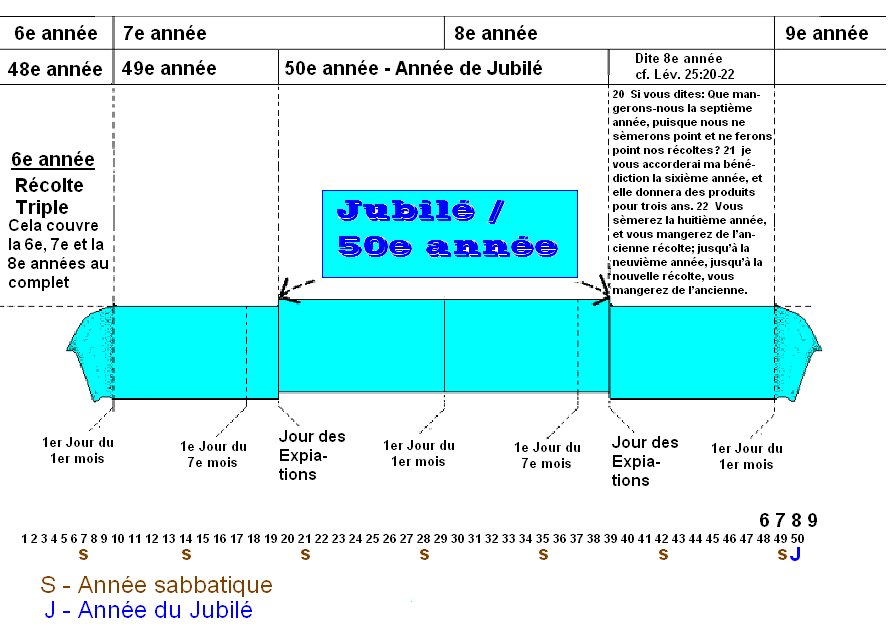
Contents

One True God:

God exist-Why is God eternal-Many names for God-Which name, which entity-Elohim/Eloah-Elohim plural-How many elohim-Jehovah/Jehovah of Hosts-SHD 3068/3069-Two different beings-God look on sin-God and His Law

Spiritual Creation:

Angel of YHVHIs Christ YHVH-Worship the son-Great Angel OT-Who spoke to Abraham-Who did Moses see-Who talked to Moses and Aaron

Sons of GodHow many sons of God-Difference in heavenly beings-24 Thrones/Elders-4 living creatures-4 rivers/4 Cherubim-Lion headed systems-Who are the host-Cause of rebellion-Cherub rebel-Rebellion-Fallen host repent-Angels male or female Lucifer: Meaning of Lucifer-Satan still has access to God-Satan not always evil- Abaddon/Apollyon Angels: Function of angels-Can we recognise angels-Pray to angels

Physical Creation:

Nephilim: Humans before Adam-Pre/post Adam DNA-Nephilim not resurrected Adam and Eve: Why create man-Mankind’s destiny-Adam rebuke Eve-Life before Adam-Children’s stories-Apple forbidden fruit-Different races-Vegetables or meat first-Physical condition early people Noah: Origin or faces from Noah-Flood worldwide-Noah’s faith Abraham: Blessings for Hagar/Ishmael

The Law:

Two tablets of stone-6 and 4 or 5 and 5-First Commandment-Sabbath-Reading the law Society: Uncleanness until sundown-Not coming near wives-Childbirth-Garments etc-Swearing-Violence on innocent-Death penalty-Tattoos-Owe no man-Gambling Food Laws: Mushrooms-Supplements-Pork and fish-Eating meat-Food and ten commandments Tithes and Offerings: 3 or 7 offerings-Atonement tax-Stealing from God

Israel:

12 Judges-Kings-Numbering of tribes-Order of tribes-Moses: Broken tablets-Wife and children-Hosts of Pharaoh-Red sea-Seven-day march-Fall of Jericho- Red cords-Blood on doorposts-Idols and Images: Golden idol-Why a calf-Worship of images-Golden calf/golden cross-Divisions of Israel

Joshua…Joshua’s life-12 rocks/12 apostles-2 spies

JudgesJudges 9:7-21;Judges 19-Gideon 70 sons-Samson’s hair-Riddle to 30

RuthRuth’s kinsman

1Samuel1Samuel 1:6-17:40-David

1Kings…1Kings chapter 6

2Kings…2Kings chapter 2

EstherEsther 9:13 Nuremburg Trials

Job7 sons 3 daughters-Job of Genesis 46:13

PsalmsPsalm 82-Psalm 187

Proverbs…Proverbs 8 and 9-Proverbs 31

EcclesiastesEcclesiastes 7:1-Birthdays

Prophets:

IsaiahIsaiah 19:23-Isaiah 65:1-6-Isaiah 1:29

Jeremiah…Jeremiah 4:15ff

EzekielEzekiel 46:20;-26:21;-Exekiel’s Temple-Ezekiel 20:37-38

DanielDaniel 12:1-2;-2:43;-7:9-10;-Daniel and 3 in oven-Lion’s den
Hosea…Hosea 2:15

JoelJoel 2:23

MicahMicah 6:4;-5:5

Zechariah…Zecariah 14:16-19

God’s Calendar:

Full moon-Time lost-Number 7-Jubilees: What is a Jubilee-How to count-Blown on Atonement-5 months in 50th or 1st year-End of Jubilee Feasts: Where does he place his name-Assemblies of God-Fat of the Feast-Pentecost: Shavuot-Trumpets: Trumpets blown-Feast of Shofar-New Year-Atonement: Meaning-Tribute tax-Half Shekel

***********************************

FAQ Old Testament

One True God

Why do you believe that God exists? 

A: It is written only a fool says in his heart that there is no God. The entire structure of the creation demands that God exist: From the Laws of Thermodynamics to the phase space volume selection of the universe and Quantum Mechanical theory. The philosophical basis of Causation is singularist and not supervenient. Why would you think that there is no God?

Why do you think God is eternal? The fact that God created us should not mean that God never dies. Maybe your God just had special power to create the whole world and maybe His life has just been very long, of years old.

A: God stands outside of time and space. The Bible is very clear that there is only One True God, whom no man has ever seen or ever can see (John 1:18), and who dwells in unapproachable light and who alone is immortal (1Tim. 6:16).

We know this to be true as the phrase “space volume selection of the universe” is held to be a factor of ten to the tenth, to the 123rd power. It cannot be written in normal denary notation, even if the entire substructure of matter in the universe were to be used. In other words, there is a point of origin, and only one for the entire universe.

We now know from the general theory of relativity and subsequent quantum mechanical theory and its adaptations that a substructure, which we call “quarks”, underpins the basis of matter.

We know from the decay of “K Mesons” that there is directionality to time. We know that the structure of matter in the universe is a directional structure in which Space, Time Mass, Energy and Gravity are equivalent expressions of a single fundamental essence, and that essence we call spirit. The Bible is understood to teach us that God creates it “ex nihilo” or “out of nothing”. This was also the doctrine of the Shepherd of Hermas, the earliest of the writings not now included in the New Testament.

God created the entire spiritual realm, and then he created the physical. This is examined in the papers How God Became a Family (No. 187) and The Purpose of the Creation and the Sacrifice of Christ (No. 160). The structure of the creation and the logical necessity of Singularist Causation and the impossibility of Absolute Creation in the work is shown in Creation: From Anthropomorphic Theology to Theomorphic Anthropology (No. B5). 

I see in my concordance that there are multiple words in Hebrew that are translated as “God.” Do they all mean the same thing? Why do the Hebrews have so many words for God? 

A: No, they don’t all mean the same thing. The various names for God are a function of His activity in the creation. Also, beings carry the name “God” and “Yahovah” when they act for the one true God. The name of God in the singular is “Eloah.” “Elohim” is a plural name, which can be used of singular beings.

In the same way “Yahovah” is used of multiple beings of the angelic host including Christ, but “Yahovih” is not so used. “Yahovih” is “Yahovah of Hosts” who is the “Most High” or the “Elyon.” The term “I am that I am” is a corruption of this idea. The text is “ ‘eyeh ‘asher ‘eyeh” or “I will be what I will become.” The term, “Yahovah” is “He causes to be” as a third person form (see fn. to Exodus 3:14 in the Oxford Annotated RSV). The names of God in the various forms are covered in the texts The Names of God (No. 116) and The Pre-Existence of Jesus Christ (No. 243).

I am confused as to the different names given in the Bible for God. I have read your papers and all makes sense, but it does not tell which name is for which entity. For example, how do you know in Genesis 1:1 that this Elohim is the One True God in the Spirit? In verse 26 it states, “Let us make man in our own image…” That sounds like the plural Elohim and not the One True God. Then I look at 2:4 and on and it states, “YHVH Elohim.” Who is the Elohim in 1:1 and who is YHVH Elohim in 2:4 and how do you know how to distinguish between them? It does say in 2:4 that YHVH Elohim created the Heavens and the Earth. Were they created by YHVH Elohim through His Elohim(s)?

A: Yes, this is a very important question. We have this basic rule. No man has ever seen God, neither heard His voice, nor seen His form (Jn. 1:18). We have this from the mouth of Christ and reinforced by John and Paul. Thus, the beings that are referred to in the Bible as Elohim who were seen or touched were sons of God and not the One True God. This One True God dwells in unapproachable light and no man has seen Him or ever can see Him. All that was experienced by man was delivered by the Great Angel of the Old Testament, who gave the Law to Moses and who became Jesus Christ, or those other sons of God who worked with him and who also bore the name of God. Look at the papers The Names of God (No. 116) and The Pre-Existence of Jesus Christ (No. 243). The One True God, Eloah has created all things by His will and all beings act under His will.

Am I to conclude that we do not know which elohim it is referring to in Genesis 1:1 and it really does not matter because all the Elohim are acting under the direction of Eloah? Do you think it is the sons of Eloah it is referring to because of the plural used in verse 26? So everything was created through the Elohim for Eloah?

A: The word God in Genesis 1:1 refers to Eloah and the first act of creation already completed, which was the extension of Himself as Elohim. Thus, the extended being is Elohim and He creates as Elohim because it involves multiple beings.

Job 38:4-7 shows the concept. He created and the sons of God were gathered together and the Morning Stars sang for joy at the creation of the earth. Thus, all were elohim under the One True God (cf. Jn. 17:3). It is irrelevant who was allocated tasks from the primary creation, which was the generation of the elohim from Eloah. Look at the papers How God Became a Family (No. 187) and The Government of God (No. 174).

Could you explain and define the Hebrew word for God, “Elohim”? Isn’t this a plural word? Are we to understand that it encompasses the Father, Son, and Holy Spirit?

A: The Hebrew word “Elohim” is a plural word meaning both “God;” and “Gods” plural, depending on its use. The singular word for God is “Eloah.” This is “Elahh” in Chaldean. The plural word for God in Chaldean is “Elahhin’” which is the same meaning as Elohim. “The God” is referred to as “Ha Elohim.” The Arabic came from the eastern Aramaic or Chaldean and that is why the Arabic word for God in the singular is “Allah’.” Elohim extends to cover all the sons of God as a council of elohim and a body of spirit beings. The Bible refers to the elohim as a plurality and elohim is rendered as “aggelos” in Greek and “angels” in English. For example, Psalm 8:5 says of Messiah that “Thou hast made him a little lower than the elohim.” This is translated in the English of the KJV as “angels” from the rendering in the Septuagint (LXX) as “aggelos”. The same is true in the Vulgate, and the Syriac. Thus, it was generally understood for three hundred years before and after Christ that the “elohim” were the “sons of God” who were termed “messengers” or “angels.” This text is also rendered “angels” in Hebrews 2:7. The Angel of the Old Testament is also an elohim. Psalm 97:7 also refers to the elohim as a wider council of elohim. It is a very important and interesting point, which is obscured by the Trinitarian system (see the paper Psalm 8 (No. 14)). The Trinity is a pagan system of the Triune God, which was introduced from Rome in the fourth century. Look also at the papers The Elect as Elohim (No. 1); The Angel of YHVH (No. 24); The Pre-Existence of Jesus Christ (No. 243); Creation: From Anthropomorphic Theology to Theomorphic Anthropology (No. B5) and The Soctratic Doctrine of the Soul (No. B6).

In Genesis 1:26 it says man was created in the image of Elohim. In 2:7 it says that YHVH Elohim formed man of the dust. In Revelation 21:17 it refers to the measure of a man, that is, of an angel. It seems to me that it is talking about two different men and maybe two different Gods. Are the words in the ancient text for man in all the places that I referenced the same word? Are we talking about the same beings?

A: The Bible does speak of various elohim. The elohim are a council, as we know from the Psalms and elsewhere. The text in Revelation speaks of the measure of a man as the measure of an angel, and that tells you that we are all brethren and made in the image of God. This aspect also has ramifications about the angelic host. We are all to become brothers and part of the City of God where God is all in all. Look at the paper The City of God (No. 180).

Are Jehovah and Jehovah of Hosts one and the same, or are we talking about different beings? 

A: We are talking about different beings. Yahovah or Jehovah in English (there is no J in Hebrew) was allotted Israel as his possession by the Most High (Deut. 32:8 esp. RSV). The Most High or “Elyon” is Yahovah of Hosts. All beings who act for Yahovah of Hosts have the title, “Yahovah.” Christ was the key figure in the Old Testament as the Great Angel of Yahovah who had this title, but there were others. In Genesis, chapters 18 and 19, we see three Yahovahs who came to see Abraham. The senior remained with Abraham and the other two went on to Lot at Sodom.

They destroyed Sodom by calling down fire from Yahovah in Heaven. Thus there were four there and the One in Heaven who sent the fire down on Sodom. That One is Yahovah of Hosts. He sent Messiah to the world as the giver of the Law and as the protector of Israel. Look also at the papers The Names of God (No. 116); The Pre-Existence of Jesus Christ (No. 243); The Angel of YHVH (No. 24) and Early Theology of the Godhead (No. 127)The creation had a purpose and Christ had a role in the creation given to him by “Yahovah of Hosts” who is “Yahovih” (cf. The Purpose of the Creation and the Sacrifice of Christ (No. 160)).

In your writings you make a distinction between Yahovah (SHD 3068) and Yahovih (SHD 3069). You state that Yahovih (3069) is superior to Yahovah (3068). It is my understanding that the original script is just the Tetragrammaton that is translated YHVH with no vowels. If I am correct, how did the translators come up with 2 different versions of the word and make one superior to the other when they both were YHVH?

A: The Hebrew Text has preserved these distinctions. The alteration by the Sopherim of “Yahovah” to “Adonai” is a basis for the vowel point argument from Adonai. Look at the comments in Strong’s Hebrew Dictionary for 3068 and 3069. You will see there the distinctions. 3068 is read as “Adonai” and 3069 is read as “elohim.”

I was reading the paper Law and the Second Commandment (No. 254) and in Deuteronomy 11:17 ‘Lord’ is referenced both ways in the same verse. Is this a misprint or are we talking about 2 different beings? If so please explain the difference. Also explain 2Corinthians 6:17-18. 

A: The word translated “Lord” in the text is “Yahovah” (SHD 3068) (cf. Green’s Interlinear Bible). The Septuagint makes no distinction in the use of “Kurios,” and it is also translated the same way.

In 2Corinthians 6:17-18, it is speaking of the “Lord Almighty” and there is no distinction. There is a distinction between the entities, as in Zechariah 2:8-11. The “Yahovah” sent to save Israel and Jerusalem is sent by “Yahovah of Hosts.” This is the distinction in Psalm 45:6-7 and seen in Hebrews 1:8-9 as “Messiah.”

Can God look on sin? I heard a sermon where the minister said “God can’t look on sin, that’s why Christ said ‘my God, my God, why have you forsaken me’ as he bore the sins of the world.” Is this true?

A: Yes, God can look on sin but we ask Him not to (Ps. 51:9ff.; Isa. 59:2).

That statement is a myth spread by people who have never read the Psalms properly. The text spoken by Christ was an Aramaic form of the Hebrew in Psalm 22:1. In Psalm 22:24 we read that God did not hide his face from him.

The events in Psalm 22 all refer to Christ and his actual crucifixion. Verse 24 says:

“For He has not despised nor abhorred the affliction of the afflicted; Neither has He hid His face from him; But when he cried unto Him, He heard.”

This fiction is designed to deal with the concept of the reparation for sin without real understanding or acknowledging the Wave Sheaf offering and the true concepts of the Passover. Because they do not obey God’s laws and kept pagan systems, they do not understand Scripture and the Laws of God. The matter of the crucifixion and the aspects of Psalm 22 are examined in the papers on the web at http://www.ccg.org and http://www.logon.org

Ezra 9:15 refers to God being righteous, and Psalm 119:172 refers to God’s Law being righteous. Is there a connection between God and His Law? 

A: God is holy (Ps. 145:17), perfect (Mat. 5:48), righteous (Ps. 145:17), good (Ps. 25:8) and true (Deut. 32:4) and His Law is holy (Rom. 7:12), perfect (Ps. 19:7), righteous (Ps. 119:172), good (Rom. 7:12), and true (Ps. 119:142). This is because the Law proceeds from the nature of God and not from His whim. This is analysed in the papers Distinction in the Law (No. 96) and Love and the Structure of the Law (No. 200).

Spiritual Creation

Angel of YHVH

It was my understanding that “YHVH of Hosts” is the Father and the King is Christ (Zech. 9:9), but in Zechariah 14:16 we are told “all shall even go up from year to year to worship the King, the LORD of Hosts.” Does Christ also have this title “YHVH of Hosts” or is this speaking of “worshipping” both the King and YHVH of Hosts?

A: Christ is given the names he is by the Father and acts for the Father under His delegation. God is King of Kings and Lord of Lords, and yet we see Christ coming as King of Kings and Lord of Lords strapped, as a title, to his thigh (Rev. 19:15-16). Only Yahovah of Hosts is worshipped and as such He is King. The title is given to Christ as it is also given to the elect.

Christ is also given a new name in this process, which will also be written on the elect (Rev. 3:12). We have all been redeemed to be a nation of kings and priests (cf. Rev. chs. 4 and 5 for the council and their statements about the saints and the Messiah).

Because some of these titles given to Christ overlap with titles ascribed to Almighty God, many have misconstrued the intent and believed that Christ is somehow God as God is God, being part of a Trinitarian, Binitarian or Ditheistic Godhead.

This is not the case. These titles given to Christ all convey the concept of delegated authority, even as the Mal’ak of YHVH was termed YHVH and Elohim because he represented YHVH of Hosts (Eloah). See the papers Isaiah 9:6 (No. 224) and The Names of God (No. 116))

In Daniel 2:45 we read about the Stone that was cut out of the Mountain and then in Daniel 7:13-14 we read about the coronation of the Son before the Ancient of Days. It appears the Son came from the Father differently than all the other creation. It almost seems like a type of cloning the Father did on Himself. Could you comment on this? If this is different from the creation of angels and the physical creation, then it would be quite acceptable to “worship” the Son in addition to the Father. He really would be in the Father and the Father in Him.

A: Christ was generated by God in the same way all the sons of God were generated by God. Christ was sent to earth in a different way and was the “only born god,” the “monogenes Theos” of John 1:18. The vision of Daniel 2 is covered in the papers on the nature of God series of the Bible Study Program (No. B1). Look especially at the paper How God Became a Family (No. 187).

No, it would not be acceptable to worship the Son as the Father. The Bible is clear that he who sanctifies and they who are sanctified are of one origin (Heb. 2:11). The doctrine that Father and Son were one God, and the son was worshipped and came to be sacrificed is the doctrine of Attis, and entered Christianity in the Council of the fourth century. “Have we not all one Father? Hath not one God created us?”(Mal. 2:10)

Who was the great Angel who was with Israel in the Old Testament? 

A: The belief of the Church in the first and second centuries was that this was Christ. He gave the Law of God to Moses. Justin Martyr, in writing to the Roman Emperor (ca. 150) in his “First Apology,” states categorically that it was the belief of the Christian Church that the Great Angel of the Old Testament who gave the Law to Moses was Christ. That is the teaching of the Original Catholic Church. See also www.originalcatholicchurch.org. Look at the papers The Angel of YHVH (No. 24)The Early Theology of the Godhead (No. 127) and The Pre-Existence of Jesus Christ (No. 243).

Who was it who spoke to Abraham? Was it Jesus? Who destroyed the cities?

A: It was the angel of Yahovah who became Jesus Christ. He was termed Yahovah, as were the other two angels who came with him to meet Abraham, and then the other two Yahovahs went on to Lot at Sodom and Gomorrah. They (Yahovah) then called fire down on the cities from Yahovah out of Heaven (Gen. 19:24). This Yahovah in Heaven was Yahovah of Hosts or Yahovih. These matters are explained in the papers: The Elect as Elohim (No. 1); The Angel of YHVH (No. 24); The Names of God (No. 116) and The Pre-Existence of Jesus Christ (No. 243).

If no man has seen God as John states, then who was it that Moses saw? Didn’t he see God? 

A: No, Moses did not see the One True God. Christ said no man has seen his form or heard his voice at any time so also repeated by John and Paul (Jn. 1:18; 1Jn. 5:20; 1Tim. 6:16). The belief of the early Church was that the Angel of the Old Testament that gave the Law to Moses was Christ. See the papers The Angel of YHVH (No. 24); The Pre-Existence of Jesus Christ (No. 243) and Early Theology of the Godhead (No. 127).

In Exodus (referring to the 10 plagues) who was giving Aaron and Moses instructions for the pharaoh?

A: The being that was with Israel in the wilderness was the rock that was Christ. He was the Angel of the Old Testament who gave the Law to Moses at Sinai. This was the teaching of the original Church and it is the teaching of the Church today (cf. Justin Martyr, First Apology). Look at the papers: The Angel of YHVH (No. 24); Early Theology of the Godhead (No. 127) and The Pre-Existence of Jesus Christ (No. 243).

Sons of God

How many sons of God does the Bible say there are? 

A: The sons of God are mentioned in the texts in the Old Testament, but no number is given. Deuteronomy 32:8 shows the nations were allocated to the sons of God according to their number (this was altered later in the Masoretic Text but the RSV has the text correct). So we have 70 by tradition for this, but we know it was much more than that from the vision in Elijah. Job 1:6; 2:1; and 38:4-7 just mentions the sons of God and the Morning Stars.

Job 33:23 indicates there are a thousand in the structure capable of ransoming men. We get the term “myriads” used of them and the term “armies” is also applied to them (Rev. 19:14). The book of Revelation gives a number of 200 million horsemen which are marshalled by the four angels bound at the Euphrates for the time appointed to slay a third of mankind (Rev. 9:16). These may well be men and not of the heavenly host.

We have no way of knowing if this reference is an exhaustive number or not. Thus, the number of the sons of God, sometimes termed Messengers, in the texts is perhaps 200 Million, but certainly numbered as armies. Perhaps they are as many as people have been since Adam. We will know when we get to The City of God (No. 180) and are joined with them as a living Temple and residence for God and the Lamb.

Could you explain the differences between all the heavenly beings – sons of God, Angels, Cherubim, Nephilim? Are all sons of God Angels, and all Angels sons of God?

A: All the heavenly host are sons of God. The ones sent to mankind are messengers, termed angels. These are in ranks and positions: Cherubim, Seraphim, and Morning Stars. All are sons of God. Christ is one of them.

The Nephilim are the product of the fallen host. See the paper The Nephilim (No. 154). They have no resurrection. The demons are the sons of God who fell from grace. We will all be Sons of God. Look at the papers How God Became a Family (No. 187); The Government of God (No. 174) and The Elect as Elohim (No. 1).

Can you explain in a nutshell about the 24 thrones and 24 elders?

A: The inner council of the elohim has thirty beings. These thirty are comprised of the twenty-four elders under the High Priest, who is Messiah. The four Living Creatures are the cherubim around the throne of God. They have the elders allocated to them on the basis of two to a system, with three systems making six to a division. God is in the centre at the throne. This makes thirty.

There are others who then make up the council of the seventy. This structure was reflected in the system in Israel, and at the Tabernacle and the Temple. The twenty-four division high priests and the High priest reflected the council of the elders. The seventy plus two reflected the outer council. Israel was divided into four divisions of twelve tribes, three tribes to a division, and with the priesthood of Levi at the tabernacle or throne (see Numbers 10). The divisions of the priesthood were allotted to the division of the tribes. The structure is also covered in the paper The Government of God (No. 174)Look also at How God Became a Family (No. 187).

What are the 4 living creatures and of what importance are they?

A: The Four Living Creatures are the anointed covering Cherubs that stand before the throne of God. The Ark carries two on the Lapporah or cover and another two stand over them. Look at the papers The Ark of the Covenant (No. 196) and The Meaning of Ezekiel’s Vision (No. 108). The paper The Government of God (No. 174) explains their function.

The four living creatures and the Council discharge function within the Host related to administration and judgment. They are in effect quadrant commanders of the universe and cover the throne of God.

The living creatures represent the four stages of the history of the priesthood and Israel. The first stage was the tabernacle of the wilderness and the Judges. The second stage or cherub was as the first Temple from Solomon to the captivity. The third stage was from the reestablishment after the return to the destruction in 70 CE and the fourth stage was as the era of the seven churches until the return of the Messiah.

Each stage is as a covering cherub that protects the throne of God and by human hands (under the wings) accomplishes His purpose on earth. The living creatures have been described elsewhere in the Bible but the symbolism of the form has a much deeper meaning than that of a created oddity with four different faces. In Revelation 4:6-8 we see the same faces but separate as four living creatures each with one of the faces but with six wings.

Do the four rivers flowing from Eden have anything symbolically to do with the four Cherubim around the throne of God? 

A: Yes, symbolically the rivers represent the four divisions of the creation. The creation and the role of the cherubim have been examined in a number of works. These are The Government of God (No. 174); The Purpose of the Creation and the Sacrifice of Christ (No. 160)The Doctrine of Original Sin Part I The Garden of Eden (No. 246) and How God Became a Family (No. 187).

You referred to the man and lion-headed systems; what are the roles or duties of these positions?

A: They are the quadrant commanders of God’s system. They are anointed covering cherubs, and they also appear as such in the Temple in Ezekiel. Revelation shows that they are at the throne of God. They occupy the position senior to the 24 elders, and they are seen in Ezekiel chapter 1 et seq where they are identified as the Cherubim. They have set areas of responsibility as we see from the fact that they do not change their orientation no matter where the throne is headed. Look at the papers: The Meaning of Ezekiel’s Vision (No. 108); How God Became a Family (No. 187); The Government of God (No. 174) and The City of God (No. 180).

Please give me as much information about the Hosts as you can. Who exactly are they, how many, their function and roll? Was Jesus part of the Host?

A: The Host are the sons of God. They are called messengers only from the fact of their mission to man. Angel is a derivation of the Greek word for messenger. “Malak” in the Hebrew has become “Malaikat” in the Arabic, and on into the Indonesian etc.

The Host are centred on the throne of God and serve Him. Christ was one of those sons of God in the beginning. The process is explained in the papers How God Became a Family (No. 187); The Government of God (No. 174) and The Pre-Existence of Jesus Christ (No. 243).

We are to become sons of God and elohim and that is covered in the paper The Elect as Elohim (No. 1). The Meaning of Ezekiel’s Vision (No. 108) also has information of interest regarding the Cherubim. How we all fit together is covered in the paper The City of God (No. 180).

What was the cause of the rebellion of the host?

A: It was always understood as being their objection to our creation. The Koran gives this as the specific reason. That is why Satan is the accuser of the brethren. They accuse us night and day to God. Look at the papers How God Became a Family (No. 187) and The Government of God (No. 174)Lost Sheep and the Prodigal Son (No. 199) is also of interest in this matter as is The Judgment of the Demons (No. 80).

Could a cherub rebel and lose his position? If so what does the future hold for him? 

A: Yes one, Satan, and perhaps two did rebel. They can repent like all of God’s sons. Look at the paper The Judgment of the Demons (No. 80) and also Lost Sheep and the Prodigal Son (No. 199)God’s mercy endures forever.

If one third of the host rebelled and there are 30 in the inner council one could speculate 10 rebelled. Is that why there are 10 components; 7 church eras, 2 witnesses, and Messiah needed to repair the problem/breach created by the hosts rebellion?

A: One might speculate that way and it would seem logical; however, the figures used by the Satanist cells are of the order of twelve/twelve. It seems they actually might have got more from the inner council than a third. However, over all they got a third as it says. Perhaps it was two cherubs and the ten. We will know when we get to Jerusalem and Christ gives us new information.

The ten components of the Temple are not related to individuals, save in the Messiah and the two witnesses. The seven are churches unless we identify the seven angels of the seven churches as potential replacements in the host, and the human elements as the new section. 

If the fallen angelic host (the demons) can repent and still become sons of God, then maybe you believe that the unrepentant demons will be killed forever? What is the difference then, between us and them? Are people just another more creative way of doing the same thing that is done with angels?

A: Yes, that is the answer. The human creation with the family system was another way of giving the angels similar responsibilities of the human family, but with greater oversight. When Satan objected to our creation and the third of the host objected and rebelled with him, they were then given responsibility for us. They became our accusers instead of our spiritual parents. They became an obstruction to the plan and our salvation. After the final rebellion at the end of the Millennium, the demons will be reduced to physical form and die. This is the sense of being brought down to the side of the Pit and to die like any man, as we see in Ezekiel 28 and also the same sense in Isaiah 14. This aspect has been examined in the paper The Fall of Egypt The Prophecy of Pharaoh’s Broken Arms (No 36) and Lucifer: Light Bearer and Morning Star (No. 223). They will then be placed within the physical resurrection at the Second or General Resurrection of the Dead. One can imagine the difficulties they will face when dealt with, in examining their roles over the last 6000 years and the havoc they caused even by simply failing to prevent false action, let alone actually inducing it in the human host.

It was probably to escape this accounting that they developed the theory and doctrine among the mystery cults, especially the Orphic, of the daemon among the humans which was a fallen theos or god, and which had to be purged in order to return to heaven. The inducement of humans in the endeavour was probably a reaction and a desire to be returned to their former estate without enduring the process of the second and physical resurrection under the human elect of the First Resurrection.

The soul doctrine is an invention of Socrates of the “psuche” in reaction to the Orphic doctrines, and from which we get the immortal soul and which later went to the heaven of the Gnostics. The eternal soul is another lie, on the same vein as demons cannot die and they cannot repent. Christ was reduced from one of the elohim to the form of a man and he died on the cross, was resurrected and ascended into heaven. If he could do that, then so can any one of the demons. God has no limitations in the creation. Look at the papers The Pre-Existence of Jesus Christ (No. 243); The Judgment of the Demons (No. 80); The Resurrection of the Dead (No. 143); The Soul (No. 92); Lost Sheep and the Prodigal Son (No. 199)and The Socratic Doctrine of the Soul (No. B6).

I have read up on the paper entitled The Nephilim (No. 154). The angels involved in this sin to create Nephilim were clearly male in origin. So, does that mean that all the spiritual creation is closer to a male type as we understand male and female, or are there also spirit beings that would be closer to the female species? 

A: The sons of God have the capacity to materialise in whatever form. If they can appear as a man, they can also appear as a woman and do appear as women often, hence Fatima etc. They appeared as Balaam’s donkey in one instance. Satan is termed the serpent and may well have literally appeared to Eve in that guise. We make the mistake of thinking that the Spirit world is just another copy of this one. We see through a glass darkly.

The Spirit world has the capacity to move through time and space without the limitations we understand or think within. Mass, space, time, gravity and energy are equivalent expressions of the single fundamental essence we understand as spirit. Some of our scientists have made the error of assuming an immanent God from this basis.

The sons of God were all gathered together here when the world was created. Their leaders, the Morning Stars, sang for joy. Satan was among them as a Morning Star and the anointed Covering Cherub. The function of woman was the capacity by which God would produce more sons of God.

Demons appeared as men to interfere with the creation. They may well have become women but then they would have been tied to the creation and the upbringing of the cuckoos they laid. They were probably emotionally immature for that responsibility without the Holy Spirit of God. Also, the woman was the one they influenced. They lost the Holy Spirit when they finally rebelled and were cast from heaven. They then had to produce the pseudo logon. Thus, they are no longer consubstantial. Look at the paper Consubstantial with the Father (No. 81).

We will all be asexual in the resurrection. The second physical resurrection also seems to demand that asexuality. Look at the paper The Resurrection of the Dead (No. 143) and Outline Timetable of the Age (No. 272).

Are you aware of any scriptures besides Psalm 8:5 that refer to spirit beings (other than the Father and the One that became Christ) as elohim?

A: Yes, there are a few texts. Moses is referred to as an elohim in Exodus 7:1. Abraham is referred to as an elohim in the original Hebrew text in Genesis 23:6, which is termed Mighty Prince in the English.

Satan is referred to as an elohim or theoi in various texts. Paul says there are many theoi (theoi polloi) or elohim in the New Testament. Zechariah 12:8 said that the household of David will become elohim with the Angel of Yahovah (Jehovah) at our head. It is written: “I said ye are gods and Scripture cannot be broken” (Jn. 10:34-35). Look at the paper The Elect as Elohim (No. 1).

Psalm 45:6-7 says that Christ, our elohim, was anointed with the oil of gladness above his partners. Thus, there is a council. Psalm 82 deals with this aspect. The other references are covered in that paper. Also look at the The Angel of YHVH (No. 24).

Are the 1000 sacrifices offered by Solomon in the Tabernacle referring to the council of the 1000 sons of God? Just as Job 33:23-24 talks of one of 1000 and redemption through Messiah; or Genesis 20:16 mentions the 1000 pieces of silver to Abraham for the vindication of Sarah but the entire council needed the appeasement for the offence; or Song of Songs with 1000 shields (Eph. 6:16 shield of faith to quench all the fiery darts of the wicked.) Bottom line, do all these scriptures tie to God’s administrative council of a 1000?

A: Yes, the reference in Genesis 20:16 is in fact an appeasement along the lines we see in Job, where the redemption was from one of the 1000. And the irony of Abimelech, in using the term brother, is because of the sin and damage he suffered.

The notion of being protected by the host is evident as well, as being redeemed by one of the 1000. This is fairly esoteric ground now. Nothing turns on it, other than the view that sin was an offence against God. That was why thirty pieces of silver was paid for Christ. Because it was an offence against the council and it was also deemed the price of a slave

Lucifer

What does the name Lucifer mean?

A: Lucifer means Light bearer. The name comes from his function as the Morning Star of this planet. It is an educative and controlling role which is taken up by Christ and the elect at the end of the age, in the not too distant future, for the millennial reign. The terms are covered in the paper Lucifer: Light Bearer and Morning Star (No. 223).

In remembering that Satan came before God with the angels as told in Job, I am wondering if he still has this access to God and does he still have influence on the angels?

A: Yes, he is the accuser of our brethren and he still has one third of the host under him. Some are held to have repented from the activities of the early Church. He is cast down and knows his time is short. Christ said He saw Satan fall like lightning from heaven. Thus, he must be cast down. Revelation speaks of the short time and his fury against the Church because of that short time. We are in that time. In fact, we are past the 1260 years of the woman in the wilderness. The Fifth Seal is still continuing and the woman that rides the beast, who is drunk on the blood of the saints, is about to be destroyed. Look at the paper Outline Timetable of the Age (No. 272) and also The Role of the Fourth Commandment in the Historical Sabbath-keeping Churches of God (No. 170).

I believe that Lucifer and Satan are one and the same being. This presents a bit of a problem though for this would mean that Satan was not always evil wouldn’t it? This is looking more like it may be true as Ezekiel 28:15 shows him being perfect from the day he was created. So how better can one be than perfection?

A: Lucifer was the anointed covering Cherub of the Throne of God and he was perfect among the sons of God. Lucifer means, “light bearer” and thus he was the educator of the host and Morning Star of the planet. See the paper Lucifer: Light Bearer and Morning Star (No. 223).

He and the fallen host became iniquitous. They sinned and tried to grasp equality with God. They failed in the test of faith. They became accusers of the brethren at the creation of Adam. Christ was not, and did not seek co-equality with God and did not try to grasp what was not His. He preferred to be given and earn the gift of power by obedience, and so He became a man and He humbled himself unto death, even death on the stake (Phil. 2:5-7). See the paper The Purpose of the Creation and the Sacrifice of Christ (No. 160).

He became a son of God in power by His resurrection from the dead (Rom. 1:4). See the paper The Pre-Existence of Jesus Christ (No. 243). All of God’s creation is perfect, but we have the choice to mess it up, and we have done so. The Plan is perfect and includes a safety net, so we will all attain to perfection in God’s time. Look at the paper Outline Timetable of the Age (No. 272).

Some of my friends believe the earth is the place of restraint for the angels that sinned. In Luke 8:31 I read where the demons begged not to be cast into the deep or the Abyss. Also Revelation 9:11, 11:7,17:8, IPeter 3:19, IIPeter 2:4 and Jude 6 leads me to believe there is more to this than just the earth in general. Is Abaddon/Apollyon a king restrained also for a future release or is he the same as Satan? Where might this place be? The ocean possibly?

A: The New Testament term is also “Tartaros” which is reserved specifically for the fallen host. Abbadon or Appollyon is the destroyer and, as such, it is another term for Satan and the system he commands. The fallen host or demons have power over the earth and over mankind for 6000 years. At the return of the Messiah, Satan and the demons are restrained for the thousand years of the Millennium.

The pit is death and the texts indicate that the demons are made to die like any man. They are then dealt with in the Second Resurrection like anyone else. This matter has been examined in the papers The Judgment of the Demons (No. 80) and in Lost Sheep and the Prodigal Son (No. 199)The timing of the activities is seen from the paper Outline Timetable of the Age (No. 272).

Angels

When asked what is the function of angels or what are they, the most common answer heard is that they are simply messengers indicating that they are basically footmen or errand boys. This does not exactly add up. For instance, the 38th chapter of Job is an explanation to Job as to how everything was created. At verse 7, it says that the sons of God, shouted for joy at the creation. I believe sons of God here refers to the angels, so if they were already around at the creation of the earth, and before the creation of man, then what were they doing up to this point?

A: Yes, that is the point. Angel is from the Greek “aggellos” meaning “messenger” which was applied to the heavenly beings. In the Septuagint the word “aggellos” was used to translate various concepts. It was used to translate “Sons of God” in Deuteronomy 32:8. During the post-Temple period, Jewish scribes changed that to read “Sons of Israel” to get away from the concept of there being sons of God in charge of Israel, as Christ was associated with the Angel of Yahovah as a son of God.

The LXX of Isaiah 9:6 says, “Angel of Great Counsel” for the Messiah who was son of God. Job 1:6 and 2:1 use the term “Aggeloi”, “Angels of God” for the “sons of God.” The same is also in Job 38:4-7 where “angels” were used for “sons of God”. The understanding of the meaning of the Hebrew texts is starting to slip by this time. And the concept of the Hebrew Morning Stars is not well understood by the translators in the LXX translation. Nehemiah says they had to explain the Hebrew to the populace during his time because they no longer understood it, speaking only Aramaic.

Basically, an Angel was a messenger. Before the creation there was no one to carry messages to, and so they were simply all sons of God. When men were created they were sent to men as messengers, and so all of them who were in that capacity were angels. Look at the papers The Angel of YHVH (No. 24)The Pre-Existence of Jesus Christ (No. 243) and How God Became a Family (No. 187)For the long-term plan look at the paper The City of God (No. 180).

Were some people able to recognise angels as soon as they saw them and yet others did not? If they appear as humans are we supposed to know they are angels? 

A: The Patriarchs recognised them, as we see by what they did and said in the Bible. It’s the “duck test.” If it walks like a duck and quacks like a duck, it’s a duck. Sometimes they are with us and we are not informed. We entertain angels unawares (Heb. 13:2). God makes His wishes known through His servants the prophets (Amos 3:7).

These people speak for God. So too, the sons of God in the heavenly Host speak for God, and are sent to men as “angels” or messengers. Look at the papers on the sons of God for example The Angel of YHVH (No. 24) and How God Became a Family (No. 187).

I have been presented with Genesis 48:16 as a supporting scripture to pray to angels. What is the correct understanding of this text?

A: This text, and the comment by Stephen, is the only text in the Bible where Christ is addressed in prayer. Moses spoke to him face to face, and stood between him and Israel, as did David. David addresses him is Psalm 45:6-7. When he says: “Therefore God thy God has anointed thee with the oil of gladness above thy partners.” In each of the cases concerned, it is a direct request to Christ in his role as protector of Israel. Look at the paper The Pre-Existence of Jesus Christ (No. 243).

In each case they are used as teaching comments. How would we know that the Angel of Redemption was the elohim of Israel (Zech. 12:8; Heb. 1:8-9), appointed by his God, unless we had the direct testimony of the Patriarchs in the Scriptures to demonstrate this fact? They reflect the direct relationship of the prophets with Christ. We pray to and worship only the One True God.

Physical Creation

Nephilim

Were there human beings alive on this planet before Adam, and when was Adam created? 

A: According to Bishop Ussher’s chronology, Adam was created in 4004 BCE. We know from archaeology that there were beings created on this planet before Homo Sapiens existed.

Thus, there was another creation prior to Adam. The discussion on what the Bible has to say about this is carried on in the works The Nephilim (No. 154) and Doctrine of Original Sin Part 2 The Generations of Adam (No. 248).

The interpretation of Genesis to confine the creation to the sons of Seth and the sons of Cain was an invention by Augustine of Hippo in the early fifth century. It denied the understanding of the ancients and left Christianity entirely unprepared to cope with the modern scientific finds of the last two hundred years. This one single false doctrine of Augustine has made the destruction of Creation theory with the false doctrine of evolution possible.

Are you aware of any information in the comparison of pre-Adam humanoid DNA and post-Adam DNA? Do you see any conflict with Bible scripture and archaeology finds?

A: Yes, recent tests made on the Neanderthals have isolated their DNA structure and it is a 27-strand system whereas a human is an 8-strand. We are trying to isolate the Cro-Magnon to see the exact divergence between it and modern humans. There seems to be a reluctance to discuss this issue of release of any results, if tests have in fact been done. What we have so far is indicative that modern primates are of a totally unrelated creation to the Neanderthals. The humanoids we have so far from Australia, such as the Arunka and Kowe Swamp people, have marked divergences from modern humans. Their mitochondrial DNA differs from modern humans. The Lake Nitchie Male was a giant. These aspects have been covered in the paper The Nephilim (No. 154).

I understand that the pre-Adamic creation was inferior and as stated in Isaiah has no resurrection. The Nephilim are not resurrected because they are not fit physical receptacles able to be acted upon by the Holy Spirit. Is this correct? After 6000 years of misrule of this planet multiple vectors such as viruses, transposons, etc that are able to insert foreign genetic material into our DNA could cause man to become nearly as corrupt as the Nephilim. If the fallen host were given a much longer time period than 6000 years, they could achieve what they tried to achieve with the Nephilim. Do you agree with this?

A: The solution is that the Creation was made in the image of God so that the Holy Spirit could be implanted or superimposed over it. The degradation of the species is certainly happening. It is probable that the limitation of the creation to 6000 years was to limit the degradation of the species by its genetic isolation and other problems. The lessening of the life spans indicates a problem. Also, it appears that there has been a deliberate attempt to interfere with the DNA makeup of humans by the Host through the pre-flood structure of the Nephilim.

There is no doubt that the Neanderthals were of a completely different system but the later structure was not. Neanderthals reportedly have a 27-strand system and the current primates have an 8-strand system. We have more in common with chimpanzee DNA than with the Neanderthals. Our capacity to survive may well be limited if it went any longer than 6000 years unchecked.

I’ve read several responses on resurrection and you state that the Nephilim have no resurrection, but Satan and his demons will have a chance to repent. Can you explain why?

A: The fallen host were all part of God’s Creation and were made in his image and through His will. They can repent and can be used. The Nephilim were not part of God’s Creation. They were made by the fallen host specifically to frustrate the Plan of God, and they are not in the image of God. Thus, they cannot function with the Holy Spirit as the demons are able to do.

God is obliged logically and morally to extend repentance to His Creation, but not to things created by the demons contrary to His Will. Thus, He will extend that capacity to the demons and they will be judged by us according to Scripture (1Cor. 6:3). In like manner, He has said that capacity will not be extended to the Nephilim. They have no resurrection (Isa. 26:14). Look at the papers The Judgment of the Demons (No. 80); The Resurrection of the Dead (No. 143) and Lost Sheep and the Prodigal Son (No. 199).

Noah was chosen to be saved in the Ark because his lineage was perfect. I understand that to mean that his lineage was not corrupted by the Nephilim. All these humans that were corrupted by the Nephilim and died in the flood would be resurrected wouldn’t they? If all of the Nephilim did not perish in the flood, are their descendants subject to resurrection or not?

A: No, the Nephilim/Rephaim have no resurrection as we know from Isaiah 26:13. The whole matter of who they were and what happened before and after the flood is covered in the paper The Nephilim (No. 154).

Adam and Eve

Why would God desire a physical human creation when He had already created spirit angelic beings to be sons of God? Why not just create more angels? What is the difference in the roles of entering His family?

A: This question is perhaps the most fundamental question to the plan of salvation. God could have made spiritual sons as many as He needed or wanted. Why then did he create a weaker physical creation that was then placed under the spiritual creation?

The same question then applies to the physical creation. Why did God create humans in a sequence of breeding animals that would suffer and perhaps die in the process? Why did they eventually die anyway? Why did He not create them all at once and simply educate them?

The answer is both simple and complex. In this way He would have to be obeyed and the entire creation would have to walk by faith. The angelic host would have to see the physical creation destined for some event as sons of God and would have to walk by faith and nurture them as ministering spirits as parents nurture children. The human creation could see even less and that is why faith exhibited in them is greater.

Satan used the creation to bring one third of the host to rebellion. These rebellious sons were then placed in charge of the creation to test both and to judge both.

The church is a group called out to test and judge the demons as they are measured against the standard we set. In the Millennium we will do the job they were set to do now under God’s laws. The demons decided to create another system with another structure of worship that does not work. So we see that the structure was made to ensure that the elect walked by faith and only those who exercise faith and obedience are made sons of God in power from the resurrection of the dead.

The sons of God had to be tested by faith and tested by their duties. Thus the spiritual creation was tested by the physical creation and both come to salvation together. Look at the papers How God Became a Family (No. 187); The Judgment of the Demons (No. 80); The Purpose of the Creation and the Sacrifice of Christ (No. 160) and The City of God (No. 180).

What is mankind’s ultimate destiny?

A: The purpose of the creation of man is to rule as God (Zech. 12:8). The name Israel means literally “he shall rule as God.” We were created to raise ourselves and the sons of God of the Angelic host in a sense of mutual interaction and shared responsibility. We are to get ourselves, and the Host, through the Resurrections to the City of God. Look at the papers The Purpose of the Creation and the Sacrifice of Christ (No. 160) and The City of God (No. 180). We will rule the heavens and we can only guess, at present, at what God has in store for us and the rest of the Host (1Cor. 2:9; Deut. 4:19).

In the Garden of Eden, why didn’t Adam rebuke Eve for eating the fruit of the tree of knowledge of good and evil, instead of following along with her?

  1. It was his responsibility to rebuke her. He did not and the way we are dealt with was changed. However, God knew that he would do it and that it would also become necessary to send Christ to become leader as the slain lamb. We were written in the Book of the Lamb, The Book of Life and of the Resurrection from the foundation of the world.

Thus, God understood the events and they were provided for in the system of Salvation. Look at the papers The Doctrine of Original Sin Part I The Garden of Eden (No. 246) and Doctrine of Original Sin Part 2 The Generations of Adam (No. 248).

The Old Testament says that Adam was created about 5000 years before Jesus Christ, but actually there have been several civilisations like the Pharaohs in year 4200 BCE and the Chinese before that. Scientifically, they found some human bones dated millions of years back. How can we justify this contradiction? 

A: According to Ussher’s chronology, which follows the Bible, Adam was created in 4005/4 BCE. The explanation of the pre-Adamic creation is contained in the paper The Nephilim (No. 154)Look also at the papers The Doctrine of Original Sin Part 1 The Garden of Eden (No. 246) and Doctrine of Original Sin Part 2 The Generations of Adam (No. 248).

Do you have any idea why so many of the children’s stories only represent Adam and Eve sinning and making themselves loin coverings of fig leaves (Gen. 3:7)? Most accounts stop the story there and do not explain the time frame, how Adam and Eve were being taught by God, or how even after their sin God made them garments of skin and clothed Adam and his wife (Gen.3:21).

A: The stopping of the text here is based on a number of false premises. Firstly, the efforts by them were man-made efforts and in contrast to the God-made clothing of animal skins. The emphasis is thus on the human effort and not on God’s effort (cf. Rom. 8:3).

The popular presentations are for a number of reasons. The Gnostics and their doctrines were ascetic vegetarians and wished to conceal the fact of the killing of animals and the consumption of meat. Look at the paper Vegetarianism and the Bible (No. 183).

The leaves also have symbolism among the mystery cults. Thus, they were portrayed more readily. The oak leaves are clearly condemned in the Bible. The priests of Attis in Rome also tattooed themselves with ivy leaves, which were sacred to their god. Thus, the leaf is often used in their symbols, as was the phallus or Asherah, and the kid.

Was the forbidden fruit really an apple? I don’t see that in my Bible, could you tell me where it says that Eve ate an apple? 

A: The notion that Eve gave Adam an apple is not biblical. It comes from the myths and mysteries and is associated with the golden fruit of discord. The full story is contained in the paper The Doctrine of Original Sin Part 1 The Garden of Eden (No. 246).

I believe in God but one thing I have difficulty understanding is if “Adam and Eve” were supposedly the first humans on earth, then where did all the distinct races of man come from? 

A: There is only one race, the human race. We are all brothers. The tongues were confused at Babel. It is a bit like the breeding of animals. The darker skinned people were basically developed, in terms of skin pigmentation, over many years. The fairer ones were in countries where they wore more clothing. However, they are still the same people with the same basic structure. The blood types or categories vary from east to west but they still have the same basic varieties.

In animal terms, we can say that the German Shepherd and the Sheepdog both come from the wolf, and not so long ago. Even though they look different they are both dogs. The creation is dealt with at The Doctrine of Original Sin Part 1 The Garden of Eden (No. 246) and the Doctrine of Original Sin Part 2 The Generations of Adam (No. 248). The pre-Adamic creation destroyed with the flood is covered in the paper The Nephilim (No. 154).

All variations of the human species are explicable in the variations we see occurring from pigmentation and family/tribal likenesses. The finds in the Choukoutien Cave in China indicate the coexistence of families with what we consider vast racial differences within what appears to be the one family group.

These findings by anthropologists are examined in the light of a series of humanoids that existed before modern man but which have no link to them. This matter is examined in the paper The Nephilim (No. 154). The matters have also been examined in the paper The Fall of Egypt (No. 36)This complex matter is too large to be explained here in detail.

God’s word teaches that it is incest to marry a brother or sister, yet how else could the family of Adam and Eve grow? Is it possible He made wives for the sons as He made one for Adam? 

A: This matter is explained in the papers Rachel and the Law (No. 281) and Doctrine of Original Sin Part 2 The Generations of Adam (No. 248)It is also forbidden in other aspects, but Lot produced Ammon and Moab through his daughters contrary to Law. They perceived it as necessity knowing that the world would end by fire and they believed they were in that position then.

‘And Cain knew his wife’. Was she his sister? Why could she live alone before marriage, without being afraid of wild animals?

A: She may have been his sister or she may have been one of the Nephilim. It is likely that she was his sister as that was the only explanation for the sons of Adam keeping their generations pure. Look at the paper The Doctrine of Original Sin Part 1 The Garden of Eden (No. 246)Doctrine of Original Sin Part 2 The Generations of Adam (248) and The Nephilim (No. 154).

Did man eat vegetables or meat first? I say vegetables since they were easier to get than hunting meat.

A: It is believed man had a balanced diet from the beginning (Gen. 1:28-30). The Adamic species has a delineated process from the Bible record. This is covered in the papers The Doctrine of Original Sin Part I The Garden of Eden (No. 246) and Doctrine of Original Sin Part 2 The Generations of Adam (No. 248) and also Vegetarianism and the Bible (No. 183)The paper, The Nephilim (No. 154) might give you some other views of interest regarding the last 140,000 years.

There are divisions to this question. In the case of pre-Adamic man, the answer is both. Man was omnivorous and ate both fruits and also grubs and insects on them and in the trees. The body structure of vegetarians make for significant guts, and this is evidenced by Australopithecines skeletal reconstructions such as Lucy.

What was the physical condition of the early biblical people? Did they exercise? What do you know of their diet? What did they do when struck with an illness? Why were so many struck with leprosy and blindness? Didn’t they have a lot of knowledge of medicinal plants, oils and such?

A: Well, if the ages of the patriarchs are any indication, they were of a vastly superior diet and genetic structure than we are. It appears we have seen a degeneration in the age of man as we have gone from a longevity of 120 years to 70 years, and we are varying downwards on that due to other problems. The diet of the ancients can be seen from the paper The Food Laws (No. 15).

Also they had superior forms of grain then which had the necessary vitamins and minerals. We have developed superior yields, which have in many cases decreased benefit. They did get a lot of exercise because they walked everywhere, or rode horses and camels and donkeys. Their knowledge of drugs was reasonably high. We now have direct evidence that they imported tobacco and cocaine into the Middle East from America at the time of King David (ca. 1000 BCE). They had extensive use of herbs and medicines.

Our evidence also shows advanced surgery such as trepanning in early times. The failure to keep the quarantine laws resulted in the transmission of leprosy. Blindness often resulted from infections carried from birth through immorality, as it does to this day. They had a great capacity for navigation, and there was a sea and trading empire from Israel and Phoenicia from 1000 BCE onwards. There was degeneration in world conditions from the fourth century. In the sixth century there was a series of cataclysms, along with the attitude of the Church, which contributed to the Dark Ages. From this time, the world lost vast levels of knowledge and we are only now putting together what was actually lost.

Noah

In the past some ministers have said one of Noah’s sons was married to a black woman, one married an oriental woman and one married a white woman. This, they explain (or speculate), was to keep the 3 races alive. After the flood they separated by migrating. I have a hard time believing this and wonder if the true reason we have people of different colours is due to the environment and that we are all really the same “race”, the human race, with the same parents Adam and Eve. After all we see a type of evolution within the various “kinds” of animals depending on what part of the world they are from, etc. What do you think about the origin of the various “races”?

A: This view postpones the issue back to Adam (meaning the one who was ruddy or red). Another variation was that Noah had the capacity to throw hybrids, being pure in his generations. This is the real basis of the explanations. Every variety of dog on the planet came from two forms based on the wolf. The capacity to be in various forms was inherent in the early peoples.

Our finds in the Choukoutien Upper Cave in China (discovered 1930 excavated by Pei (1939, 1940) in 1933 show a peculiar group. This one group comprised of two adult males, two adult females, one adolescent, one child, and one baby showed a surprising spread of racial characteristics. The female skulls were a Melanesoid and an Eskimoid. Of the two adult males, one was elderly (estimated at 60), and was relative to the Obercassel skull but was defined as being primitive Mongoloid. Weidenreich (1939) defined these as being of three different racial types, primitive Mongoloid, Melanesoid and Eskimoid type (R.M. and C.H. Berndt, Aboriginal Man in Australia, 1965, p. 30).

Professor Berndt was of the view that current Australians are related to the ancient Egyptians and the Indian Dravidians.  Egyptian relics have allegedly been found in some parts of Australia (cf. notes to I.L. Idriess’ Drums of Mer first edition re the ancient artefacts in the caves of the Zogo Le). There are also numerous boomerangs from the tomb of Tutankhamen now in the Egyptian museum.

The Choukoutien finds were in the one cave in the same strata, all living together so it seems. This indicates that the family groups, who resettled China, all had the diverse genetic capacity to encompass at least three racial groups in the one family system. This matter has not been fully examined from this point of view for obvious reasons.

The Epic of Gilgamesh states that Noah also took the artisans on board with their families as well. If looked at in this light, then the eight people were the heads of families and the women were not counted among the eight. This raises other matters as well. The eruption of the Nephilim is placed in the Midrash at the foot of Og, who allegedly stowed away on the top of the ark and Noah allowed him to remain. Look at the paper The Nephilim (No. 154).

The question of the diversity of current racial types is simply explained as one of pigmentation and localised breeding patterns. For example, one can tell someone from Manx as they have a peculiar line to their ears in relation to the jaw, which is not seen elsewhere in Britain. Pigmentation is simply resistance to the sun’s rays. Modern mapping of the genome and DNA shows we are all from the same ancestors, and not all that far back. The discussion is now merely where and how far.

Was Noah’s flood a worldwide catastrophe or was it limited to the Mediterranean area? If it was worldwide, how was it possible for Noah to gather all the species of plants and animals into the ark? 

A: The Bible indicates it was worldwide. A localised flood scenario has been mooted to resolve the problems seen by geologists and archaeologists working to the current accepted theories of planet age. The Ark was basically a box that God told Noah to build, which Noah did, over a period of one hundred years.

The animals of the earth were the responsibility of God to collect, and he did so collect them. The genetic diversity of the animals was contained in the mother species, and they had the capacity over the following millennia to diversify. Plants did not need to be gathered as they were seed driven and simply germinated when conditions were ready, as they do now. The same is true with spores and others.

Many seeds were taken into the ark as well in the form of food supplies. With, for example, the desert plants and eucalyptus, fire is needed to germinate the seeds. Wood is preserved underwater for a long time, so all the forests were either swept to certain areas, as appears to be the case in the North Pole area with the trees and mammoths etc., or left in areas to generate, first through grass to start the next series off.

We are finding out more and more about the species of the planet. In fact, the procedures for mapping the human genome have shown that the entire creation is based on a similar model. All humans are 99.99 percent exactly the same, and so it is with other species. There is no race other than the human race, and most animals are of the one common species. Mammals are all based on a similar blue print.

We know that this is not so with the DNA of the Neanderthals for example as they are an entirely different structure to our DNA and even chimpanzees, with which we have more in common than the Neanderthals. Look at the paper The Nephilim (No. 154).

During a sermon, our pastor was preaching on faith. He made the statement, “Look at the faith of Noah. God told Noah to build the ark before he even had a family (a wife, three sons, and daughters-in-law).” He said if you will read this chronologically you will see that this is true. Can you explain this to me?

A: The Bible says at Genesis 6:10: “And Noah begat three sons Shem, Ham and Japeth.” He then proceeds to tell Noah (V. 14) that the earth is corrupt and orders him to build the ark. The sons helped to build the ark. Other versions of this flood account all agree in this aspect (cf. The Epic of Gilgamesh).

The genealogies, up to the flood, are covered in the paper Doctrine of Original Sin Part 2 The Generations of Adam (No. 248)The genealogy of Shem, the youngest son of Noah, is covered in the paper Melchisedek (No. 128).


Tower of Babel

What in your opinion was God’s purpose at the Tower of Babel? What do you think He was trying to accomplish? 

A: The dispersion at Babel was to ensure that mankind did not become as elohim of their own accord and destroy the planet under Satan before time.

Satan had been given 6000 years as Morning Star of the planet. As it is Christ is going to have to return so that we are saved. If he did not there would be no flesh left alive. The plan of Salvation can be seen from the papers. Look at the papers Outline Timetable of the Age (No. 272)Lucifer: Light Bearer and Morning Star (No. 223) and The Millennium and the Rapture (No. 95)There are also many other papers dealing with prophecy.

What exactly was happening at the tower of Babel, and why was God so worried about it? Seems to me there must have been a bit more going on there than just building a church with a tall steeple that would reach the heavens. 

A: Yes, there was a lot more to it. The false system at Babel was destroyed and the languages confused so that man would not progress at a rate that was so fast as to endanger the existence of the planet too early within the time frame given to Satan.

They would become as elohim but without the Holy Spirit and thus destroy this planet and hence, the Plan of God. The system you see unfolding now might have happened two or more thousand years ago. The planet would not exist now.

Abraham

Did Hagar or Ishmael receive any blessings for their relationship to Abram? 

A: Indeed, they did receive a blessing. Christ himself said, at the direction of God, He would bless Ishmael and make a mighty nation from him (Gen. 21:17-18).

Look at the various papers that deal with Abraham: Why was Abraham called “the Friend of God” (No. 35); The Angel and Abraham’s Sacrifice (No. 71); Abraham and Sodom (No. 91) and also look at Genesis 22, Judaism, Islam and the Sacrifice of Isaac (No. 244).

The Law

Is there a reason why the commandments were given on two tables of stone? 

A: Yes, there is a reason. The two tablets were small and they were carried by Moses. They appear to have been written on both sides. The tablets appear to be duplicates as a double witness. The tablets of the law were placed within the Ark of the Covenant (See the papers The Ark of the Covenant (No. 196) and Distinction in the Law (No. 96).)

The Law is explained in the series The Law of God (No. L1). The concept of being written on stone was one of God, who is the rock (Ps. 17:31) from which we, and Christ, are all cut (Isa 51:1) and who engraves his Law in our hearts through his power. He becomes all in all.

In Deuteronomy 10 it talks about the covenant (Ex. 34:28) being the Ten Commandments that were written on the 2 tablets. In verse 5 it says he put the tablets IN THE ARK. Is this the LAW that is the New Covenant that is written in the minds and hearts of the elect? Is there more significance to this that you could expound on?

A: Yes, that is the significance both of the Ark and of the tablets being placed inside it. The Law of God was to be placed in the hearts and minds of the elect. This aspect is examined in the papers: Distinction in the Law (No. 96); The Ark of the Covenant (No. 196)The Oracles of God (No. 184) and The Law of God (No. L1).

Are the commandments in two lots of 4 and 6 or 5 and 5? 

A: Assuming you refer to the divisions based on the two great Commandments of the Law; the First Great Commandment is “You shall love the Lord your God with all your mind and with all your heart and with all your strength.” The second is like unto it. “You shall love your neighbour as yourself.” The Commandments fall into two natural divisions of the first four dealing with the love of God and the last six dealing with the love of man. Thus the Fourth Commandment, dealing with the Sabbath day, covers the aspects of the Law and the testimony concerning God’s Calendar and His worship and is the technical end of the First Great Commandment proper.

The Fifth Commandment, concerning the love of father and mother, is the first with a promise. It relates to life on this earth and the formation of the family, which is the building block on which God has chosen to build society. This extends into the heavenly family of the Church and the sons of God. Thus, this Commandment forms a link between the first four and the last six so that, in a sense, both answers are correct.

The Law is divided into two great commandments the first four and the last six linked by the fifth, which joins both the First and the Second Great Commandments. Look at the papers in the series on The Law of God (No. L1) and the associated reference papers as well.

Could you please define and interpret the first commandment?

A: It is written (Ex. 20:2-3):

“I am the Lord thy God Which has brought thee out of the land of Egypt, out of the House of bondage. Thou shalt have no other gods before me.”

Roman Catholics join the second commandment to this commandment and split the tenth commandment into two, which is impossible, based on the text in Deuteronomy 5.

The words for “Lord thy God” here is not simply “Yahovah.” It is “Yahovah Elohim” meaning God in His extended and creative sense. If it were Yahovah, as Bullinger says, it might be argued that the Law was limited to Israel, which it is not.

The first two Commandments are in the first person. The remainder are in the third person. Deuteronomy has the same structure for the first two Commandments. The section in Deuteronomy is argued to be a repeat and definite explanation by Moses of the original ten, which were in Exodus (cf. Soncino Commentary, Chumash p. 458).

“Thou shalt have no other elohim before me” means that no other elohim is to be placed before, or worshipped as, or in place of the One True God, who in the singular is “Eloah” the God of the Temple who placed His name at Jerusalem. See the text in Ezra 4:24-7:26 for the use of Eloah in relation to the Temple and the Law. It is the Law of Eloah.

Eloah has a son from Proverbs 30:4-5. Thus, the Son is not the One True God, Eloah. The First Commandment and the application of the Law and the Prophets have been outlined in the text Law and the First Commandment (No. 253) which was prepared for the Reading of the Law in the Sabbath Year of 1998.

Knowledge of the One True God, and Jesus Christ whom He sent, is eternal life (John 17:3). Explanation of the names of God and of the position of Jesus Christ are contained in the papers The Names of God (No. 116)God Revealed Chapter 1 – Ancient Monotheism (No. G1) and The Pre-Existence of Jesus Christ (No. 243).


Exodus 16 (before the 10 commandments were given) vs. 23 “…then he said to them, This is what the Lord meant: Tomorrow is a Sabbath Rest (how did they know it was the Sabbath since it wasn’t given at Sinai? It must have been through oral transmission from Adam to Moses) a Holy Sabbath to the Lord.” Vs. 28 “Then the Lord said to Moses ‘How long do you refuse to keep my commandments and my instruction? Vs. 29 “The Lord has (past tense) given you the Sabbath…”. When did God give them the Sabbath?

A: The law was given to Adam at the creation. Not only was the Sabbath established then but also the sacrifices and the Calendar were established. Abel’s sacrifice was more acceptable to God than Cain’s because it was a blood sacrifice and he was more righteous.

The SDA doctrine of preflood vegetarianism is quite wrong, as is the notion that the law was not given until Sinai. Look at the paper Vegetarianism and the Bible (No. 183) and also Rachel and the Law (No. 281). The Passover also preceded Sinai and the New Moons, and the sequence of the Calendar was set in place from the first week of the creation. Look also at the paper God’s Calendar (No. 156)Look also at the papers The Doctrine of Original Sin Part I The Garden of Eden (No. 246) and Doctrine of Original Sin Part 2 The Generations of Adam (No. 248)The preflood system was destroyed because it broke the laws of God. See the paper The Nephilim (No. 154).

The commandments were in place and known when Abraham went into Egypt. See the paper Abraham and Sodom (No. 91). Look also at the paper The Doctrine of Balaam and Balaam’s Prophecy (No. 204). Abraham tithed to Melchisedek over four hundred years before Sinai. See the paper Melchisedek (No. 128).

The Fourth Commandment covers a system of God’s order and the system will be enforced when Christ returns. Look at the paper Law and the Fourth Commandment (No. 256). The Sabbaths will be kept with the New Moons (Isa. 66:23). The feasts will be kept and the nations will send their representatives to Jerusalem each year, or they will get no rain in due season and the plagues of Egypt will be brought down on them. This is Scripture and Scripture cannot be broken.

Reading the Law

We are seeing instruction at Deuteronomy 31:9-12 to read the Law every Sabbath year at the Feast of Tabernacles. On which day at the Feast is this to be done? The idea that the law is to be read on one day is a Jewish idea and they do it on the Last Great Day.

A: The Law was read over the entire feast in the seventh year. To read the Law and the testimony correctly, utilising the Law and the Prophets and explaining it correctly as Ezra and Nehemiah did at Jerusalem, takes the entire feast of Tabernacles.

That is why God demands it be done every seventh year, and that it is set aside for the purposes of the reading so that Israel does not forget the Laws of God. Look at the papers Reading the Law with Ezra and Nehemiah (No. 250) and the Law series listed under The Law of God (No. L1) which were read at the commanded Reading of the Law in 1998.

Society

How does the uncleanness until sundown relate to us today as being sanctified? Is there a time now, or a time in the future that He does not want us to sleep with our wives? If so, when and why would this be do you think?

A: The whole process of sanctification for the Seventh of the First month and the Tenth of the Seventh month logically requires fasting from all aspects, including our partners.

The separation from our partners in total will come at the Advent. The High Priests always regarded themselves as being separate when they went into the Temple on the sacred days. They disqualified themselves when ritually unclean. We have to prepare ourselves to enter into a relationship with Christ.

Could you please explain these passages about the days and what is meant about not coming near your wives? I believe this has to do with the second coming of Jesus, but I am not really sure.

  1. The process involves the sanctification of the elect. Under the law a man was ritually unclean if he had an issue of semen until sundown and the aim here was to ensure the host of Israel was sanctified in the day that the Lord was to come to them.

The process of the sanctification of Israel is examined and explained in the papers The Sanctification of the Temple of God (No. 241) and The Sanctification of the Simple and the Erroneous (No. 291)See also Ezekiel 45:18-20.

The entire process of the calendar and the sanctification that takes place in the structure of the plan of God as explained in the calendar and its Sabbaths new Moons and Holy Days all point to Messiah and the restoration of the planet. Look at the papers God’s Calendar (No. 156) and Law and the Fourth Commandment (No. 256).


We are the Temple of God and the Law of God will live in our hearts. We will go from the church to the nations to the world as the Temple of God and will become the City of God. Look at the papers The Oracles of God (No. 184)Measuring the Temple (No. 137) and The City of God (No. 180).

Why was a woman considered unclean for forty days after giving birth to a male child, and eighty days after giving birth to a female child?

A: There are some very difficult issues arising from the laws of female purification (cf. Purification and Circumcision (No. 251)). Science has studied food in many of its aspects, especially its physiology and nutritional value. As a result, we can now understand why certain foods are “clean” and others are not and have been forbidden to us (see the paper The Food Laws (No. 15)). However, for generations we have been following those food laws simply because God told us to. We understand that God gave us His laws in order for us to be able to lead healthy, well balanced, well ordered lives. The laws relating to women have not been studied in the same way; therefore, we must do as we have always done. Rely on the fact that if God has said so, then it is in our best interests to do so. These matters are also qualified in and by their spiritual aspects, as they relate to Messiah.

The term “unclean woman” might bother many people. It seems to be offensive, but it is not. It is simply a time of separation because the woman requires rest and understanding. The term “unclean” is not the equivalent of “sinner.” The purification is scientifically a time of cleansing for seven days. It is a natural and physical act, where the lining of the womb, in not receiving a fertile ovum for the process of impregnation, is rejected during menstruation. Normally, it is a period of seven days in every 28. This process of cleaning permits the continuation of human kind for which this law, in the same manner as all the others, is a blessing from God (Gen. 1:28). The fulfilling of the laws are tied to the daily life of the human being. The Law of God is in force in its totality both physically and spiritually (2Cor. 7:1).

In the text in Leviticus 12:4 we see the term “to touch not what is holy.” In these terms we see the parallel symbolism that goes to setting apart the elect in purification. This distinction was made until Christ. The theory was that the woman in her condition would defile that which was holy. However, that which was holy would also sanctify that which was in a state of purification. For this reason, the woman who was in a state of discharge and in need of cure was made clean by touching Christ’s garment. This did not make Christ unclean but rather the Holy Spirit flowed from Him to her making her clean.

Matthew 9:20-22  And, behold, a woman, which was diseased with an issue of blood twelve years, came behind him, and touched the hem of his garment: 21 For she said within herself, If I may but touch his garment, I shall be whole. 22 But Jesus turned him about, and when he saw her, he said, Daughter, be of good comfort; thy faith hath made thee whole. And the woman was made whole from that hour. (KJV)

This action pointed towards two things. One was that Christ was the new High Priest whose hem was set apart from Exodus 28:33-34; 39:25-26 and whose headband was also Holiness to the Lord (Ex. 28:36; 39:30). The second lesson was that by faith through the Holy Spirit cleanliness and purification are extended to the sick and the infirm. This is repeated again in Matthew, that we might see the importance of the presence of Christ to the impact of the Law and the prophets and the restoration of the sick and the infirm and the unclean.

Thus, from the Law, that which was unholy could not touch that which was holy. This was asked of the priests and the answer was given. Yet from God’s own law and prophecy the same situation pointed towards a time when God would pour out his Spirit on all flesh and make it Holy within His law and He would write it on their hearts. This action was accomplished through Messiah.

Thus all flesh was made holy in the Spirit and was cleansed through Messiah in the Holy Spirit. The Purification legislation pointed towards the cleansing of the human mother as Israel the Church, and Bride of Christ, and mother of the new nation. From this position we see that the mother is cleansed and may partake of the Lord’s Supper and Passover as one of the elect, being cleansed in the Holy Spirit.

If Christians are supposed to keep the Old Testament food laws, what about other Old Testament laws such as not wearing garments mingled of wool and linen? What about the quarantine legislation, and when a woman has an issue of blood? Are Christians to observe these also?

A: Yes, they are supposed to keep those laws. Some matters are covered in the paper Purification and Circumcision (No. 251)Quarantine legislation is very important and badly neglected. TB was eradicated in Australia by concerted effort forty years ago and now, through failure to observe strict quarantine, it is back and some of it is resistant.

When one is asked to testify in a court of law, one is asked to “swear.” But I believe scripture indicates not to swear.

Do you have any suggestions of how to handle the situation?

A: Israel swore oaths before God. The Law says thou “shalt not swear by my name falsely, nor profane the name of thy God. I am the Lord” (Lev. 19:12). There are many references to Israel swearing to truth. David swore an oath to Jonathan (1Sam. 20:12). Israel was made to swear (Ezra 10:5). Isaiah 65:16 prophecies that the earth shall swear by the God of truth and Scripture cannot be broken.

The idea of not swearing in Christianity comes from Matthew 5:34-36 when Christ said: “Swear not at all; neither by heaven; for it is God’s throne: Nor by the earth; for it is His footstool: neither by Jerusalem; for it is the city of the great King. Neither shalt thou swear by thy head, because thou canst not make one hair white or black.”

This was interpreted as meaning you shall not swear an oath at all. For that reason, affirmations were permitted in a court of law. The text by Christ is “let your yes be yes and your no be no.” The sense of this was that pagans were swearing by their mother’s graves, and by all sorts of other strange ideas. The oath is: “Do you swear by almighty God to tell the truth the whole truth and nothing but the truth, so help you God?” This is in accord with the sentiment of the text in Isaiah. The word “swear” has been changed to “affirm” and the term “Almighty God” has been removed. Pressure for the change came from Atheists and Pagans, but it also assisted the truly devout to avoid the possibility that they were in contravention of the dictum of Christ here in Matthew 5:34-37. Thus, he produced a hedge around the sentiment of swearing using the texts in Exodus 20:7; Numbers 30:2; Deuteronomy 23:21. Thus, we can deduce that Judah had introduced practices regarding swearing under the Law which contravened the Law and the Spirit of God. Look at the papers Law and the Ninth Commandment (No. 262)Law and the Third Commandment (No. 255)  and Swearing By God (No. 32)).

What is your view on what the punishment should be for violence on the innocent?

A: The implementation of punishment is contained in the papers on The Law of God (No. L1). Look at the papers: Law and the Sixth Commandment (No. 259); Law and the Seventh Commandment (No. 260); Law and the Eighth Commandment (No. 261) and Law and the Ninth Commandment (No. 262).

In the second resurrection, violence to the innocent is made good by God. All are resurrected and all are retrained in the Holy Spirit. Look at the logic of the release of Satan. At the end of the Millennium, God orders the release of Satan in order to deal with the planet. He also has allowed him to remain in power on this planet for six thousand years when he has the power to restrain him, and does so restrain him for the Millennium.

In this sense God is complicit in the evils of this world and responsible for allowing the evils to take place. Do we then judge God: By no means. This whole creation is a teaching exercise and at the end of it we will lose no one. We will keep the laws of God and love one another because it is clear to us all what will happen when we do not do so. The purpose of all punishment is the rehabilitation and protection of all people concerned.

What is your position on the death penalty? Is it biblical? If so, how should it be accomplished?

A: Yes, every one of the Ten Commandments is backed by the death penalty. The application of the death penalty is covered in the paper Law and the Sixth Commandment (No. 259) and Law and the Fifth Commandment (No. 258).

Leviticus 19:28 and Deuteronomy 14:2 teaches a Bible student what in relation to tattoos?

A: Tattooing and marking or carapacing is an ancient practice that is forbidden under the laws of God. The origins of the system are found in most ancient societies. The word (tat) actually comes from Polynesia and means, “to strike repeatedly.” The history and ancient times in both Egypt and Mesopotamia are in the paper Tattooing (No. 5)The earliest tattoos in ancient Egypt had the form of a fly (associated perhaps or seemingly with the god of Ekron) and also a form of cross like a swastika.

I appreciate the Biblical direction to “Owe no man.” I have been reading how the 7th year of a 7-year cycle should work. It would appear to me that there is provision to “owe” others at least for a time, otherwise why would debt that lingered past the 6th year need to be forgiven in the 7th year? In this day and age there seems no way to purchase land or houses within 6 years. How can we live in current economic conditions and obey this law?

A: The Bible is quite clear that it is improper to charge interest on any loan. Our world system makes slaves of our children and our poor. No debt can be carried on past the Sabbath year. We should owe no man anything. We should pay our debts. This is very difficult in modern society. Our people have virtually been sold into slavery by the system we have. We are all trying to get out of debt and simplify our lifestyles. We all find this very hard, and we have made it harder for our children than it was for us. The Jews get around this by saying that only applies to the Jews but they are only one of twelve tribes. Our houses are over priced. Our people are destroyed for lack of knowledge and those who obey God’s Laws make themselves prey. Look at the papers on The Law of God (No. L1), and especially Law and the Eighth Commandment (No. 261).


Is it okay to gamble? Surely it is simply spending hard-earned money to make more?

A: The Law works on productive increase. The making of money off the losses of another is contrary to the spirit of the Law of God. The Roman Catholic Church condones and in fact uses gambling. That is almost unique in the English speaking system. Gambling in America and Australia has been allowed to increase and the poker machine system has intruded virtually everywhere, such that the results are catastrophic. Gambling can become compulsive addictive behaviour for some as is the case with alcoholics and other drugs users. Compulsive gamblers lie, cheat and even steal to maintain and support their habit. At this point it destroys relationships, marriages and families. Many resort to suicide when things are out of control.

Problem gamblers have a specific mind-set in which the brain operates differently to that of other people. The prospect of gain makes the brain cross transfer impulses and produces larger than normal activity. They can’t help what they do. The pleasure is in the rush of actually risking all and losing. It is only the loss that is the true and full release. The social costs of gambling are horrendous and it will be stamped out in a just society

Food Laws

We are careful to obey Gods food laws. A friend of ours does not eat mushrooms because they have spores to reproduce and he does not consider a spore to be a seed. Have I been wrong in eating mushrooms?

A: No, Mushrooms can be eaten. This idea came from the concept that as we were given seeds to eat and clean animals and spore driven items were not specifically mentioned then anything that grows from spores is unclean in that they are not mentioned among the foods to be eaten or not eaten.

If spore borne items were not to be eaten as unclean then we would be in real trouble. We could not eat Leavened Bread at all as yeast is a spore product. The offerings at Pentecost would be a bizarre contradiction as the two loaves at Pentecost are leavened. God would be ordering us to contradict his own laws.

Beer is leavened by yeast. Wine is yeast fermented. Wild spores are in the air and we eat them all the time. All food has been exposed to some spore activity. Yet God tells us that only for seven days are we not to eat leaven. This is a case of excess zeal not according to knowledge. The people who said this no doubt are trying to be faithful to what they know but have picked up this error from some of the more way out groups keeping the food laws.

One of the academics in the Oxford/Cambridge system published a book a few years ago now about Christ and the mushroom cult. That sort of reasoning is the result of an overactive imagination. The Church of God should be able to see through this error.

We know the food laws are in effect, but if someone needs supplements, i.e. calcium, should it be from a clean animal or plant-based or because it is not being consumed for food, it does not matter? 

A: This is an interesting point. Most food supplements that are required are necessitated by vegetarianism, which is a perversion of Bible laws. If the food laws are obeyed and clean animals are consumed, the necessity for food supplements is considerably reduced. If quality vegetables are consumed in proportion, then the likelihood is reduced. If vitamins were needed, then the manufacturing process would not normally involve unclean animals. In the case of insulin, there are types available from clean animals. The Food laws protect the planet and its environment as well. Look at the papers The Food Laws (No. 15); Vegetarianism and the Bible (No. 183); Wine in the Bible (No. 188) and Balance (No. 209).

Some people I know refuse to eat pork and certain fish. Are they just being fanatical or could there be a valid reason for this in this century with refrigeration available?

A: There is a valid reason for it. The food laws were given in the Bible. God does nothing without good reason. The food laws were dismissed by anthropologists such as Mary Douglas on taboo grounds. Drs. Nanji and French had demonstrated in 1986 that pork was a cause of cirrhosis of the liver. There are a host of other scientific reasons that are covered in the paper The Food Laws (No. 15).


There are sound reasons for not eating all the unclean varieties prohibited in Leviticus 11 and Deuteronomy 14 and the handling legislation. The Foodlaws were not eliminated in the New Testament and Acts 10 concerns the conversion of the Gentiles, and not Peter eating unclean food. Look also at the papers Balance (No. 209)Vegetarianism and the Bible (No. 183) and Wine in the Bible (No. 188).

Do biblical food laws prohibit eating meat? Or just certain meats like pork?

A: The food laws prohibit the eating of certain types of meat such as pork. All animals that chew the cud and have cloven hooves are clean to eat. Thus, one can eat a giraffe but not a pig. The pig, among other things, has been demonstrated to cause cirrhosis of the liver due to a chemical in the soft tissue of its flesh that cannot be removed. There are sound scientific reasons for all the food laws.

Fish that can be eaten must have fins and scales. The reason for this is that fish without scales lack the capacity to isolate heavy metals and toxins making them unavailable for human consumption. For example, one can eat tuna but not shark. The reason is that a tuna has scales and that seems to be indicative of a process whereby the mercury levels, while similar to a shark, are bound up with selenium to make it unavailable for human digestion. The selenium is again bound up with arsenates, which are too small to effect human digestion. Prawns and similar seafood have heavy metals in distributed forms throughout their bodies. Oysters cause various entero-viruses and are reinfective agents. Look at the paper The Food Laws (No. 15).

Leviticus 11 and Deuteronomy 14 seem to indicate we are to eat certain types of food and avoid other types of food. Do these food laws tie to the ten commandments?

A: All of the law and the prophets are subtended from the Two Great Commandments. These are:

  1. You shall love the Lord your God with all your heart and with all your mind and with all your strength.
  2. You shall love your neighbour as yourself.

The Ten Commandments are directly under these. The first four Commandments hang from the First Great and the last six hang from the Second Great Commandment. The Fifth Commandment ties the two together. The responsibility to “make alive” covers a series of aspects both of the environment and of the individual. The well being of the planet depends in part on the food laws. These are explained at the paper The Food Laws (No. 15).

The relationship to the Law is found in the Law series Law of God (No. L1) and particularly Law and the Fifth Commandment (No. 258) and Law and the Sixth Commandment (No. 259).

All of the Laws of God tie into the Ten Commandments and the prophets explain them all. The New Testament is simply commentary on them. That is why it is so absurd to suggest that Messiah would have eliminated them in any way. That is why we are commanded to read the Law every Sabbath year so that we understand how the Law works and interacts. All of the Law proceeds from the nature of God and reflects that nature.

Tithes and Offerings

I once belonged to a church, which had special offerings that were taken up on the Feast day, seven times during the year. I’ve also read in Deuteronomy 16 and in Exodus 23 that there are three feasts to attend and that offerings were made here. Wouldn’t God be more pleased with seven annual offerings than with only three? 

A: If God had wanted seven offerings in a year, He would have said seven and not three times a year. If He had wanted a weekly offering, He would have said that. Instead, He instituted the tithe system and three offerings a year at the three feast seasons. The issue of tithing and offerings is examined in the papers Tithing (No. 161) and Law and the Fourth Commandment (No. 256).

I was studying your paper Tithing (No. 161), when I saw that offerings are to be 3 times a year not 7. I do agree. You also mentioned Atonement is strictly forbidden as an offering. Could you please tell me where I could find the Atonement offering forbidden in these scriptures?

A: The law regarding the Atonement tax is at Exodus 30:15: “The rich shall not give more the poor shall not give less than half a shekel when they give and offering unto the Lord to make an atonement for your souls.” Originally it was a tax without exception in Israel. Now it is a tax without distinction paid for us by Christ, and salvation is open to the Gentiles and they enter Israel by grace and adoption as sons of God.

This concept is developed in Acts 10:34 and Romans 3:22,23; 10:12. The offering is a heave offering. Bullinger also understands this point in his notes to the Companion Bible at Exodus 30:15. When an offering is taken up on Atonement, it is a direct violation of the Law and a rejection of the all-embracing power of the redemption of Christ and the extension of Salvation to the Gentiles.

My pastor says that if a believer does not tithe he is stealing from God and therefore is a thief, and that thieves do not go to heaven. Is he scripturally correct? 

A: Your pastor is referring to the text in Malachi 3:7-12. If you do not tithe, you rob God. This is covered in the paper Tithing (No. 161). It is a sign of the return of the individual to God. However, it is only one sign and your pastor cannot have it both ways. The Law of God has to be kept and so do the commandments regarding the festivals. The Tithes and Offerings are tied up with the Feasts of the Lord. Look at the paper Law and the Fourth Commandment (No. 256). It is all too common for ministers to appeal to the law regarding tithing, and yet ignore it on all the other important aspects. You may find it interesting to look at the series on The Law of God (No. L1).

No one goes to heaven. It was the test of a true Christian in the early church. If anyone said that they were a Christian and that when they died they went to heaven, they were not to be believed. That was the test of a Christian and a Gnostic. Anyone who said that when they died they went to heaven, showed by that statement they were a Gnostic and not a Christian (see Justin Martyr, Second Apology). This is covered in the papers The Soul (No. 92) and The Resurrection of the Dead (No. 143).

ISRAEL

Weren’t there 12 judges in Israel? Does this have anything to do with there being twelve tribes? 

A: The twelve judges of Israel have a relationship to the twelve tribes and were drawn from them. The apostles also head the twelve tribes and the 144,000 are also allocated to them. The twelve apostles and the twelve judges all represent the twenty-four elders of the inner council, and the twenty-four high priests of the division of the Temple also have this symbolism. Look at the papers The City of God (No. 180) and Samson and the Judges (No. 73).

Do you know how many kings there were in Israel from Saul until the deportation by the Assyrians? 

A: There is a list of the kings in the Companion Bible at Appendix 50 but the chronology is completely erroneous. The Kings of the combined kingdom of Israel and Judah were Saul, David and Solomon.

Jeroboam reigned over Israel from the Division, and Rehoboam reigned over Judah. From then on the kings of Israel were: Nadab, Baasha, Elah, Zimri (7days), Omri, Ahab, Ahaziah, Jehoram, Jehu, Jehoahaz, Jehoash, Jeroboam II, Zechariah, Shallum (1 month), Menahem, Pekahiah s. of Menahem, Pekah s. of Remaliah, and Hoshea. In 722 BCE, the fall of Samaria to the Assyrians occurred and Israel was taken into captivity. Total: 22 kings of Israel.

This question involves one of the tribes of Israel. The tribes are numbered as thirteen when the two half-tribes of Ephraim and Manasseh are counted separately but when they are counted as one single tribe they are numbered as twelve. In Genesis 49 Ephraim and Manasseh are counted as one tribe. In Ezekiel 48 the two half-tribes of Ephraim and Manasseh are treated as two separate tribes, making the number of the tribes thirteen. Regardless of how one counts the tribes, the fact is Dan has been left out here. Why has Dan been left out of the 144,000?

A: The birthright is with Joseph because Reuben lost it through fornication with one of the wives. Levi was the priesthood and so became the thirteenth tribe, but not taking part in the physical blessings of Israel directly but through the tithe, which was given to it as the priesthood. Joseph, as the birthright holder, had a double portion under the law. This went to Ephraim firstly and Manasseh secondly. Look at the papers Law and the Fifth Commandment (No. 258) and The Law of God (No. L1) and the Law series generally.

In Numbers 10 we see the battle order of the tribes of Israel. These are East: Judah, Issachar, and Zebulun; South: Reuben, Simeon, and Gad; West: Ephraim, Manasseh and Benjamin; North: Dan, Asher, and Napthali. These differ from Ezekiel 48, which is a prophetic or millennial system. In that system, Joseph goes back to one allocation and Dan resumes their order. Reuben goes to the North with Judah as firstborn, and this is now the reverse of the order of battle of the original tribes. There is also an allocation of the lands according to the tribes as well, which is not being examined here. The lands of Israel will stretch to the Euphrates.

The text in Revelation 7 refers to the priesthood for the inner priests of Christ comprising the 144,000. These were drawn out as living sacrifices comprising a council of 72 per year for the forty Jubilees of the church in the wilderness. 72 x 2000 equals 144,000. This is explained in the paper The Harvests of God, the New Moon Sacrifices, and the 144,000 (No. 120). Levi’s major function is as a priest tribe therefore they resume their normal duties and take a share in the priesthood of the 144,000.

To achieve this Dan who has another major birthright promise to take up yields part of its inheritance as does Ephraim and they share in the 12,000 of Joseph who is always a combined tribe. Manasseh takes 12,000 in its own right, which is very interesting. Dan then takes its birthright and becomes judge in Israel as promised in Genesis 49:16. This is the reason for the verse: “I have waited for thy salvation O Lord.” Only on the return does Dan take up his inheritance as Judge in Israel. This is Scripture and cannot be broken.

Dan then takes its position at the East gate in Ezekiel’s system with Joseph and Benjamin, the children of Rachel. This is the place of entry of the Messiah and hence the seat of Judgment. There is another point also in the birthright promises that has not been taken up as yet, and that is the calling of the people to Jerusalem. That birthright is taken up by Issachar and Zebulun (Deut. 33:18-19). Look at the paper Calling the Peoples to Jerusalem (No. 238). None of these three tribes has exercised these birthright promises as yet and Scripture cannot be broken. God’s word does not come back void or empty.

Does God give any indication as to the criterion for the order of the tribes for battle (as referenced in your answer citing Numbers 10) and for the order of the tribes at the gates (cited in Ezekiel 48)? Levi is not in the battle order (with Ephraim and Manasseh counted as sons of Israel) but Levi is in the gate order (with Ephraim and Manasseh represented by Joseph)?

A: Levi is in the battle order in Numbers 10 carrying the Ark of the Covenant and the Temple, but is broken up for these purposes. Look at the paper The Ark of the Covenant (No. 196). They carried the physical structure and thus, were an order of priests set apart for that purpose.

We are the Temple of God now and we are the Oracles of God. We are the Ark of the Covenant and that is why Jeremiah was told to hide it where he did. If they found it again where it is hidden, we would have to send a team to re-bury it. There is a new order of priests after the order of Melchisedek, and which comprises Levi who paid tithes in the loins of Abraham to Melchisedek and is thus a lesser priesthood. Hence, Levi is one of the priesthood for the millennial system and thus appears in the gate order as the apostles of the twelve tribes are over each one. Look also at the papers Melchisedek (No. 128) and The Oracles of God (No. 184). This gate order in Ezekiel tells you the gate order of the City of God. Thus, we can also be given an indication of the foundations of the apostles over the tribes from their placement and dispersion. This is another matter. Look at the paper The City of God (No. 180).

It is also our view that the order of the tribes in the Gates is indicative of the order of March. As you are aware, Messiah enters always via the east gate and that is why it is bricked up at the moment in the wall at the Temple Mount in Jerusalem. The witnesses will probably shatter that gate when they arrive, in preparation for or at the arrival of Messiah, when the Mount of Olives cleaves and the First Resurrection occurs. Look at the paper The Witnesses (including the Two Witnesses) (No. 135). As Dan is judge, it is also in the East gate with the birthright tribes, but Dan leads the sons of Rachel, the birthright tribe of Joseph (i.e. Ephraim, Manasseh and the son of the promise, Benjamin). Dan thus becomes first and not last. Judah is the rearguard, instead of Dan, as Messiah is our rearward or rearguard protection. This will take place during the Millennium also. It is written: Manasseh shall feed off Ephraim then Ephraim shall feed off Manasseh (which is where we are now) and then both shall feed off Judah. Again, Scripture cannot be broken. Look also at the paper Rachel and the Law (No. 281). This may also give an indication of the birthright shift from west to east.

Three tribes were also given an inheritance over Jordan, these were half Manasseh, Reuben and Gad and some Ephraim and Dan also joined them in Gilead. Dan split into two as well in the occupation. Israel and Assyria will come out of Europe in the north, hand in hand, to reoccupy the Middle East also. We moved into Europe in the second century CE when the Parthian Empire fell and joined the rest of the Israelite-Hittite-Phoenician alliance in Britain and West Europe in the fourth century. The Bar Kochba rebels of Judah had gone on to America after the failure of the revolt in the second century. Look at the paper The Unitarian/Trinitarian Wars (No. 268).

Allen’s work of Judah’s Sceptre and Joseph’s Birthright misidentified the tribal movements and trivialised the issue. The US and BC in Prophecy, published by the  Worldwide Church of God, merely reinforced the historical errors by plagiarising Allen’s work. The movement from Europe will be after the wars of the Fifth and Sixth trumpets. The last wars of the kings of the North and South are about to begin. Look also at The Seven Seals (No. 140) and The Seven Trumpets (No. 141). The movement will commence with the flooding of the Netherlands and the low countries in the not too distant future (See the paper Global Warming and Bible Prophecy (No. 218).


This is in reference to the allocation of the 24 elders. I realise there are 4 cherubim around God’s throne. I thought this would make 4 quadrants or areas of responsibility; therefore I would divide 24 by 4 and get 6 elders given responsibility under each cherub. The division might continue with the 12 judges and 12 apostles each also being allocated responsibility under a cherub, with 3 judges and 3 apostles to each quadrant. Would this be correct?

A: Yes, your idea is correct. Israel was divided as two divisions to a tribe. There were three tribes to a quadrant. The zodiac is a corruption of the divisions of the government which the tribes represent.

The East, and first, quadrant under the Lion which is of Judah is: Judah, Issachar and Zebulun. They are first in the order of march. Second is the South, or man system, of Reuben Simeon and Gad. Third is the Western, or Bull-headed system, which is Ephraim, Manasseh and Benjamin. Fourth, or last, is the Northern or Eagle system, which is also represented by a Scorpion and balances in judgment. These tribes are Dan, Asher and Napthali.

These are the rearguard of Israel, hence the sting in the tail and also the symbol of the serpents path. The Tabernacles and the priesthood move between the First and Second Quadrants. The position of the Ark is examined in the paper The Ark of the Covenant (No. 196). Look also at the papers The Meaning of Ezekiel’s Vision (No. 108) and The Government of God (No. 174). This structure will become the City of God. Look at the paper The City of God (No. 180).

Moses

In this verse (Ex. 32:19) it states that Moses broke the 2 tablets. Then he had to go back up to get them written again. Does this have any significant meaning? Is there more to this than Moses just getting mad?

A: Yes, this has great significance. The symbolism was that Israel would break the law and be unable to keep it in a state of sin, being divorced from God. The second time represented the new Moses who was to come as Jesus Christ, who would ascend to the Mountain of God and return with the Holy Spirit, which would lock the law of God in all our hearts.

That is why, when Christ ascended to the throne of God on the Wave Sheaf at 9 a.m. following his resurrection, he returned that day and breathed the Holy Spirit on the disciples and said, “Receive the Holy Spirit” (Jn. 20:22).

Would you please explain if Moses’ wife and 2 children went with Moses when he returned to Egypt to lead God’s people to freedom? Exodus 4:20 seems to indicate they were along on part of the trip; yet, Exodus 18:1-5 indicates that Jethro brought Moses’ wife and children.

A: Zipporah went down to Egypt with Moses and the two boys as we see in Exodus 4. She appears to have tried to prevent the circumcision of Eliezar and nearly had him killed because of that fact. She then did it herself to save his life and accused Moses because of it. The language in the texts is accusative. She was herself a descendent of Abraham, through the sons of Keturah, and should have known better.

Exodus 18:2 says that Moses sent her back. It was probably at this point in Ex. 4:26 that he sent her back to her father Jethro from the inn, thus she did not make it to Egypt. The meeting of Aaron and Moses in the next verse (Ex. 4:27) makes no mention of her or the boys. Nothing short of wholehearted spiritual strength would bring Israel out of this Exodus with their minds set on God.

In Exodus 14 it speaks of the hosts of Pharaoh. Who were these and do they have symbolic meaning? 

A: The entire story of Moses and the Exodus is dealing with the nation, and also the fallen host that it worshipped and by which it was governed. The significance of this is covered in a paper on the Exodus called Moses and the Gods of Egypt (No. 105).

The entire structure of the Bible is allegory and parables dealing with the structure of the Plan of Salvation. You will also enjoy the paper Pentecost at Sinai (No. 115), which takes the Exodus on to Sinai and the giving of the Law. The next paper in that aspect is The Golden Calf (No. 222). Thus, we have both a physical host and spiritual host, which God dealt with through Christ. Look also at the paper The Pre-Existence of Jesus Christ (No. 243).

I need some information on the Red Sea parting. I once saw something about a scientific reason for this. Any biblical reference will be of great importance for what I am looking for.

A: For a long time scientists and people in general have been trying to explain away the miracle of Israel and the Exodus in the crossing of the Red Sea. Some linguists try to make it read the Reed Sea and place it as a marsh in the area of the canal. The Israelites allegedly marched over the marsh of the reed sea and the Egyptian chariots sank. However, that is not what the Bible says happened.

There is another version which places Pi ha Hiroth on the Gulf of Aqaba. It is asserted that the gaps in the mountains either side allowed the deluge to wash down massive amounts of soil and that there is a bridge under the water, some few hundred feet down. Thus, the sea was piled up on the sides of the underwater bridge and the Israelites crossed into Midian near Jebel el Laws in Saudi Arabia. The name means, “The Mountain of the Law” in Arabic. There is a video purporting to have been made at this site. We have no evidence of its authenticity. When we can send a team there, we will look for the crossing.

Which day of the First month did Israel start the seven-day march around the walls of Jericho?

A: Israel, under Joshua, crossed into the Promised Land on the tenth day of the First month, and was set aside to the Lord in circumcision on that day. They abode four days and on the Fourteenth day of the First month, they killed the Passover and ate of the old corn of Canaan on the First Holy Day of Unleavened Bread (Josh. 5:11). This act enabled Rahab to be counted by the scarlet thread on her lintels, and salvation was again extended to the Gentiles as part of Israel.

Joshua 5:13 says that “it came to pass that when Joshua was by Jericho that he lifted his eyes and there stood a man against him with a drawn sword.”

This is held to be between the 15th and 21st of the First month. We can assume that they kept the 15th as a holy day as commanded. We can make one of two deductions. The command of Christ as the Captain of the Host of God came to him when he was near Jericho. We might assume that the story is conjoint and that he spoke with Christ on the 14th day, and that the activities of the host took place from 15th Nisan and went for seven days. The Seventh Days were the Holy Days, and the walls went flat and the children of Israel entered on the last Holy Day of Unleavened Bread. This has merit in that the symbolism of the feast of Unleavened Bread is to remove sin, as malice and wickedness, from among us. The fall of Jericho is symbolised by this activity. The difficulty with this is that the major activity of the battle took place on a Holy Day.

We might conclude that this was done to show the victory of the host was enabled by the right conduct of Israel as the Church keeping the feasts of God. In this light, the case has merit. In the other view, we might say that the story is continuing; that the events took place over the Feast and the Last day’s activities took place on the day after the Holy Day. In which case, we overcome the objection but we lose the full power of the symbolism of the Battle and the purpose of the feast of Unleavened Bread.

The story is covered in the paper The Fall of Jericho (No. 142) but this aspect is not properly developed there. The seven days were most probably the seven days of Unleavened Bread from 15 to 21 Abib. The battle and victory took place at the end of the Feast. The end result is that the first day was 15 Abib, but it may possibly have been 16 Abib. It is discounted as being after the 21st, as the full symbolism of Abib is lost.

Christ probably appeared to Joshua as the prototype on 14 Abib.

The fall of Jericho sounds a little like the book of Revelation with the marching around the city for seven days, and going around seven times on the seventh day. Is this coincidence, or is there a link here? 

A: The actions of the Old Testament were a reflection of the New Testament and the Church. The entire story of the forty years in the wilderness and the taking of the Promised Land were a reflection of the forty Jubilees in the wilderness of the church.

Christ met Joshua, son of Nun of Ephraim, at the plain of Jericho as the captain of the Army of God, and he will come again to Israel to save them and place them again in their inheritance. The paper The Fall of Jericho (No. 142) deals with the similarities of which you speak.

Was there any significance to the red cords that Rahab was told to put in the window of her house so that the Israelite army would not kill anyone in her house? 

A: The red cords were a symbol of the blood of the lamb that was on the doorposts and lintels of Israel in Egypt. Rahab had made a deliberate decision to affix herself to the body of Israel. She was the symbol of the salvation of the Gentiles. There was a mixed multitude that also joined Israel when they went out of Egypt.

The Lamb was her protection here, as it was in Egypt. Here he came as the captain of the Army of the Lord. He also gave the Law to Moses. The same thing was said to Joshua as was said to Moses: “Take off your shoes for the place where you are standing is Holy Ground.” Look at the paper The Fall of Jericho (No. 142).

Rahab was told to put red cords in the window of her house so that the Israelite army would not kill her or her family. Is this the same concept as the blood put on the doorposts of the Israelites’ houses on the first Passover?

A: Yes, but not many people make that connection. If Judah understood that, then they would all be converted. This is why we have to keep the Lord’s Supper on 14 Abib and the Night of Watchings on 15 Abib. That is why the first thing the pagans eliminated from the Church was the Passover, and substituted Easter using the bishops in Rome from Anicetus in 152 to Victor in 190-192. Once they did that, the Church in Rome was cut off from Christ and the rest was easy. Look at the paper The Quartodeciman Disputes (No. 277) and also the papers The Lord’s Supper (No. 103)The Passover (No. 98) and Sanctification of the Temple of God (No. 241).

Idols and Images

There seems to be a contradiction in the story of the golden idol or idols that Aaron either made or allowed to be made while Moses was upon the Mount. After the completion of the molten calf or calves, he said at Exodus 32:4 “These be thy gods, O Israel, which brought thee up out of the land of Egypt.” Then Nehemiah 9:18 says they had made for themselves a molten calf, indicating a singular idolCould you please clarify the difference?

A: Yes, this is another contradiction in the Bible, which serves to illustrate a lesson. Aaron is recorded as saying: “These be thy gods, O Israel” and Nehemiah says Aaron said, “This is thy god, O Israel.” Aaron is speaking of the earrings that were used in the construction, which were themselves amulets which were collected, and from which the calf was made.

Nehemiah’s reference is in the singular to illustrate it was only one idol made up from many individual amulets. The calf was allowed because it served as a teaching lesson and cleaned idolaters out of the priesthood. The nation was also cleaned of the amulets. The idolatrous purpose behind these protections for the orifices of the head is explained in the paper The Origin of the Wearing of Earrings and Jewellery in Ancient Times (No. 197)The story of the Calf and the theology behind it is found in the paper The Golden Calf (No. 222).

In reading further about the account of Israel making an idol while Moses was away, I am wondering why they chose to make a calf instead of say a lion or a bear or some other creature. Was there some particular reason why they chose to make a calf?

A: The calf was a symbol of the moon god, Sin. The horns, symbolised by the crescent moon, were also associated with the finger of Ashirat, which was another name for the deity associated with the feminine aspects, as Istar. The horns in Egypt were also associated with Hathor who was a symbol of fertility as a pregnant horned female. As the mother goddess she was associated with Isis and also Nut. Isis was the consort of Osiris and the mother lover of Horus, as was Easter (or Istar or Ashtoreth) of the Baal-Easter system. They are all part of the mystery sun cults.

The Trinity stems from this system as the Triune God and appears in Egypt as Osiris, Isis and Horus; in Palestine as Baal, Ashtoreth and the Morning star as the third element; and in Rome it was as Jupiter, Juno, and Minerva who was the virgin of the Immaculate Conception. These elements were transferred into Christianity in total by the fifth and sixth centuries. The term “Easter” comes from “Istar,” as does “Ostar” or “Ostara.”

The Minotaur of the Cretans is the same as the god Chemosh and Milcom (hence Malcolm) of the Moabites and Ammonites. The human sacrifices were offered to the god and sometimes cooked alive inside it. This is the origin of passing your children through the fire to Moloch. This Golden Calf was worshipped among the Irish Celts until the 5th century and cannibalism is noted among the Scots in France during the same century. The details are found in the papers The Golden Calf (No. 222) and The Origins of Christmas and Easter (No. 235).

I heard that images were authorized based on John 3:14 “And as Moses lifted up the serpent in the wilderness, even so must the Son of Man be lifted up.” The reasoning was that Christ approved the making and exalting of the brazen serpent, by which the Israelites were healed in the desert. I know Christ would never support worshipping an image but what is the correct understanding of the text?

A: Moses used the brazen serpent as a symbol to Israel that they had power over the serpents and it acted as a psychological prop for people who were bitten (cf. Num. 21:9). No one prayed to it or worshipped it. Moses was dealing with the problem of getting an uneducated people to a point where God could work with them. It was also a prophecy that referred back to the position in Genesis where the heel of the seed of the woman would bruise the head of the serpent and he would bruise his heel. This referred to the battle between Christ, as head of Israel and the Church, and Satan. It looked forward to the redemption of man by the elevated Christ who was to die for our sins. These papers are relevant: Moses and the God’s of Egypt (No. 105); Pentecost at Sinai (No. 115) and The Cross: Its Origin and Significance (No. 39).

Joshua

I am doing a report on the man Joshua in the Bible. I have several questions, but a lack of resources. I need a basic bibliography of Joshua’s life and how he did things. Can you help?

A: You can get an idea of the life of Joshua, and the symbolism of what he did and his environment, from looking at five papers for the background to the Exodus and the significance of what he did: The Passover (No. 98); Moses and the Gods of Egypt (No. 105); Pentecost at Sinai (No. 115); The Golden Calf (No. 222) and The Fall of Jericho (No. 142).

He was the son of Nun of the tribe of Ephraim. The concept of his name here means, “the Salvation of God (Yahoshua) comes through Endurance (Nun).” These were names of the Messiah. “Jesus” is a rendering in English of the Greek form of writing “Joshua.” It is correctly translated Joshua in English (see the paper Joshua, the Messiah, the Son of God (No. 134)).

He was a young man in Egypt who came out with Moses. He was one of the twelve spies and the only one of the twelve, along with Caleb of Judah, to enter the Promised Land. He rose to war leader of Israel and was chosen as Judge of Israel to enter the Promised Land. He took Jericho and then the cities mentioned in the Bible text in progression. He lived to 110 years of age. He was buried in his inheritance on the North side of the hill of Gaash on the border of his inheritance, which was the city of Timnath Serah in Mount Ephraim. The Septuagint adds to Joshua 24:30 that they buried the knives of stone with him that he used to circumcise Israel at Gilgal.

Look at the Book of Joshua for the details of the conquest and his life, as that is the most comprehensive account. You will find sketches of his life in the Bible dictionaries at your library. Interpreter’s Dictionary of the Bible is a good one and so too is ISBE.

I was reading the book of Joshua and saw a few things that were of interest. One was that when he was to take the people over the Jordan to the land God had promised them, he had a priest step into the Jordan and it was divided just like the red sea and the people went across on dry land. Does this prefigure baptism? Also they had to circumcise all the males again because they had wandered in the wilderness for forty years. Why weren’t they circumcised 8 days after birth? Joshua was instructed to take 12 rocks and make a memorial. Do the 12 rocks represent the 12 apostles?

A: Joshua is a very interesting text. The symbolism of entering the Promised Land was like that of Israel in the Exodus. The Passover brought them out of Egypt. This was a type of Christ, who was the Passover Lamb. They could have gone into the Promised Land when the twelve were sent to spy out the land but only two, Joshua and Caleb, were dedicated enough. These two symbolised Israel and Judah.

They then had to spend forty years in the wilderness before they were allowed to enter. That is the same as the Forty Jubilees of the Church in the wilderness. They were not circumcised so as to make a difference between the old generation, which refused to take up their inheritance, and the ones not part of the decision that were born in the wilderness. That represented the Church.

The Church has to be prepared once again for the coming of the Messiah, and so does Israel. The priest standing in the Jordan was symbolic of baptism. These people were brought through the Jordan and then circumcised into Israel and the Covenant. The circumcision here represents the rolling of sin from the Gentiles and from the nation of Israel. There were twelve stones left in the middle thread of the river. This is a boundary marker and the division of Israel and the world. There were twelve stones also taken as an altar at Gilgal.

There are thus two lots of twelve as twenty-four stones. These in two divisions represent the two aspects of the priesthood and the apostles and judges. The symbolism of what happened there and its relationship to the Plan of Salvation and the Return of Messiah is explained in the paper The Fall of Jericho (No. 142).


What is the meaning of the 2 spies hiding in the hill country for 3 days (Joshua 2:1-24)? There are many references to 3 days, i.e. sign of Jonah, etc.

A: It is another example of the two witnesses’ concept. We saw it with John and Messiah, and we will see it again when the witnesses get here. The two spies act as witnesses against the civilisation they are sent to spy out. In the last days, the two will stand for 1,260 days and then they will be killed by the world systems. They will lie in the streets for 3 ½ days and then be resurrected. Look at the papers The Fall of Jericho (No. 142) and The Witnesses (including the Two Witnesses) (No. 135).


Judges

What is the meaning of this passage (Jud 9:7-21) in reference to 4 different types of trees and other components of the text?

A: The trees of Judges 9:7-21 represent the trees of Israel’s power and the fourth false system of the Antichrist that is allowed to rule over it, and in the end destroys it.

Trees went forth, in the emphatic sense in the Hebrew, with great earnestness of purpose. (cf. Companion Bible n. to v. 8). The first is the olive, which represented Israel’s religious privileges and power (cf. Rom. 11 and Zechariah 4 re the olive trees). The Olive Trees are the power of witness of the nation of Israel. By the oil of its fatness, the nation honours God. In other words, the power of its witness was used to glorify God. But the spirit, who represented the trees, wanted it to participate in a false system of self-aggrandisement.

They asked the fig tree, which was the symbol of Israel’s national privileges (Mat. 21:19-20; Mk. 11:13, 20, 21; Lk. 13:6-9). This was its birthright promise. The fig held to its birthright under temptation of the host, who wanted to tempt it to defeat its birthright promise.

The vine was Israel’s spiritual privilege. For the vineyard of the Lord is the whole house of Israel (cf. Isaiah chap 5 and John chap 15). The word “leave” in v. 13 is “forsake” as in v. 11, and the concept is that of forsaking the power of the Holy Spirit through this temptation of the host and its false system. The wine here is “tirosh” or “new wine” which cheers both God and man. This is the wine of the Lord’s Supper and the Passover of the saints of God.

The bramble is the false tree of the Antichrist system and the false system of worship, which devours Israel through the fallen host and the Babylonian Mystery and sun cults. This is seen as devouring the false nation under the Antichrist system. This also can be seen from the concept of the story of Gideon. Look at Gideon’s Force and the Last Days (No. 22).

In Judges 19 we read about a situation where a Levite has a concubine that has been gone 4 months and he goes after her to reconcile after she has been unfaithful. It is quite similar to the time of Lot. The woman is raped to death by the sons of Belial then her man dismembers her and distributes the 12 body parts into all the coasts of Israel. Is there some symbolism here for us today and why did they not hesitate to turn the women over to these men as Lot was also willing to give his daughters?

A: Yes, there are some striking parallels in this story. The tempting conclusion is that the symbolism of the Levite is Christ, as elohim of Israel. The concubine from Bethlehem-Judah (a Jewess of Messiah’s clan) who was unfaithful was Israel that was taken in and repented as the church. Bethlehem-Judah was also of the Gentiles in Tamar and Ruth.

There are two periods of four whole months, which are two lots of 120 prophetic days. This was allowed to happen so that the message to the tribes would be understood. The tribe of Benjamin was the youngest and the “son of the promise.” Saul was also from Gibeah. The tribe was almost wiped out and then was allowed to be rebuilt by the stealing of the daughters of the tribes.

The Church was abused and murdered by the sons of Israel. Israel decided to rebuke Benjamin, but lost 40,000 men in two days. But Benjamin was destroyed except for 600 who formed a nucleus of the new tribe. The real message is that Israel paid a price for the treatment of the Church and the sons of the promise were also wiped out and then had to be built up at the expense of all.

Gideon

Would you please explain if Gideon had 70 sons (Jdg. 8:30) or 72 because Abimelech and Jotham were his sons and not accounted for in the dead of Jdg. 9:5? What is the significance of these numbers and systems?

A: Yes, the seventy represent the elders of Israel and the council of the Church. The Sanhedrin were always referred to as the seventy, but were always understood as seventy plus two. They represented the Council of God and were understood as having the two. This was depicted by the seventy with Eldad and Medad outside the tabernacle under Moses. Moses and Aaron also depicted the positions of Christ and God over the seventy.

This position was also seen in the Sanhedrin at the time of Christ, where the Seventy were supervised by the High Priest and his deputy (Annas and Caiaphas at the time of Christ). This later became the Nasi or prince and the High priest. Luke 10:1,17 shows that the seventy were ordained by Christ and sent out but the text in the Greek reads “hebdomekonta”[duo] or seventy[two]. Gideon represents the story of the church in the last days. Look at the paper Gideon’s Force and the Last Days (No. 22).

Samson

Was Samson’s power really derived from his hair, or did he just think so? 

A: His hair was a symbol of the power of the Holy Spirit. Until the Messiah, the closest one could get to the elect was as a Nazirite under vow, and their hair was not cut.

Other than that, God conferred his power on individuals according to their selection as prophets or kings, such as David, or the elders of Israel, and the Judges. Now all men can approach God through Christ and be given the Holy Spirit. What they do with it determines their entry to the First Resurrection.

God also calls whom He chooses and predestines. These are the called and chosen of Romans 8:29-30 and they are thus justified and glorified. Many are called but few are chosen. Look at the paper Samson and the Judges (No. 73) for a fuller explanation of the operation of the Holy Spirit in the cycles and the explanation of some important parables.

Samson gave a riddle to thirty companions (Jdg. 14:12-14). Later Samson’s wife told them the answer, after which he got mad and went into town and slayed 30 men and took their festal garments and gave them to the companions. My question is this: Is there some kind of symbolism to this story?

A: The story points to the structure of the inner council of God and also to the salvation of the Gentiles. The council is comprised of seventy plus two. But the inner council is comprised of twenty-four divisional commanders or elders allotted to the four covering cherubim, in divisions and structures of two to a unit of twelve as were the high priests symbolising them; and then into quadrants of six in three units as were the tribes of Israel divided into quadrants of three making up twelve tribes (see Num. 10).

The Lamb and the Ancient of Days make up the inner throne council of the thirty. Satan was also removed from this council and will be replaced. The thirty garments are representative of the allocation of the Holy Spirit in power and the opportunity of salvation going to the Gentiles. If they had gone to God, He would have told them that out of the dead carcasses of the lion came the fruit or honey of the Holy Spirit.

The word “Essene” means “Bees” and this was the ancient religion of Assyria right up until the time of Christ, and was seen in the Celibate priests of the Baal-Easter system. Instead they ploughed with Samson’s heifer and he killed them and took the garments they already had. This was a warning to the demonic host as well. Look at the paper Samson and the Judges (No. 73); The Judgment of the Demons (No. 80); David and Goliath (No. 126) and The Pinata (No. 276).

Ruth

In the book of Ruth, Boaz represents Christ and Ruth the Church. Who does Ruth’s kinsman, who does not fulfil his obligation to marry her, represent? Is it Satan or someone or something else? 

A: It is symbolic of Levi and Judah as a whole who failed the Gentiles because of their xenophobia, and also of Satan and the fallen Host who were given the responsibility for the Gentiles but failed to take them into the Kingdom of God as brides.

The elder kinsman is both Levi and Judah, and the Anointed Covering Cherub that was Lucifer. Look at the paper Ruth (No. 27) and also look at Lucifer: Light Bearer and Morning Star (No. 223) and Lost Sheep and The Prodigal Son (No. 199).

1Samuel

Would you comment on 1Samuel 6. Once again I noticed it contained the number 5. How did the Philistines have a concept of the guilt offering? Is there any significance regarding the cities and their religions? Also was the ark returned around Pentecost since they were harvesting wheat?

A: In this text in 1Samuel 6 we see the Ark receives its own divine title as “The Ark of Yahovah.” The Law was placed within the Ark, as the Law proceeded from Yahovah of Hosts to the entire Host through the Holy Spirit.

The Ark was captured after the Feasts of the Seventh month and was with the Philistines for seven months. The symbolism is this. Israel was to live by the law of God and protect the Law as Holy, Perfect, Righteous and Good Truth, which thing also is God.

The Ark was given to the Gentiles and they had it but did not live according to the laws of God and so the curses or the plagues of Egypt came upon them. In this way, they attracted the emerods and the mice, which were the plagues of Egypt. They got piles, in other words, and no doubt boils and other things, as well as the mice plague.

However, we know that the five cities of the Lords of the Philistines were all struck by the plagues and they were given until the Passover, and then the second Passover experienced during the Omer count and the fifty days to Pentecost, which is the Wheat Harvest.

So, the Philistines were given a chance at salvation. They were given the five months of grace, from the Last Great Day to the Preparation for the Sanctification of the Temple and the Passover, which they did not observe and so they were under judgment and the curses of Deuteronomy 28 came on them being under judgment. Look at the paper The Blessings and the Curses (No. 75).

They did not repent and take the First Passover, and then failing that the second Passover, as is provided by Law. Look at the paper Law and the Fourth Commandment (No. 256). This was to look forward to the opportunity, which was to be given to the Gentiles for the Law of God to come upon them as the Philistines were given charge of the Ark.

The five Lords had as witness against them the two plagues, which they symbolised in their votive offerings of emerods (haemorrhoids) and mice. These five cities of the Philistines were similar to the five nations that were later given the area of Samaria and Galilee. The five are a symbol of grace. By grace God conferred salvation on the Gentiles.

The Philistines failed to live by the laws of God and so incurred the penalties. They had literally to give up the Law of God and the Ark, symbolising the Holy Spirit that proceeded from God. They had to hand it back to those whose right it was. In this way, any Gentile who comes into the Church and does not live by the commandments of God is removed and cannot enter the Kingdom of God. If they do not speak according to the Law and the Testimony (Prophets), there is no light in them (Isa 8:20).

The Holy Spirit gave command to the priests of the Philistines as it commanded Balaam. Look at the paper The Doctrine of Balaam and Balaam’s Prophecy (No. 204). The Philistines knew what the religion of Israel was and had observed it first hand for centuries.

The result was also to stand as a witness to Israel. They asked for a sign that they might tell that it was the God of Israel that smote them with the plagues. It was to have gone up by the way of the House of the Sun, which stood on the border of Judah and Dan.

This is another reprimand for Israel, as they have been backsliders into the worship of the sun cults and Baal-Easter for millennia. They will not learn, even to this very day, for they are a stubborn and rebellious people, the whole house of Israel.

The cart came into the field of Joshua, which is the name of the Messiah, and the cart was used as fuel and the oxen were offered up as a sacrifice to the Lord God in that place called the House of the Sun Beth-Shemesh.

The Ark was set down on the Great Stone of Abel at Beth Shemesh. This is a reference to the Church that was begun with Adam, and the first sacrifices that were accepted as those of righteous Abel. The Holy Spirit had been given to the patriarchs, and the Church had been founded on the Rock that was God with the Ark representing the Holy Spirit. On this stone God would build His church through the Holy Spirit and on the foundation of the apostles with the chief corner stone who was Joshua, the Messiah, the Son of God. Look at the papers The Ark of the Covenant (No. 196); Doctrine of Original Sin Part 2 The Generations of Adam (No. 248) and Joshua, the Messiah, the Son of God (No. 134).

When David slew Goliath we are told that he picked up 5 rocks from the stream, one of which killed Goliath (1Sam. 17:40). Do you think there’s any symbolism to there being 5 rocks and not say 4 or 6 or 7 rocks?

  1. Yes, there is a symbolism. The five rocks represent the five churches that make it into the Kingdom of God in Revelation, chapters 2 and 3. Two churches do not make it. These are Sardis and Laodicea, with only individuals of these organisations who triumph.

One of these churches is used by Messiah, here represented by David, to strike the giant of the world’s systems in the forehead, where is found the mark of its system. In the last days, truth and the well-aimed stone of David as the anointed King of Israel, who is yet to take up his crown, overcome this system. The symbolism of the religious structures of the world and the Philistine’s relationship to them is seen in the paper David and Goliath (No. 126).

What did King David achieve in his life? Why is his story important? How did God touch his life? 

A: David was chosen by God to be King of Israel, and David was given the Holy Spirit to achieve that end. He was also placed in various positions and tests to provide lessons for all of us, as to the conduct of a man after God’s own heart.

He was used to make all preparations for the Temple of God. David prepared and then Solomon built the Temple. This was to serve as an illustration of the lessons of creation and the Plan of Salvation. The story of his battle with Goliath and the theological significance of that event are covered in the paper David and Goliath (No. 126).

The place of David in the Plan of God will be dealt with in the paper Rule of the Kings Part II: David (No. 282B)His time in history and the entry into Jerusalem is discussed in the paper Outline Timetable of the Age (No. 272)He is to be the king of Israel under Messiah as elohim, as are the elect from Zechariah 12:8.

1Kings

In Exodus 20:3 God commanded us not to make any carved images of anything. When I was studying 1Kings 6, especially verse 23 and on I see that Solomon made 2 cherubim of olivewood and carved others. Why is this? Also what is the significance of the cherubim, palm trees and the open flowers that were carved?

A: The Second Commandment is read in two ways. One is that no image of anything is to be made at all. The second way is that no image on anything that is to be worshipped is to be made. It is “thou shalt not bow down to it or worship it” that is conditional to the making of the image itself.

This is obviously the meaning, otherwise the instructions for the building of the Ark of the Covenant were in direct contradiction to the Second Commandment and Solomon’s actions here, and in the subsequent temple, are all in breach of the Commandment. So too, we see Ezekiel’s Temple is in breach of the Law.

Israel never worshipped any graven image or object, and the cherubim were no exception. It is from Ezekiel that we see the identity and purpose of the anointed Covering Cherubim. There were four of them. They are represented as the Bull-headed, Lion-headed, Eagle-headed, and Man-headed cherubim. They surround the throne of God. Look at the papers The Meaning of Ezekiel’s Vision (No. 108); The Government of God (No. 174) and Pentecost at Sinai (No. 115).

2Kings

From 2Kings chapter 2 is there any significance to the fact that just before Elijah gave his mantle to Elisha and was taken by God, that they went from Gilgal to Bethel, to Jericho, and finally to Jordan, each time Elijah telling Elisha to wait for him?

A: The Gilgal here is not the well known Gilgal near Jericho, but the one between Tibneh and Shiloh (cf. 4:38). In this case, it was a circle. The instructions were a test for devotion and the passage of the power. He had been foreordained, from his anointing, to follow Elijah and to slay those that Jehu did not slay. His devotion shows his progression and identification, and then his receipt of power after the taking of Elijah in the chariot of God. At each point, Elisha was met by prophets and told that his master was to go that day. The effect of all this was to establish Elijah in the eyes of the prophets, and as the key prophet of God.

Would you please explain why 2Kings 25:8 and Jeremiah 52:12 both seem to be describing the same event but have different dates listed? The same question follows with Jehioachin’s release from prison in 2Kings 25:27 and Jer. 52:31.

A: The word in Kings is that he came “to” Jerusalem on the seventh day of the month. He set fire to the city. Jeremiah says he came “into” Jerusalem. This is a bit like the fall of Jerusalem to the Australians and British in December 1917. The attack went in on the seventh, and it was taken by the eighth, but Allenby did not enter until the Australians had secured it and the contingents were in place on the eleventh of the month. This aspect has been examined in the paper The Oracles of God (No. 184).

In the case of the release of Jehoiachin the order appears to have been given on the twenty-fifth day but not carried out until the twenty-seventh. The texts of 2Kings 25:27 in the Septuagint and the Syriac say “and brought him forth out of his prison”. The text in Jeremiah does not say that. Thus, we must deduce that he was ordered released and that he did not take his place at the king’s table for two days. This was probably to rehabilitate him.

Esther

Do you think Esther 9:13 is a prophecy of the 10 men being hung after the Nuremburg trials?

A: This is an interesting parallel but not necessarily prophecy. The Book of Esther is certainly not just a story about Judah 2,500 years ago. Haman was an Amalekite. Agag was killed by Samuel in front of Saul because Saul had let him live. That activity looked forward in prophecy.

The wars of the Amalekites look forward to the days of the end at the end of the forty Jubilees in the wilderness. They were carried out just before Israel went into the Promised Land. Israel was forty years in the Exodus and then fought the wars of the Amalekites. Israel was forty Jubilees in the wilderness and then fought the wars of the 20th century. The wars of the Fifth and Sixth Trumpets have still to be fought. Look at the papers The Seven Seals (No. 140) and The Seven Trumpets (No. 141).

Over that last period, from 1914 to the present, we have seen a drive for the defeat and extermination of Judah, and also of Israel. The Jews are not the Israelites. Judah is only one Tribe of Israel, and Levi is another while not all Levi is in Judah. The Holocaust was involved in the story of Esther and the hanging at Nuremburg was part of that story, but it has gone on for decades.

The Arab wars are also part of the process. Messiah will come to save those who eagerly await him. Judah will be converted in the last days at the very end. The explanation of the Story of Esther is in the paper Commentary on Esther (No. 63).

Job

Could you explain the significance of the fact that Job had 7 sons and three daughters? These numbers are repeated in that he had 7000 sheep and 3000 camels, 5000 oxen and 5000 she asses. These numbers must have important significance?

A: The round numbers 7, 3 and 5 are held to denote perfection and sufficiency according to Daath Mikra (cf. Soncino fn. to Job). This aspect also carried over into the function of the numbers in relation to the church. The seven spirits of God and the seven angels of the seven churches are accompanied by the three other candlesticks of Messiah and the two witnesses making the ten.

The seven churches have five only that are accounted worthy, and hence five is also the number of grace. The entire structure is one of plenty and sufficiency according to the purpose of God, yet these were allowed to be destroyed by Satan because they sinned. Look at the papers Symbolism of Numbers (No. 7) and Birthdays (No. 287).

The point is that of perfection removed through sin. Children are sanctified in their parents, but are killed through sin. God allows actions to be undertaken to test and deal with people in the faith. Job could not save his children because they were of age and they had taken up with a foreign religious system in the practices they were undertaking as Job knew, and hence the sacrifices.

This lesson is to the church and the nation. The nation is not protected in the birthright promises through idolatry. The Church is not protected in sin. Loss is made good also through faith and faithfulness. The break-up of the 5000 is through grace. The five and the five, wise and foolish virgins also are a consideration in the concept of the retention and loss of salvation.

Can you give me some insight on the book of Job? Was this Job also the Job mentioned in Genesis 46:13?

A: Yes, it is commonly accepted that Job is the son of Issachar mentioned in Genesis 46:13. It seems most probable that Job was in Midian and the friends seem to be Midianites. The work was most likely given to and written by Moses while he was in Midian, and formed the preparation for the Exodus and the writing of the Pentateuch. It may well have been the first book of the Bible written.

Psalms

Can you explain Psalm 82? Is the Psalm referring to the angelic host or the human elect?

A: The text refers to all the sons of God, both heavenly and human. He said he was a son of God and He quoted this Psalm in John 10:34-35 and said that Scripture cannot be broken. We are to all become elohim (cf. also Zech. 12:8). We are all to be sons of God and as elohim or gods. The text also speaks of the fallen host as judging unjustly (the poor here are the oppressed) as well because in 82:7 it says: “But you shall die like men and fall like one of the princes.” Thus, the unjust ones of the elohim are brought down to the pit and die like men and fall as any human prince. This theme is also taken up in Ezekiel 28 ff., and Isaiah 14.

In this text we are speaking of Messiah who stands as judge among the congregation of the elohim. 82:8 says, “Arise o elohim, judge thou the earth for thou shall inherit the nations.” This is Messiah, and the true version of Deuteronomy 32:8 (RSV) has Israel allotted to Yahovah as his inheritance when the nations were allotted to the sons of God. However, here all nations are part of the inheritance and so we see that all nations are to come into Israel and under Messiah. Thus, the entire host will come under Messiah as judge and king. Look also at the paper The City of God (No. 180).

Psalm 137 indicates that Israel’s captors required them to sing “one of the songs of Zion.” This seems like a strange request if you are conquering a people to ask them to remember their songs and the meanings of the song. Any ideas why this request of their captors?

A: The captives of Judah had been taken away, just as Israel had been taken away by the Assyrians under Shalmaneser in 722 BCE. The Babylonians were mocking them. The songs of Zion are the Psalms of the Lord. They were effectively saying, “Well, you were not protected by your God. Where is He now? Sing us a song to Him.” The purpose of captivity is to bring us to repentance and to a knowledge of the Lord God of Hosts. Each time we have fallen into the ways of the heathen we have been sent into captivity and that may well occur again very soon.

Proverbs

I have a question regarding the book of Proverbs, chapters 8 and 9. I’ve heard from people, that the wisdom in that book is Christ. Is that true? I always believed that it was talking about the Holy Spirit or one aspect of that Spirit. Some try to prove the eternal existence of Christ with that text. What is the correct answer? 

A: Wisdom is rendered here in the feminine and was understood as the “Sophia,” Greek for “wisdom.” The Holy Spirit is the function or power of God, which confers wisdom. Kings (and princes) reign in wisdom through it, as the text says in verses 15 and 16. The Lord possessed wisdom in the beginning, before His works of Old. The text says: “I was set up from everlasting from the beginning before ever the earth was.”

The Trinitarians cannot use this as a text for the co-eternality of Christ, as it clearly says that wisdom was set up from everlasting: from the beginning. Thus, wisdom is a creation of God, whether it was referring to Christ or the Holy Spirit.

The text that refers to Christ is in verse 30:

“Then I was by Him as one brought up with Him and I was daily His delight; Rejoicing always before Him. Rejoicing in the habitable parts of His world” (Heb: tebel ‘arez and tr. earth in the KJV: See Bullinger fn. to v. 31 Companion Bible).

Whosoever finds wisdom finds life and favour from the Lord. This is the Holy Spirit, which is being spoken of, as the cosmology of the Bible depends on this force of God tying all the sons of God together from their generation.

Thus, for Christ to be one with God, he needed the Holy Spirit to achieve that and thus, the Holy Spirit is logically prior to the unity of the Host. The fact that it was removed from the sons of God who rebelled reinforces that fact.

The comments in chapter 9 place wisdom as a female building her house. She has hewn out the seven pillars. She has killed her beasts, she has mingled her wine and she has sent forth her maidens. She is the Church. The Holy Spirit is the Church because without it, the Temple of God cannot exist. We are that Temple. We are the house of living stones that is the Temple of God. She is the bride of Christ. Her maidens are the elect of the marriage supper. The seven pillars are the angels of the Seven Churches and are the seven spirits of God.

One could say that the invitation to come eat my bread and the wine, which I have mingled, refers to Christ. But remember that John says clearly that Christ had to go to the Father who was his Father and our Father and his God and our God. When he returned to the Apostles he was able then to blow the spirit on them and say, “Receive the Holy Spirit” (Jn. 20:22). The text explains itself.

The Fear of the Lord is the beginning of wisdom, and the knowledge of the Holy Spirit is understanding. “For by me your days shall be multiplied and the years of your life shall be increased.” From Proverbs 9:13, we are given the example of the foolish woman, which is the false church under the false spirit set up by the fallen Host under Satan. It is referred to in the New Testament (cf. 1Tim 4:1-2).

There is no doubt we are speaking of two women here and one was with God from everlasting and is the woman that is the Church. The concepts are explained in the papers The Holy Spirit (No. 117); Consubstantial with the Father (No. 81)The Development of the Neo-Platonist Model (No. 17)How God Became a Family (No. 187) and The City of God (No. 180).

I once belonged to a church, which taught that the main message of Proverbs 31 is that women should be subservient to their husbands. While I do agree that the head of the woman is her husband, I am beginning to think that there is more to Proverbs 31. What would you say is the main message in that text? 

A: The king is Christ and the woman is the Church, and the Church is then comprised of men as heads of families, and women as the woman. The main message is that the church has to perform as a proverbs 31 woman at all times. The explanation of this text is given in the paper Proverbs 31 (No. 114). Too often the text is used by churches to silence women and deny their own responsibilities.

Ecclesiastes

Ecclesiastes 7:1 states “A good name is better than precious ointment; and the day of death than the day of one’s birth.” Could you explain why the day of death is better than the day of birth? This would seem to be the opposite of what most people would believe?

A: The celebration of birthdays is a pagan custom that came from the Babylonians. Look at the paper Birthdays (No. 287). The idea is carried on by the Satanists and the Stargazers, who use it as a fate determination and to elevate the individual above God and as a god. The Bible position forbids this view. Our destiny is to become sons of God. We await the resurrection of the dead so we can become sons of God in power through the Holy Spirit so God can become all in all (Eph. 4:6). Look at the papers The Soul (No. 92) and The Resurrection of the Dead (No. 143).

So, you’re saying that the day of one’s death is better than that of their birth because we are that much closer to the final destiny of mankind which is to be a son of God in power, as God becomes all in all? Interesting how Satan has deceived most of the world into celebrating their birthday while confusing them as to their destiny after the resurrection from the dead.

A: Yes, the Soul Doctrine and the invention of the great lies of Heaven and Hell are part of the deception of the false religious system he established.

PROPHETS

Isaiah

Does Pharaoh have symbolic meaning for the future exodus that is coming?

A: Sodom and Egypt are names for the nations under the demons. In this sense Pharaoh is a name for Satan, as is Tyre and Babylon. In the coming Exodus the demons under Satan will be bound. The Bible shows that Israel will march out of the north, hand in hand with Assyria, and a highway will be built from the north to Jerusalem and also from Egypt to Assyria (Isa 19:23). They shall all serve together, and Israel will be a third with them. They will all be blessed together by God and they will serve the Lord together from Jerusalem.

Isaiah walked naked and barefoot for three years as a sign to Egypt and Ethiopia that they would be taken captive, and the coast land would also be taken captive, naked and barefoot by the Assyrians (Isa. 20:3-6). In the final phase the breach will be healed and they will serve the Lord together at Jerusalem. Look at the paper Outline Timetable of the Age (No. 272)Trumpets (No. 136)The Day of the Lord and the Last Days (No. 192); The Seven Trumpets (No 141) and The Millennium and the Rapture (No. 95).

Who is being spoken of here in Isaiah?

Isaiah 65:1-6  I am sought of them that asked not for me; I am found of them that sought me not: I said, Behold me, behold me, unto a nation that was not called by my name. 2 I have spread out my hands all the day unto a rebellious people, which walketh in a way that was not good, after their own thoughts; 3 A people that provoketh me to anger continually to my face; that sacrificeth in gardens, and burneth incense upon altars of brick; 4 Which remain among the graves, and lodge in the monuments, which eat swine’s flesh, and broth of abominable things is in their vessels; 5 Which say, Stand by thyself, come not near to me; for I am holier than thou. These are a smoke in my nose, a fire that burneth all the day. 6 Behold, it is written before me: I will not keep silence, but will recompense, even recompense into their bosom,

A: There are two groups here. One group represents the gentiles of the church who seek God and obey His commandments. The other represents the nation of Israel, and those who associate themselves with it – those who know God but eat swine flesh and other abominations and burn incense on their hewn and constructed altars contrary to God’s Law.

These are the false priests of the false religious system who destroy the commandments of God and lead the people astray. They set themselves apart as holy from the people they lead. God says these people are an abomination in His sight, a smoke in His nostrils. To fully understand the ramifications of the text, you have to know where the ten tribes of Israel are found. Israel is not the Jewish people, but Judah is one of the twelve tribes of Israel. There are elements of Judah, which also fall into this self-righteous mentality. It stems from the Pharisees and entered rabbinical Judaism from that source.

The movement of the Tribes and their location is discussed in the paper The Unitarian/Trinitarian Wars (No. 268)The identity of these false priests and what happens to them is also discussed in the paper The Messages of Revelation 14 (No. 270).

Isaiah 26:14; 43:17 and Jeremiah 51:57 are used by some to claim that there are many that will not be awakened from the dead. To whom are these verses referring? Was it from a certain time frame only?

A: The text in Isaiah 26:13-14 refers to the Rephaim, who have no resurrection. They are the Nephilim of Genesis 6:4. Their identities are examined in the paper The Nephilim (No. 154). Jeremiah 51:57 refers to the fall of Babylon and the death of the host who are with them. This is not the same as the Rephaim in Isaiah. These people are put to sleep and are dead. However, the matters are examined in the papers The Judgment of the Demons (No. 80) and The Resurrection of the Dead (No. 143).

What is meant by purifying themselves in the gardens behind one tree? Why the reference again to eating swine flesh? What’s the significance of the mouse? (Isa 66:17)

A: The structure of the Mystery cults was around the Asherah, which was often an oak tree. Isaiah 1:29 commences this sequence and we see it in the texts in 57:5; 65:3; and 66:17. It runs oaks, gardens, oak, garden in the sequence. These are the places of worship in the Mystery cults. The oak leaf is also condemned in 1:30. The Asherah was a phallus and it was often used with a phallic implement.

The cutting of mistletoe and the other items associated with the solstice are part of this festival. It is the basis of Christmas and Easter. In the depictions of the mystery cults in the Roman frescoes there was also a kid. This appears to be the origin of the Bible prohibition of the kid seethed in the milk of its mother. A phallic implement was also depicted and that is why the mysteries were also popular with the women. The fertility rites associated with these systems came in as the Christmas and Janus festivals. They then went on through the Carnival and Shrove to Ash Wednesday, and then Lent, and on into the Easter festivities. None of it is Christian, and that is what God is condemning here. Look at the paper The Origins of Christmas and Easter (No. 235).

The mouse is ‘akbar (SHD 5909 pr. ‘akbawr) as attacking and hence a mouse as nibbling. There are twenty-three members of the family Muridae in Palestine, and we are unsure of the exact species. There was a cultic practice of sacrificing and eating field mice, and Maimonedes preserves the tradition that it was carried out by the Harranians. Haran was the centre of the Babylonian Moon cult from 2000 BCE, and hence the centre of the mystery cults. It was a centre of Lunar paganism down until Christian Times. (cf. Interpreter’s Dictionary of the Bible, vol. 2, p. 524). They worshipped the Moon God, Sin, and the Triune system of the Mother goddess, and the Easter and sun system. This same system penetrated Christianity. Look also at the paper The Golden Calf (No. 222).

The real problem is that Israel will not repent of this evil. The English speaking people, and the European Aryans, are wedded to their iniquity and to these pagan festivals.

The entire civil calendar of the USA is based on the pagan days of Human Sacrifice. It is impossible for it to be a coincidence. The administration has to be influenced by paganism and witchcraft at their decision making levels. God will deal with these people very soon.

Jeremiah

Jeremiah 4:15ff. seems to infer a prophet in the end times warning the nations and condemning false religions etc. How will we know when this prophet is among us? Is there a time sequence for this prophet?

A: The text refers to the voice from Dan that publishes affliction from the mountains of Ephraim. Warn the nations that “He” is coming and beseigers or watchers come from a distant land. The term in this text is not the same as the Watchers elsewhere and thus may not refer to the heavenly host.

The text is corrupted in some Bibles because of its implications. The fact of the voice does not mean it is a single prophet but rather it is a warning issued in the last days concerning the coming of the Messiah and may be a work of many people of the church. It is however a specific warning. The question has been examined in the paper The Warning of the Last Days (No. 44).

Ezekiel

Ezekiel 46:20 seems to say that animal sacrifices will be performed again in the Kingdom? Could this be possible?

A: Yes, it does and they will be performed. The killing of animals will be for the festivals and systems of worship on the Sabbaths and New Moons. Zechariah 14:16-21 shows clearly also that there will be meat killed and eaten in Jerusalem and the pots shall be holy to the Lord. Look at the papers: The Millennium and the Rapture (No. 95); Vegetarianism and the Bible (No. 183); God’s Calendar (No. 156) and Law and the Fourth Commandment (No. 256).


We read in Ezekiel chapter 26 about the destruction of Tyre by Nebuchadnezzar. In verse 21 it says that Tyre shall be no more and never found again. Yet, in Matthew 15:21, we find Jesus going to Tyre. How can this be?

A: Tyre was taken by Nebuchadnezzar after a thirteen year siege (Isa. 23:1; Josephus. A of J, x, 11, 1; Contr. Apion, i, 20). The prophecy began to be fulfilled then. The prophecy covers a period of time and deals with it as a declaration.

The fate of Sidon was different. Tyre was destroyed and was a promontory in the sea and she was made as a bare rock. The garrisons or pillars are visible even today in the sea. The area was known at the time of Christ and the text of which you speak says he went into the parts or regions of Tyre and Sidon. It is rendered “coasts” in the KJV. The text in Ezekiel is concerned with the fallen host as well, and Tyre typifies Satan and we see that develop over the texts in Ezekiel 28. The text in chapter 29 then goes on to deal with Egypt and its fall. See the paper The Fall of Egypt The Prophecy of Pharaoh’s Broken Arms (No. 36).

Is there a reason in Ezekial’s Temple that there are carvings of a young lion’s face toward a palm tree and a man’s face toward the palm tree on the other side? 

A: Yes, there is a reason. The lion-headed and man-headed beings are the two living creatures around the throne of God. The palm tree represents Messiah, who was the tree Moses used to cleanse the waters at Meribah on the way to Sinai. In other words, we could not take of the Holy Spirit without Messiah.

The rebellion involved a third of the Host, but one area is only a quadrant thus, there had to be two quadrants involved in the rebellion. These are the manheaded and aeon systems. These two beings are to be replaced and the elohim, with Messiah, are listed in the Bible. They are Moses (Ex 7:1) and Abraham. The text that makes Abraham an elohim has been mistranslated so it is impossible to find except in the original Hebrew. Look at the papers The Government of God (No. 174)How God Became a Family (No. 187) and The Covenant of God (No. 152).

Most of the people that have entered Israel since the war do not keep God’s Law. How do you understand the following scripture?

Ezekiel 20:37-38  “I will make you pass under the rod, and I will let you go in by number. 38 I will purge out the rebels from among you, and those who transgress against me; I will bring them out of the land where they sojourn, but they shall not enter the land of Israel. Then you will know that I am the LORD.” (RSV)

A: The Jews are only a part of Israel. There are nations of the ten tribes still out there who are greater and mightier than the Jews. In the last days there will be a second Exodus. This Exodus will make the first one pale into insignificance. It is mentioned in Isaiah (66:18-23).

This period sees the First Resurrection and then the breaking of the nations at Armageddon. After that event, the nations will be required to give up their Israelites from among them and they will be returned under the rod, as was Israel in the first Exodus.

Some that have already returned will be sent away into captivity. These rebellious will also die in the wilderness. The only people who will return will be those who keep God’s Law either physically or spiritually. All others will be allowed to die in the wilderness. Each will pass under the rod of judgment.

Those nations, which do not obey and send their representatives to Jerusalem each year at the feast of Tabernacles, will be given no rain in due season. Those that attempt to get around the law by irrigation, such as in Egypt, will be destroyed by plagues (Zech. 14:16-19). Eventually everyone will keep the Commandments of God and the Feasts, New Moons and Sabbaths.

The people who argue that the Law was nailed to the “stauros” in Colossians 2:14 will simply die. There will be no further discussion. That is Scripture, and Scripture cannot be broken. Look also at the papers Measuring the Temple (No. 137) and Law and the Fourth Commandment (No. 256).

Daniel

Could you explain to me Daniel 7:23-27?

A: The fourth kingdom is the “legs of iron” of chapter 2. This empire was the Roman Empire. It followed the gold of Babylon and the silver of the Medes and Persians and the brass of the Greeks and the Hellenised system. It went on into the feet of iron and clay.

The feet referred to the Holy Roman Empire formed in 590 CE and which lasted until the revolutions in 1848 ending in 1850 and being confined in 1870. The ten kings did arise and form part of this system. They persecuted the saints over the 1260 years of the empire. They first subdued the ten tribes by intrigue and treason after the fall of the Parthian Empire and the move into Europe (see the paper The Unitarian/Trinitarian Wars (No. 268)).

The feet also had ten toes, which formed the structure of the Alcvin twins or the “Thing” of Europe: The Parliament of the Aryans. In the last days this union forms a beast. This entire structure is the system of Antichrist, yet it claims for itself the power of God and uses that charge against others. This system wore out the Saints of the Most High over the 1,260 years, and in the 20th century from WWI and the Holocaust to the end of WWII and the death of Stalin.

The system changed times and laws for its followers. The “three and a half times” of the 1,260 years is the same time as that in Revelation 12. The Church is pursued by the dragon, which tries to kill the seed of the woman. But the earth helped her and swallowed the Church so that it could not be identified and destroyed by this false religious system and the power of the dragon.

This system will establish a final empire for one hour, which will rule the world and then disaster will descend upon it. The kingdom will be given to the Saints in the final wars of the end. Soon Christ will come to save those who eagerly await him.

In Daniel 12:1-2 God tells us of a time when Michael stands up and there shall be a time of trouble unlike ever before. Then the Bible says: ‘at that time many that sleep in the dust of the earth will awake, some to everlasting life and some to everlasting contempt’. Which resurrection is this and what exactly does it mean to be raised to “everlasting contempt”?

A: This period is referring to the Day of the Lord and to the entire structure of the resurrection. The concept here of everlasting life means the restoration to the spiritual fold as sons of God. The words “everlasting” here are “owlam” (SHD 5769) meaning time out of mind or to the vanishing point from the concept of concealed.

The Hebrew word rendered “contempt” is actually two words, neither of which is confined to what we understand as contempt. The first one is SHD 2781 “cherpah,” meaning reproaches or shame. The second is “dera’own,” (SHD 1860)  meaning abhorring, and in this sense it is contempt.

The view is that individuals will face judgment. The shame and abhorrence one feels when sin is made known is a very serious matter. We are healed by grace and the love of God. That does not mean we do not face shame for what we have done ourselves, and many will endure that knowledge as spirit beings and know that other spirit beings also know their sin.

That is why forgiveness is so central to the love of God. If we cannot forgive others, how can we expect forgiveness and, most importantly, how can we deal with shame that comes from perfect knowledge as a spirit being? The details of these processes are explained in the papers: The Soul (No. 92); The Resurrection of the Dead (No. 143) and The City of God (No. 180).

In Daniel 2:43 there is a statement about the toes of the image that says that “they shall mingle themselves with the seed of men: but they shall not cleave one to another, even as iron is not mixed with clay.” My question is who are the “they” being spoken of here, and what is meant by not mingling themselves with the seed of men?

A: These ten kings are also spiritual powers as the sons of God from Deuteronomy 32:8 who were allocated the nations according to the number of the sons of God. There were two cherubim, Satan and the Aeon and ten others making the inner twelve elohim of the fallen host. This was then also extended to seventy in the original.

This is a reason why Deuteronomy 32:8 was changed after the fall of the temple and the Jewish Hebrew MT is incorrect. One of the few Bibles that has it right is the RSV. Another is the Roman Catholic New American Bible. Thus, the government is that of the Antichrist over the entire period of its existence. It is the image of the beast of the Holy Roman Empire and then the union of Europe in the last days. This union is given dominion over the whole world and Christ returns to destroy it.

The demons are not allowed to mingle with the seed of men as they did prior to the flood. That happens within the Sign of Jonah and the fortieth Jubilee. “Their days” means the end of the time of the fifth and sixth power. Look at the paper Outline Timetable of the Age (No. 272).

Daniel 7:9-10 seems to refer to fire being at the throne of God. What is the symbolism of fire? There are so many items that come to mind: the burning bush, pillar of fire, walking on coals of fire, etc.

A: The fire is the spiritual power that issues from the Throne of God. As the Ancient of Days, He dwells in unapproachable light. No man has ever seen him, or can see Him. He alone is immortal (1Tim. 6:16). It is in this aspect, as the One True God and Creator, that He is seen as Judge of the Universe. He has given this power to Christ in judgment.

Fire is used to portray the spirits, and power of God, and also the demons that fell from grace before this throne. That is why the flame is so important in demonology, especially in the seats of its power, for example at Rome in the Temple of Vesta and among the curia.

In the book of Daniel, we read of the three friends of Daniel being thrown into the oven. Is there some kind of symbolism here, and if so what is it? Also, why three men and not say seven, or twelve?

A: The three friends were chosen with Daniel to show the captivity of Israel and its deliverance under persecution.

The Triune system is represented also in these three. They were taken by Babylon and given names of the Babylonian system and these three represent in their own way the elect called out under God’s protection. The Son of Man was sent to protect them. As Christ walks with these three in the furnace he walks with us now. The heat of the furnace has been raised and as it killed the guards there so it will kill the system in the last days.

There are so many references to lions in scripture. Do you have any idea why Daniel was thrown into a lion’s den versus some other kind of animal or other test?

A: Lions were the largest predators available to them in Mesopotamia. They used them for disciplinary reasons as far down as the Roman Empire. They did not feed them well so that they would tear their victims to death and eat them.

Many of God’s people were tested in this way and were torn apart by wild animals. Daniel had no way of knowing if God would protect him or not. The same was true in the furnace of fire. They said, “We do not know if God will save us or not, but we will not worship you.” In this case, the king pronounced his own judgment as he said, “Your God whom you continually serve, He will deliver you.” In this case, God did this as an example to the king.

The king was caught in his own laws. His decree could not be altered even though he knew he had been tricked into the plan to kill Daniel. The fact that King Astyages spent the night fasting for Daniel showed his respect, and God heard the prayers of the king. The people who sought to kill Daniel set the test.

The Bible position is this: “He who digs a pit for another, falls into it himself and catches himself in his own snare getting out” (Prov 26:27). These people were then killed and eaten by the same lions they sought to use to kill Daniel, as were their wives and children. This is a powerful lesson on the laws of God (see The Law of God (No. L1)).

Hosea

What is the meaning of the Door of Hope and valley of Achor in Hosea 2:15? 

A: “Achor” means, “trouble.” The Door of Hope is Christ who is the door of salvation. The valley of trouble becomes the door of hope. This text must be compared with Joshua 7:24-26. Israel was burdened through the idolatry of some among it and one, Achan was stoned to death. The Lord’s wrath was stilled in that day and the valley of Achor also became a valley of hope to those who trusted in God through the Messiah. Look also at the paper The Fall of Jericho (No. 142).

Hosea takes the story of Joshua onward to the end days, and the idolatry that has permeated Israel through the Baal-Easter system will be removed. Israel shall be restored and they will call Yahovah, “Ishi” and “Baali” no more. For He will remove the names of these idolatrous gods from among us.

Joel

Could you explain Joel 2:23 for me? Some Bibles translate “early rain” as “teacher of righteousness”. Does this refer to Jesus and/or someone else?

A: Joel 2:23 is a prophecy that concerns Messiah and the Holy Spirit. The rainfall system in Israel was sparse and they were placed there in Canaan so that they were in direct relationship with God. The blessing of the rain was indicative of that relationship. That was in direct contrast to Egypt that relied on flood irrigation. The crops of Barley and wheat are reliant on the rains to develop their root system and then to branch correctly. The latter rain is necessary to fill out the corn for harvest. But it must not be too late other wise the crop is blackened.

Thus, the latter rain falls early in the first month to enable the Wave Sheaf and the subsequent harvest to be fully developed. Christ was the Passover lamb, but He was also the Wave Sheaf offering at 9 a.m. on the Sunday Morning. This also began the count to Pentecost of fifty days occurring on the Sunday at 9 a.m. fifty days later.

When Christ was presented as the Wave Sheaf, on the Sunday morning after the resurrection the previous evening (see John 20:17), He told Mary Magdalene to go and tell the disciples that he was going to His Father and their Father, and His God and their God.

Later that same day before dark, He returned and spoke to the disciples and breathed on them the Holy Spirit. This was the sign that He had returned with the rain of the Holy Spirit. Now this latter rain aspect has a twofold meaning. He was the Messiah of two advents. This was the former rain of the planting as well as the Passover of the harvest. The Omer count had begun to the wheat harvest, which harvest we are.

The latter rain will come with the Restoration of all things spoken of by Malachi. That process is commencing to be implemented now. In a few years, the witnesses will be with us and then the nexus of the law will be restored. Then the Messiah will come. Thus the latter rain is the final pouring out of the Holy Spirit on all mankind. It will take a lot of hard knocks to get there however, as most of humanity seems dedicated to destroying itself and ignoring God.

Micah

What is the meaning of: I set before you Moses, Aaron, Miriam? What symbolism do these individuals have when we read scripture? (Mic. 6:4)

A: Moses, Aaron and Miriam were sent before Israel when they were brought up out of the land of Egypt. The symbolism here in Micah 6:4 is that The Lord is expressing His controversy with Israel. He asks where has He wearied Israel? What has He done to us? He asks us to testify against Him. He brought us out of Egypt and He gave us leaders, priests, and prophets as represented by these three. He does nothing except that he warns His people through His servants the prophets first.

He reminds Israel of what the Moabites under Balak wanted to do and how they wanted to use Balaam, son of Beor. However, God was righteous. He also says that He requires us to do justly, to love mercy, and to walk humbly with our God. The rich among us use wrong measures and rob from the poor. The rich are full of violence and the inhabitants of our cities speak lies and are full of deceit.

He will smite Israel for the statues of Omri and all the works of the house of Ahab who served Baal-Easter. For this He will make us a desolation and a reproach. Israel still worships the Easter goddess to this very day. They are filled with the servants of Baal-Easter and the Khemarim, or black cassocked priests, who worship the sun cults and Easter. Their laws are not based on the law of God and they are changing them daily to this false European system. The inhabitants of the city are being spoken to in rebuke.

Chapter 5 speaks of the Messiah and His establishment of Israel. Chapter 6 deals with his rebuke of Israel. In this entire process, we see a span of 2000 years or forty jubilees. Messiah came, and Judah was given 40 years to repent but did not, and they were destroyed. The church was sent into the wilderness for forty jubilees, and a new order of Melchisedek was established. Messiah was at its head. In this period of time, Israel was given its birthright and will be brought to subjection before its God, and then the nations will be brought into it.

This period is covered in the paper Outline Timetable of the Age (No. 272)The papers Measuring the Temple (No. 137) and The Messages of Revelation 14 (No. 270) are also important to understanding what is happening.

Would you please explain the meaning of Micah 5:5. Who are the 7 shepherds and 8 leaders of men?

A: Micah 5:2-3 refers to Messiah and the meaning of that text is covered in the paper Micah 5:2-3 (No. 121)The text in Micah 5:5 refers to the invasion of the nation of Israel in the last days by Assyria.  Isaiah 5:3 refers to the Church, which Christ has given up to the world until she has brought forth those of the elect who were predestined. Then, the remnant of Christ’s brethren shall be returned unto the children of Israel, which is also the Church.

At that time of the end, there will be a great tribulation and Messiah shall return to save those who eagerly await him. He shall stand in Israel as the great shepherd of Israel. The term feed means to tend as the flock.

Compare the following verses with this verse. Psalm 80:1; Jeremiah 31:10; Ezekiel 34:23; and importantly Genesis 49:24. He shall be great refers also to Psalm. 22:27; 72:8; 98:1; Isaiah 49:5,7; 52:13; Zechariah 9:10. The Hebrew regarding the Assyrian is emphatic. The terms regarding “When he shall tread in our palaces” can be compared with Isaiah 7:20; 8:7-10; 37:31-36;

The sequence as to what follows can also be compared with Isaiah 44:28; 59:19; Zechariah 1:18-21; 9:13; 10:3; 12:6. In the last days, the Israelite nations will be so weakened by treason from within and apostasy, that the Assyrian people will enter Israel. They will then turn to Messiah in repentance.

In the sequence that follows, there will be raised seven shepherds and eight principal men. This sequence is yet to be fulfilled. The concept of seven shepherds is akin to the seven angels of the seven churches. The eight principal men are akin to the judges in Israel as war leaders. The exact nature of this prophecy has not yet been revealed.

The time frame would indicate that this will occur probably in the next ten years. Seven nations under Ephraim will be galvanised with the eighth of Manasseh. The European system will again commence the war — WWIII. This time the English-speaking people will be destroyed by treason from within, through the agency of this European system. They will fight on their own soil for their very survival.

Messiah will return and the nations will be brought to repentance through their own almost total annihilation. Zechariah 2:8-13 shows that Yahovah of Hosts sends Yahovah to Jerusalem in the last days, and Messiah shall stand there to protect it. Judah will be restored in the last days, as will Jerusalem.

Isaiah shows that after this, Assyria and Israel will come hand in hand out of the north. In other words, Assyria will be brought to repentance as well. Have a look at the process in the papers Measuring the Temple (No. 137) and Outline Timetable of the Age (No. 272).

The text in Micah 5:7-8 shows that the remnant of Jacob shall be mighty as a young lion among the Gentiles at that time. There is a distinction between the land of Assyria and the Land of Nimrod in this text (cf. Gen. 10:8-10). The entrances mean the passes of the land of Nimrod.

In other words, we will be cleaned of apostasy and weakness through our tribulation and the saving strength of Messiah. In the last days, we will have gone through the process of weakening and strengthening. Manasseh fed of Ephraim, and now Ephraim must feed of Manasseh, but at the end time both will feed of Judah under Messiah.

Zechariah

When do you think this prophecy of Zechariah 14 will come to pass?

Zechariah 14:16-19  And it shall come to pass, that every one that is left of all the nations which came against Jerusalem shall even go up from year to year to worship the King, the LORD of hosts, and to keep the feast of tabernacles.17 And it shall be, that whoso will not come up of all the families of the earth unto Jerusalem to worship the King, the LORD of hosts, even upon them shall be no rain. 18 And if the family of Egypt go not up, and come not, that have no rain; there shall be the plague, wherewith the LORD will smite the heathen that come not up to keep the feast of tabernacles.19 This shall be the punishment of Egypt, and the punishment of all nations that come not up to keep the feast of tabernacles.

A: After the return of the Messiah, the armies of the nations will be brought down to Armageddon and subjugated. Then the Second Great Exodus will occur. The system of the millennial structure will be set up at Jerusalem and the Law of God will emanate from there. All nations will be required to keep the Holy Days of the Bible (cf. Isa. 66:23) and send their representatives to Jerusalem for the Feast of Tabernacles and especially for the Reading of the Law in the seventh year. If they do not go up to Jerusalem every year, that nation will receive no rain and suffer the plagues of Egypt. This will take effect from the 121st Jubilee, which is the 41st since Messiah, and the 50th since the Restoration under Ezra and Nehemiah and the issue of what became the finalisation of the canon of Scripture, which we term the Old Testament. Look at the papers Outline Timetable of the Age (No. 272and Reading the Law with Ezra and Nehemiah (No. 250). This is Scripture and Scripture cannot be broken. The cosmology of the Roman Catholic Church is borrowed from the pagans and Gnostics and has completely negated the doctrines of the original Church through their introduced traditions.

God’s Calendar

In some literature, there is reference to blowing a trumpet on the full moon. In searching the Strong’s Concordance, I cannot find the term “Full Moon” mentioned even one time. Do we ever need to determine when the full moon happens?

A: No, it is not mentioned but some try to make Psalm 81:3 say “full moon” when it is the “new moon” of Abib or the new year in Abib or Nisan that is meant as the solemn New Year feast of the First Moon. It is a New Moon. If the New Moon is correctly determined according to the conjunction, then the feasts will fall correctly anyway.

The Feasts are centred on and determined from the New Moons according to the conjunction. These aspects are discussed in the papers: The Moon and the New Year (No. 213) and God’s Calendar (No. 156)Some fall on the full moon but all are determined from the New Moon. The full moon has significance for paganism and non-biblical cults.

Due to the passage at Joshua 10:13 where it is said that the moon stood still for about a day, some have said that time has been lost and that we cannot determine the exact days that God set aside for worship. Does this fact cause any calendar concerns for us today?

A: There are a number of miracles in connection with the sun and the moon. 2Kings 20:11 and Isaiah 38:8 also show that the sun went backwards. Amos 8:9 says it went down at noon. Isaiah 60:20 mentions “no more going down.” It is darkened in Isaiah 13:10; Ezekiel 32:7; Joel 2:10:31; 3:15 and Matthew 24:29; Revelation 6:12; 8:12; 9:2; 16:8.

This miracle is to be performed again (Luke 23:44,45). Psalm 19:4-6 deals with the motion. The important thing to note is that at no time was it ever suggested by any of God prophets that the times had been lost or the days misplaced. The entire Temple period was regulated according to the Calendar and there was never any suggestion, from Joshua to the close of the Temple, that the Sabbath and other days had been misplaced. Christ was silent on the matter and kept the entire Temple calendar.

If a day had been lost, then He was presented as the Wave Sheaf on the wrong day and there are no firstfruits. There has never been any suggestion that the Sabbath is misplaced except for a few uninformed Protestants who try to make Sunday the Sabbath. An equally uninformed group in Islam are trying to make the sixth day of the week the Sabbath using exactly the same arguments as the Protestants do for Sunday.

You have commented on the number seven being significant. Is there any correlation of the 7 days of the week to God’s plan?

A: Yes, the number 7 is the symbol of perfect spiritual completion and it relates to the entire creation. The seven days of the week are also of that complete creation. The Seventh Day Sabbath is part of the Plan of God, as a perfect “Sabbaton” or week made complete by the reconciliation to God in the last day, which is the Sabbath. The Hebrews and Arabs always had the week ending on the Sabbath.

The seven-day week came into the Roman system from the Egyptians. The Babylonians began the corruption of the week with the seventh day being determined from the New Moon instead of being independent from it (cf. ERE, vol. 3, p. 63). Look also at the paper God’s Calendar (No. 156).

Jubilee

What is a Jubilee, and what if anything is its significance? 

A: The Jubilee is the key cycle of fifty years in the calendar and the Law of God. The Jubilee determines the cycles of the tithe and of land ownership and control. It ensures freedom from oppression and slavery.

The Jubilee is a cycle of fifty years with the Jubilee year as the fiftieth year, but starting in the forty-ninth year with Atonement and lasting until Atonement in the Fiftieth. The Jubilee is blown at Atonement. The Law is read in the seventh year of the cycle and also with the Jubilee when all lands are returned to the lines of owners in the tribes. From the day after the Last Great Day at the end of Tabernacles the lands are then worked. That is so the harvest is ready again for the barley harvest at Passover and the Wave Sheaf Ceremony in Unleavened Bread. Look at the papers Law and the Fourth Commandment (No. 256); God’s Calendar (No. 156); Reading the Law with Ezra and Nehemiah (No. 250) and Tithing (No. 161).


We’ve learned that there are 7-year time cycles similar to the 7-day week and that the 7th year of each cycle is like the 7th day Sabbath where there is a rest. Then after 7 of these cycles, or at 7 X 7 (49) there is a special rest year called a Jubilee. How is the Jubilee year counted then? It would not start the next cycle as year 1 would it?

A: The Jubilee is counted as an eighth year of the cycle. It runs from Atonement of the Sabbath year to Atonement of the Jubilee year unlike normal years. This is so the restoration of lands can be made and the new holders can commence ploughing and sowing for the harvest at the Passover of the next and first year of the new Sabbath and Jubilee cycle. The cycle of the Jubilee is covered in the papers: God’s Calendar (No. 156); Tithing (No. 161) and Law and the Fourth Commandment (No. 256).

The Jubilee seems to be “blown” on Atonement (Lev. 25:9) and I assume this is a special observance during that particular 8th year. If it actually begins with Atonement then into which year do the first 7 months fall that occur just after the last day of the previous 7th year? Is it an extension of the 7th year or is this space of time not counted at all until Atonement? Could it be that the Jubilee functions start at Atonement and then extend partly into this New First Year?

A: In the 48th year of the jubilee cycle, which is the Sixth year of the Seventh Sabbath cycle, God gives a treble harvest. The next year in which this occurs will be 2025. The Sabbath year of the cycle starts at 1 Abib, like all normal years. From Trumpets the reading of the law is prepared, as we saw in the restoration of Ezra and Nehemiah. The Jubilee year commences from Atonement in the Sabbath year and continues until Atonement in the Jubilee year. At Tabernacles of that Sabbath year, the Law is read and the Jubilee festivities and the rest accorded to the lands and trees occurs.

From the blowing of Atonement in the jubilee year, all lands revert to their owners. Only the houses in towns can be sold in perpetuity. After the Last Great Day following Tabernacles all the restoration is put in place. This is termed the eighth year for the purposes of calculation. This period of five months is used for ploughing and sowing so that the first harvest can occur in the month of Abib of the first year of the new cycle. Look at the papers: Tithing (No. 161)Law and the Fourth Commandment (No. 256); Reading the Law with Ezra and Nehemiah (No. 250) and God’s Calendar (No. 156).

In a previous question it was said the Jubilee year is from Atonement to the next Atonement or in the fall of the year. Stored crops are eaten and there is no planting or tithe paying. What happens to the next five months and are they in the 50th or the 1st year of the next cycle?

A: The Bible says that they were in the eighth year of the cycle, which is the Jubilee year. However, the actual Jubilee itself is blown from Atonement to Atonement, which is why there is a treble harvest year in the 48th year of the Jubilee cycle, to enable this extended period of rest. The preparation for the harvests must be undertaken after the Last Great Day of the Feast cycle in the Seventh month, and so that period is normal for agricultural purposes. The structure is examined in the papers Law and the Fourth Commandment (No. 256) and Tithing (No. 161).

When does the Jubilee end? Are there different jubilees for different kinds of people?

A: There is only one true jubilee–the jubilee of the Bible. It is fifty years in duration and consists of seven seven-year cycles with the fiftieth year as the jubilee. The jubilee is also called the Acceptable Year of the Lord and was declared by Christ in 27 CE, the year he was baptised by John. The determination of the jubilee year is made from a number of Bible references. Look at the paper Law and the Fourth Commandment (No. 256).

The jubilees occur in the years 27 and 77 of each century of the current era, and the years 24 and 74 BCE. The reading of the Law occurs at each Sabbath year and in each jubilee. The jubilee is declared or blown from Atonement of the Sabbath to Atonement of the Jubilee year. Look at the paper Reading the Law with Ezra and Nehemiah (No. 250).

In that year, all lands are to be restored and the jubilee acts as an eighth year of the cycle. From the end of the Last Great Day of the Feasts of Tabernacles, the lands are ploughed and sown for the Harvests of the next year in Abib and through to the Wheat Harvest at Pentecost.

New Years day begins on 1 Abib approximating March of the Pagan Roman Calendar. This is explained in the paper The Moon and the New Year (No. 213). The calendar is set by God from Creation and is essential for the correct system of worship. Look at God’s Calendar (No. 156)The year 2000 is an invention of man and is not a jubilee year. Look at the paper The Significance of the Year 2000 (No. 286).

Feasts

We are told to keep the holy days of YHVH-where He places His Name. In this world today with all the confusion in the churches how can we really know where He places His name for His feasts?

A: Finding a place where Yahovah has placed His name is the same commandment to discern the body of Christ for the Passover. We are all commanded to discern the body of Christ in order to take the Lord’s Supper and Passover sequence with that body. To do that we normally examine which church is faithfully adhering to the doctrines of the Original Church of God. In the past, that has been fairly easy as we have normally been underground and persecuted but faithful to the truth.

The Doctrine of the nature of God was readily understood, and Christ was understood to be the Great Angel of the Old Testament who gave the Law to Moses and was never confused with the One True God. This century the Hillel Calendar was introduced from Judaism in some branches, which has made it even more diverse.

The task is fairly simple on the face of it. You have to find the people on the planet doing what the Church has done for two thousand years; keeping the original Calendar with all the Sabbaths and Feasts (including the Wave Sheaf service and New Moons) and worshipping the one True God in the name of His Son, Jesus Christ.

Once you have found them, you have found the place where God has placed his hand and where Christ will be for the Feast. Nothing has changed — there are just more errors and confusion in the last days. The work by Samuel Kohn, Sabbatarians in Transylvania will show you what the church was doing at the Reformation in Europe. We are still doing the same thing.

If the men of Israel were to go to Judea at least 3 times a year, on Passover, Tabernacles, and First Fruits, and now Jesus is our Passover and Pentecost is our First Fruits, that leaves Tabernacles as the required Feast right? Why do we have a weekly Service to hear the word? What did the men of Israel do the rest of the year? We should only have to go to services 2 or 3 times a year.

A: The commanded assemblies of God are in Leviticus 23 and the New Moons in Numbers 10. The Sabbath is the first commanded assembly and feast of the Lord. Thus, it precedes the others and all the commanded assemblies of God flow from this text and the Fourth commandment. The New Testament church had to keep Pentecost at the right place and time together otherwise the Holy Spirit would not have come upon them. The weekly Sabbath was kept by the New Testament church; and so were the New Moons. They also kept Passover and Unleavened Bread, the Wave Sheaf, which is the first of the First Fruits, Pentecost, Trumpets, Atonement, Tabernacles and the Last Great Day. Acts shows they kept the feasts. Colossians 2:16 shows they kept the Sabbath, New Moons and Feasts and were not to let anyone judge them in how they kept them.

The Bible is quite clear, Christ will enforce the Sabbaths, New Moons and Feasts when He returns, and if you do not keep them you will die of starvation or the plagues of Egypt (Isa. 66:23; Zech. 14:16-19). The Witnesses will be the first to address this issue when they get here and Elijah restores the Nexus of the Law and restores all things. Then all debates are over.

What exactly is the ‘fat of the feast’ mentioned in Exodus 23:18?

A: The fat of the feast in this context is the same as that used for the command to eat the fat and drink the sweet in the Restoration of Ezra and Nehemiah (Neh. 8:10). It has nothing to do with the consumption of, or usage of animal fat. It is the concept of the fat and sweet of the feast being distributed, and the offerings taken as soon as the feast is commenced. Thus, the Levites and the poor can eat.

That is why there are only three offerings, one at the beginning of each feast season. The Second Tithe is also used for this activity as we see by Nehemiah’s command on the Day of Trumpets. The fat of the feast, the offerings, are not to remain until the morning. In other words, they are to be collected and used, being distributed to the poor so that they may also enjoy the feast in a timely manner.

Pentecost

What day is Pentecost?

Many Christian churches, that observe God’s holy days, calculate the day of Pentecost by counting fifty days from the day after the weekly Sabbath that falls within the days of Unleavened Bread. This is the Wave Sheaf Offering (Sunday) which commences the countdown to Pentecost (Lev 23:15-17).

The early church kept Pentecost on a Sunday. Only the Jews kept a Sivan 6 and only after the Temple was destroyed. See the paper The Wave Sheaf Offering (No. 106b).

What is the meaning of Shavuot?

A: Note: Shavuot = Feast of Weeks or Pentecost.

“Unlike all the other Holidays in the Tanach [Hebrew Scriptures], the Feast of Weeks is not given a fixed calendar date but instead we are commanded to celebrate it at the end of a 50-day period known as “The Counting of the Omer” (Shavuot being the 50th day). The commencement of this 50-day period is marked by the bringing of the Omer Offering in the Temple as we read, “And you shall count from the morrow after the Sabbath from the day you bring the Omer [Sheaf] of Waving; seven complete Sabbaths shall you count… until the morrow of the seventh Sabbath you will count fifty days… and you shall proclaim on this very day, it shall be a holy convocation for you ” (Lev 23,15-16.21).”

In late Second Temple times a debate arose between the Boethusians and the Pharisees about whether the “morrow after the Sabbath” [Heb. Mimohorat Ha-Shabbat] refers to the Sunday during Hag HaMatzot [Feast of Unleavened Bread] or the second day of Hag HaMatzot (i.e. the 16th of Nissan). Like the Boethusians and Ancient Israelites before them, the Karaites count the 50 days of the Omer from the Sunday during Hag HaMatzot [Unleavened Bread] and consequently always celebrate Shavuot on a Sunday.”

The quotation above is taken from the Karaite Jews:

www.karaite-korner.org/shavuot.shtml

The Karaite Jews follow the Judaism of the Sadducees. It doesn’t matter that Paul was a Pharisee; it was the Sadducees who were in control of the Temple. The explanation of the Karaites also follows the Church and the Ancient Temple system as well as the Samaritans.

Trumpets

I read the paper Trumpets (No. 136). I see that trumpets were blown at this commanded assembly. Were trumpets blown at other times as well?

A: Yes, they were. The trumpets were blown on New Moons and feasts in various forms. It is a good exercise to look up “trumpets” in Strongs and then look at when they were commanded. Also look at the papers God’s Calendar (No. 156); The Holy Days of God (No. 97) and The Moon and the New Year (No. 213).

Should the Feast of Trumpets be called the Feast of Shofar or Yom Teruah, Day of Blowing? Using The Interlinear Bible (Hebrew, Greek, English)

A: Leviticus 23:24 (Hebrew) In the month seventh, on the first of the month (2320) shall be to you a Sabbath (7677) (Sabbathown) reminder (2146) SIGNALLED (8643) a gathering (4744) holy (6944)

Leviticus 23:24 (English) In the seventh month, on the first of the month, you shall have a Sabbath, a Memorable Acclamation, a holy gathering.

Numbers 29:1(Hebrew) And in month the seventh, on the first of the month, a convocation holy shall be to you any work of service not shall you do; A DAY (yom) OF BLOWING (8643) [the trumpet] (included, but no Hebrew word or number for it) it shall be to you. 8643 Teruah (Teruwah) a type of blowing. 8643 comes from 7321, split the ear, blow an alarm, shout. Cry (alarm, aloud, out) destroy, make a joyful noise, smart, shout sound an alarm, triumph.

I am finding the use of the word Trumpet is mostly translated as Ram’s Horn in the Interlinear Bible…the shofar. Trumpets…. 2689 Shofar…7782. Is the Shofar as well as the Silver Trumpet to be blown? Is the blowing…..the sounding of the alarm to awaken us to the coming events of Atonement and Tabernacles?

A: Trumpets is a New Moon. The sound of the ram’s horn is heard by those keeping the New Moons. The Day of Trumpets is a traditional term applied to the festival. It is also a New Moon and so the double sacrifices were applied to this day and also the New Moon instruction. 3117 is prior to 8643 in Numbers 29:1 and Green translates this as “a day of blowing of the trumpets.” We say Day of Atonement or Yom Kippur but, as we are English speakers, we say Day of Atonement more often and it conveys meaning to us. The word “teruwah” means a “clamour” or “acclamation” or “battle cry” and especially of the clangour of trumpets as an alarm. The word carries with it the implicit meaning of raising an alarm as a battle sound of trumpets. The use of trumpets occurs elsewhere in Numbers.

In dealing with Trumpets we must always bear in mind that it is a double Holy Day and the New Moon activities are also carried out. Look at the papers God’s Calendar (No. 156); The New Moons (No. 125); The Holy Days of God (No. 97) and Trumpets (No. 136).

Many times I’ve heard of Trumpets or the beginning of the 7th month as being celebrated as the Jewish New Year. I am wondering if this could be true and whether the Jews have always had this for their New Year?

A: The Day of Trumpets has always been celebrated in the Temple Calendar, but it was not the New Year under the Temple system. According to the Mishnah, we see it intruding in as a New Year, beside the New Year of 1 Abib or the First Month. The festival of Rosh Hashanah, which modern Jews keep, did not enter Judaism until the Third century of the current era. Rabbi Samuel Kohn makes this comment as proof of Jewish influence on a Sabbatarian sect in Europe after the Reformation. This is contained in the work Sabbatarians in Transylvania, CCG Publishing, 1998 which is available from the CCG offices in USA and Australia.

The effect of the Hillel Calendar of 358 was calculated to enshrine the postponement system in the Jewish calendar. It effectively made the Babylonian New Year the means of determining the beginning of the year and effectively moved the New Year, and hence all the Holy Days, out by one or two days. Consequently, Judaism rarely keeps the true calendar. Look at the papers God’s Calendar (No. 156)The Moon and the New Year (No. 213) and The Calendar and the Moon: Postponements or Festivals? (No. 195).

Atonement

Since every word of God is given for a reason what is the meaning of the Day of Atonement from Leviticus 23:27 and following?

A: Atonement points toward the reconciliation of the Nation and the planet to God in Messiah. The Azazel goat, being placed in the wilderness, is the symbol of binding Satan for the millennial system. This aspect is covered in the paper Azazel and Atonement (No. 214). The High Priest firstly performs his duties in linen symbolising the priest Messiah of the First Advent. After the atonement is undertaken, the High Priest then changes into the royal garments of the High Priest symbolising the King Messiah at the return of the Messiah and in the Second Advent. Look also at the paper Atonement (No. 138).

It appears that Messiah paid the tribute tax on Atonement from this text (Ex 30:11-16). If that is correct is it because he kept the entire law, which required it to be paid even though he was to be the ransom, atonement, kaphar?

A: Yes, this was the didrachma or half shekel tax of Exodus 30:11-16. It is shown here that we are free but, so as not to cause offence and break the law before his death and atonement, the tax was collected in this way to show us that he paid it for us. This text shows we are forbidden to take up a collection on Atonement as it is an affront to the atoning sacrifice of Messiah. Only three offerings a year are authorised under the law.

Regarding Exodus 30:13 “This is what everyone who is numbered shall give: half a shekel according to the shekel of the sanctuary (the shekel is twenty gerahs), half a shekel as a contribution to the Lord.” Does this mean the person gave a full shekel and 1/2 shekel went to maintaining the sanctuary and the other 1/2 shekel was a heave offering to the Lord?

A: No, only one half shekel was given in this tax. It was reduced to a third of a shekel under the Babylonian captivity as the shekel then was thirty gerahs according to their system of weights and measures. This tax pointed towards the Salvation of Messiah who paid our tax for us as an atoning sacrifice. That is why it is forbidden to take up a collection on Atonement in any Church. It is a census tax under ancient Israel and hence, forbidden to Judah as well and it was paid by Christ and hence forbidden to Christians as well. The early Church kept this day as we see from Acts 27:9.